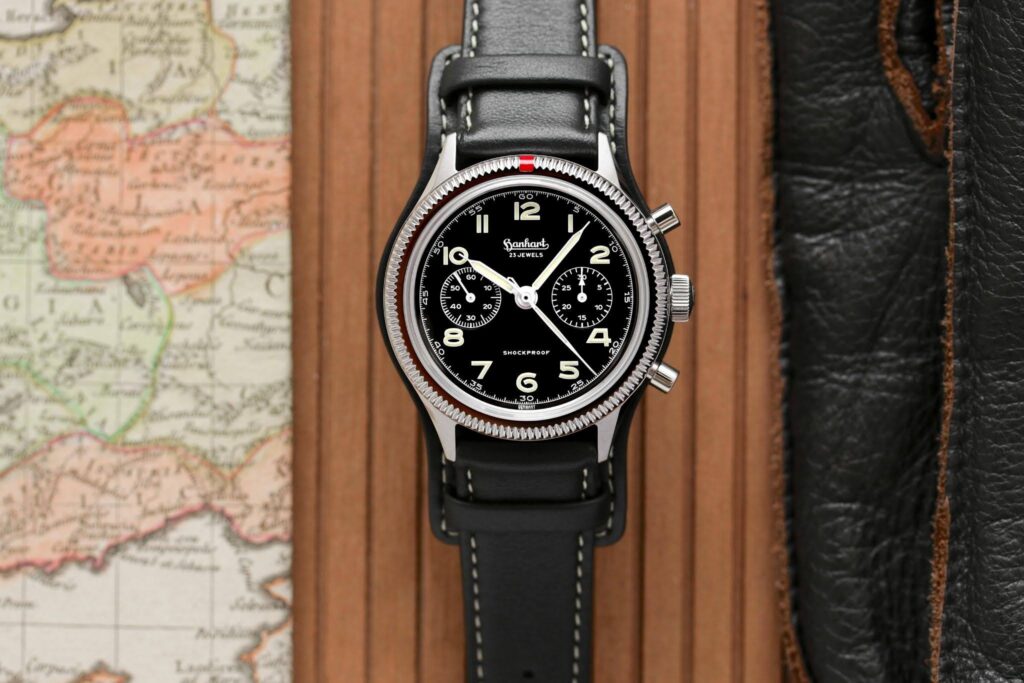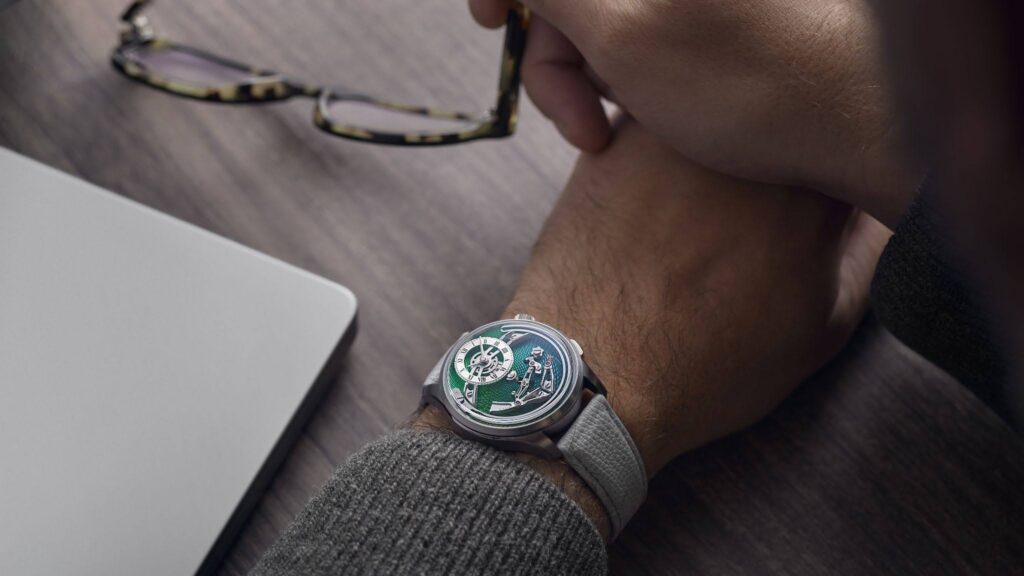
The last high-grade American mechanical movement made in series was the Hamilton 992B, which stopped being produced in 1969. The next one came in 2007, from a workshop in Lancaster County, Pennsylvania. It was called the Caliber 801, signed Roland G. Murphy, and it was the first time in nearly four decades that anyone had tried, at scale, to make a serious mechanical movement on American soil.
Nineteen years later, Murphy has done it three times: the Caliber 801, the Caliber 20, and the Pennsylvania Tourbillon, the only tourbillon ever produced in series in the United States. A new in-house movement is now on his bench, and like the others, it will arrive without a press tour.
This is what RGM Watch Co. is actually for.

The RGM workshop in Lancaster County, Pennsylvania, where every in-house caliber is designed, built, and finished by hand.
The Technique Problem
Most modern watchmaking, even at the upper end, quietly depends on things Murphy will not use: modified ETA bases sold as in-house, applied coatings marketed as finishes, printed dials described in language borrowed from enamel, and silicon parts dropped into movements that advertise themselves as traditional. The vocabulary of craftsmanship has outpaced the craft, and Murphy picked a different lane thirty-four years ago and has not left it since.
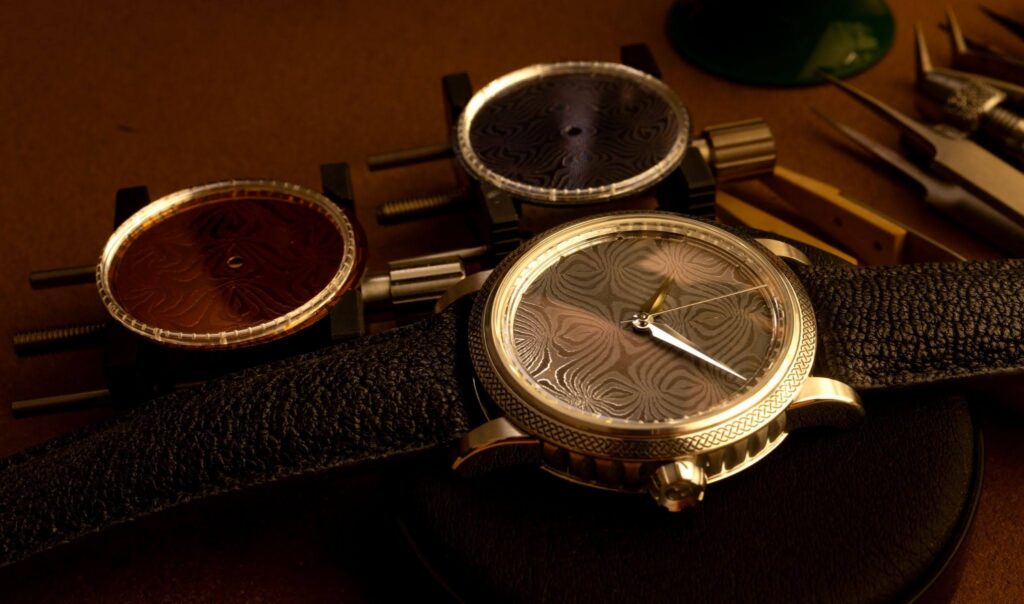
Engine-turning worked by hand in the RGM workshop. All of the brand’s guilloché is executed in-house.
“Everything we create, and everything we ask others to create for us, is done using true, traditional techniques. Our guilloché is crafted entirely by hand in-house. Our enamel dials are genuine fired dials. We use only solid case materials that can be refinished over time, never relying on platings or coatings. Our movements are designed and built using time-tested methods and traditional materials, without the use of modern high-tech processes.”
Roland G. Murphy, Founder, RGM Watch Co.
Each of those sentences has an industry shortcut attached to it, and Murphy is refusing all of them. The guilloché on an RGM dial is engine-turned by hand, in-house, on rose and straight-line engines. The Grand Feu enamel dials are real fired glass, made by a specialist he has worked with for years. The cases are solid 316L stainless steel, finished by hand, and made to be refinishable twenty years from now because twenty years from now they will need it. Each movement is finished by hand.
Ninety percent of the components in an RGM in-house caliber are made domestically. That number is unusual even among brands that advertise themselves as domestic.
Why the 801 Looks the Way It Looks
The Caliber 801 is not a tribute to early American watchmaking, because tributes are decorative. It is a continuation, and Murphy is one of the few living watchmakers with the research to continue the lineage honestly.
The bridge shapes were inspired by the E. Howard “Edward Howard,” one of the highest-grade American pocket watch movements of the early twentieth century. The winding click adapts a mechanism patented in 1918 by Charles E. DeLong of the Illinois Watch Company, U.S. Patent No. 1,283,476, originally used in the “Illini.” The winding wheels borrow their deep-polished finish from the Illinois “Bunn Special,” the railroad-grade standard of its era.
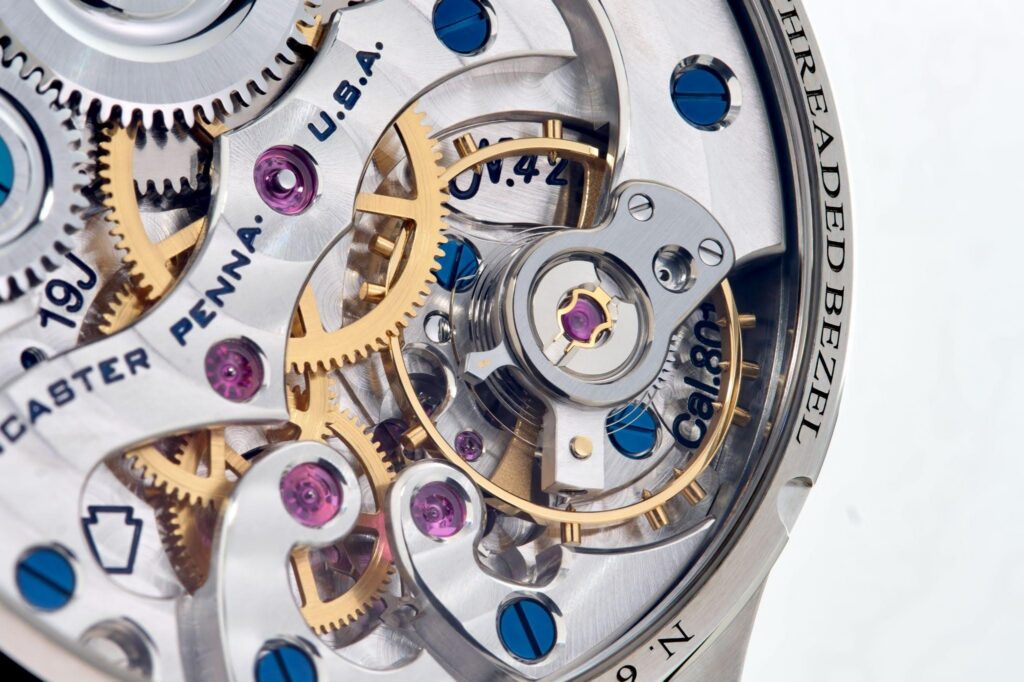
The Caliber 801, RGM’s in-house movement. The bridge shapes reference the Keystone Howard “Edward Howard,” the winding click derives from an Illinois Watch Company patent of 1918, and the winding wheels are finished in the manner of the Illinois “Bunn Special.”
Murphy didn’t source those references from catalogs; he owns the watches. His personal collection includes early American pieces from Waltham, Elgin, Hamilton, E.F. Bowman, and others, alongside vintage Swiss work from Patek Philippe, Vacheron Constantin, and more. He draws no line between Swiss and American watchmaking, only between what is done well and what isn’t, and the American pieces are in his collection because, as he puts it, “you can learn a lot from how things were designed in the past.”
The 801 is what that study looks like when it comes back out as a working movement: 18,000 vph, 19 jewels, hand-finished with Côte de Genève striping and perlage, and a set of design decisions each traceable to a specific American pocket watch that outlasted its generation.
The Discipline Behind the Refusal
Murphy’s rule about solid materials is not aesthetic; it comes from the beginning of his career.
“I started in repair and restoration, so I understand what works and what could fail,” he says. “Many watches are designed today without that insight, even from some big brands.”
That is a carefully worded sentence. What it is saying, underneath, is that you cannot design a watch to last if you have not spent years taking apart watches that didn’t. Murphy trained at Bowman Technical School in Lancaster, completed the WOSTEP program in Neuchâtel, and rose to Technical Director of product development at Hamilton Watch Company before founding RGM in 1992. By the time he started building his own movements, he had already seen, firsthand, how every shortcut ages.

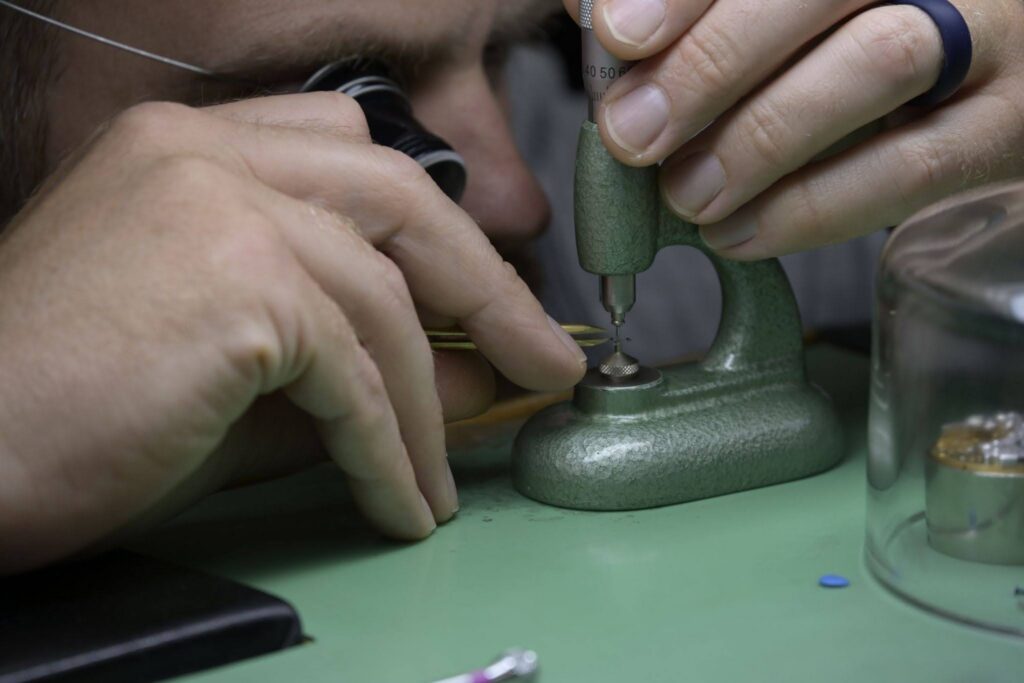
Hand-finishing at the bench. RGM’s refusal to use platings, coatings, or modern shortcuts is rooted in Murphy’s early career in repair and restoration.
Which is why RGM does not take them. There are no platings, no coatings, and no modern high-tech processes slipped into a movement sold as traditional. The cases are built to be refinished across decades, not replaced, and that is also why Murphy’s line about his own philosophy is so short.
“I only make watches I like. We stick to classic styles and watchmaking, classic mechanical movements, and functions. We don’t follow trends.”
Thirty-four years in, that stops reading like a philosophy statement and starts reading like an operational fact.
The Range, and What It Tells You
RGM produces about 400 watches a year, sold direct. The catalog is displayed on rgmwatches.com, but there is no cart and no checkout; a buyer who wants a specific model contacts the workshop, and the conversation proceeds from there. The lineup runs from pieces built around the in-house calibers, at the top of the line, to watches designed around Swiss and vintage movements further down, and Murphy is unusually clear about which is which. That kind of clarity is a quiet act of defiance in an industry where “assembled in Switzerland” and “manufactured in Switzerland” are routinely treated as interchangeable.

The Model 801/40-CE, built around RGM’s in-house Caliber 801. The enamel dial is real fired glass, the hands are heat-blued by hand, and the 316L stainless steel case is finished and refinishable across decades.
Inside the lineup there is also a steady stream of custom work for private clients, alongside a new in-house caliber in development to join the existing family of Murphy-designed movements. Murphy tends not to announce any of this until it exists; the pieces simply appear on the site one day.
The Model 501, the Swiss-movement piece that recently turned up on Ben Affleck’s wrist, sits in the middle of the catalog and is a useful illustration of the range, nothing more. The center of gravity at RGM is, and has always been, the in-house work.
What He Wants You to Know
At the end of a long technical interview, asked what serious buyers understand about his work that other people miss, Murphy answered in two sentences.
“Our watches are built to last. I started in repair and restoration, so I understand what works and what could fail.”
And then, a line later:
“My entire watchmaking career has been driven by a passion for watches and the art of watchmaking.”
That is the whole brand, stated plainly. Everything else, from the Pennsylvania Tourbillon to the Illinois patent, the Howard bridges, the hand guilloché, the fired enamel, the refinishable cases, and the ninety percent domestic components, is the working out of those two sentences.
A final look at the Caliber 801 — the movement that, in 2007, brought high-grade American mechanical watchmaking back from a thirty-eight-year silence.
RGM Watch Co. is based in Lancaster County, Pennsylvania. The collection is shown at rgmwatches.com, and sales are arranged directly through the workshop.