And why the person you bring along — even if they couldn’t care less about complications — will thank you for it
There are museums dedicated to art, history, and science — and then there is the Patek Philippe Museum in Geneva, a place that manages to be all three at once. For watch collectors and enthusiasts, it is not merely a destination. It is a pilgrimage. But even for a spouse, partner, or friend who considers a watch nothing more than a device for telling time, the museum delivers something genuinely rare: a four-floor journey through five centuries of human ingenuity, artistry, and obsession.
I visited in March 2026, and the experience has stayed with me.
Where to find it
Patek Philippe Museum
Rue des Vieux-Grenadiers 7, 1205 Geneva, Switzerland
The museum sits in Geneva’s Plainpalais neighborhood, a short tram or taxi ride from the city center — and a different location entirely from Patek Philippe’s manufacture in Plan-les-Ouates. Tickets can be reserved online, and slots fill quickly on Saturdays.
Planning your visit
Opening hours
Tuesday to Friday: 2:00 pm – 6:00 pm
Saturday: 10:00 am – 6:00 pm
Closed Sunday, Monday, and public holidays.
Admission
CHF 10 — adults
CHF 7 — seniors (65+), students, and visitors with disabilities
Free — children under 18 accompanied by an adult
Guided tours
Public guided tours are offered on Saturdays in English, French, German, and Italian, and must be reserved in advance. Private group tours can be arranged outside public hours by contacting the museum directly.
Library access
The museum’s library, which holds more than 8,000 works on horology, is open to researchers Tuesday through Friday by appointment.
Good to know
Photography is permitted inside the museum, but video recording is not. Allow at least two to three hours for a full visit. Verify current hours, fees, and tour availability at patek.com/en/museum/plan-your-visit before traveling, as schedules can shift around Swiss public holidays.
The museum occupies a beautifully restored early 20th-century building in Geneva’s old watchmaking quarter. It was assembled over decades by Philippe Stern, honorary president of the manufacturer, who turned a personal passion into one of the world’s most significant horological collections. Today it houses approximately 2,500 watches, automatons, precious objects, and miniature enamel portraits, along with a library of more than 8,000 works dedicated to the art of timekeeping.
What you’ll see — floor by floor
| Floor | Collection |
|---|---|
| Ground Floor | The Artisan’s Atelier — workbenches & restoration |
| First Floor | Patek Philippe Collection — 1839 to present |
| Second Floor | Antique Collection — 16th to 19th century |
| Third Floor | Library, archives & enamel portraits |
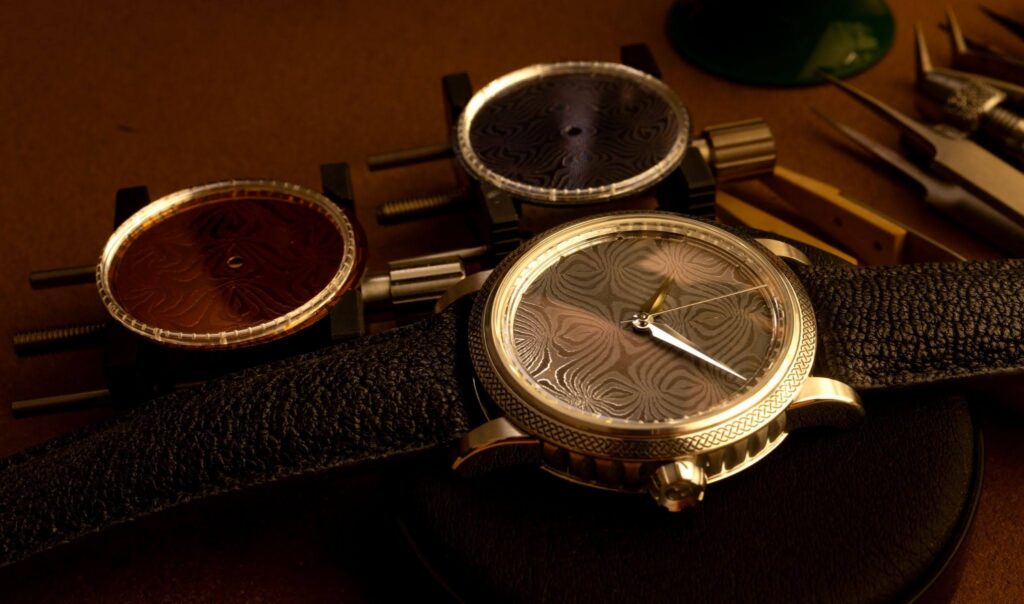
The ground floor sets the tone immediately. Here you find a collection of 19th-century watchmaking workbenches, complete with hand-forged tools for shaping gears, engraving dials, and assembling movements. The restoration atelier — where watchmakers revive historical timepieces using methods largely unchanged for centuries — operates in plain view of visitors. It is one of the most quietly dramatic rooms in any museum anywhere: the past being physically brought back to life, in real time, under a loupe.
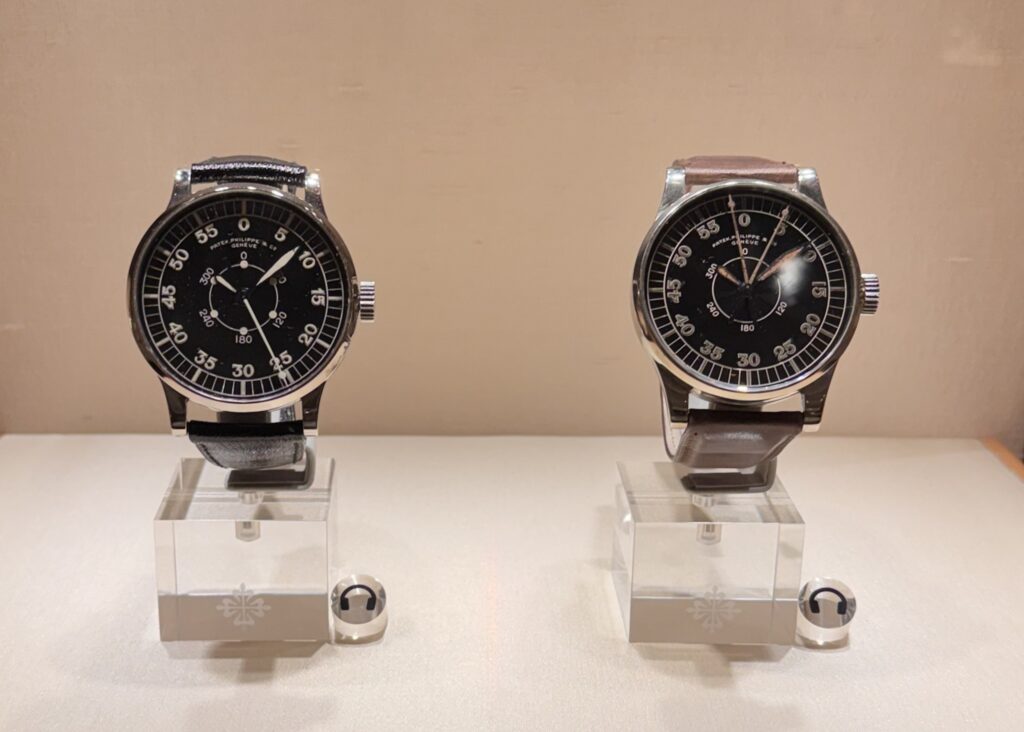
Two Patek Philippe aviator’s wristwatches from 1936, built around the Calibre 19”’ movement. The high-contrast dials and oversized Arabic numerals reflect the cockpit-driven design priorities of pre-war pilot watches. Photo by Adam Levy.
The first floor is the emotional heart of the visit for any collector. The Patek Philippe Collection traces the manufacturer’s history from its founding in 1839 to the present day. Here you’ll find the first Patek Philippe wristwatch, made in 1868 for Countess Koscowicz of Hungary. Nearby sits a pendant watch acquired by Queen Victoria at London’s Great Exhibition in 1851, equipped with Jean Adrien Philippe’s then-revolutionary keyless winding system. The first known perpetual calendar wristwatch, from 1925, sits under glass — a milestone that redefined what a wristwatch could do. And Caliber 89, unveiled in 1989 for the manufacturer’s 150th anniversary with 33 complications, remains one of the most complicated portable timepieces ever built.
“A pendant watch acquired by Queen Victoria in 1851. The first perpetual calendar wristwatch. Caliber 89 with 33 complications. These are not just horological milestones — they are moments where craft became history.”
The second floor houses the Antique Collection, which traces the origins of the portable timekeeper back to around 1500. This is where even non-enthusiasts tend to fall silent. The earliest watches are not sleek instruments — they are jeweled, enameled, sculptural objects worn as much for their beauty as for their function, signed by the greatest European watchmakers of their age. Musical automata add a theatrical dimension. It is part history museum, part jewelry exhibition, and deeply absorbing.
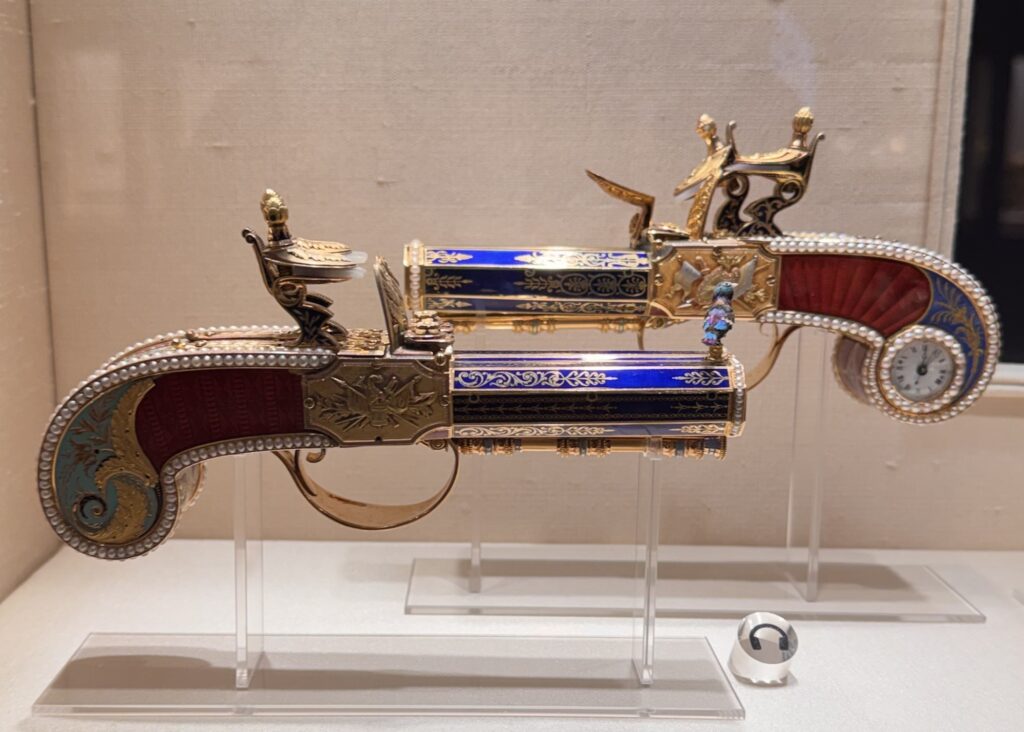
A pair of early 19th-century Geneva-made pieces in the Antique Collection: a singing-bird pistol by Rochat Frères (c. 1815) and a musical pistol-watch by Rochat Frères and Piguet & Meylan (c. 1810). Enamel, pearls, gold, and concealed mechanisms — the case for watchmaking as objet d’art. Photo by Adam Levy.
Why your non-watch-loving companion will love it
The secret of the Patek Philippe Museum is that it never asks you to love watches in order to love what you see. The enamel miniatures are exquisite paintings in their own right — impossibly detailed portraits that rival anything hanging in a fine art gallery. The mechanical automata would delight anyone with an imagination. The story of the manufacture itself — an independent family business spanning nearly two centuries, still privately held by the Stern family — is a compelling narrative about values, craft, and legacy that transcends the watch industry entirely. For a visitor with no prior interest in horology, the museum reads as a study in what human beings are capable of when they commit to doing one thing extraordinarily well.
What you’ll learn about watchmaking and Patek Philippe
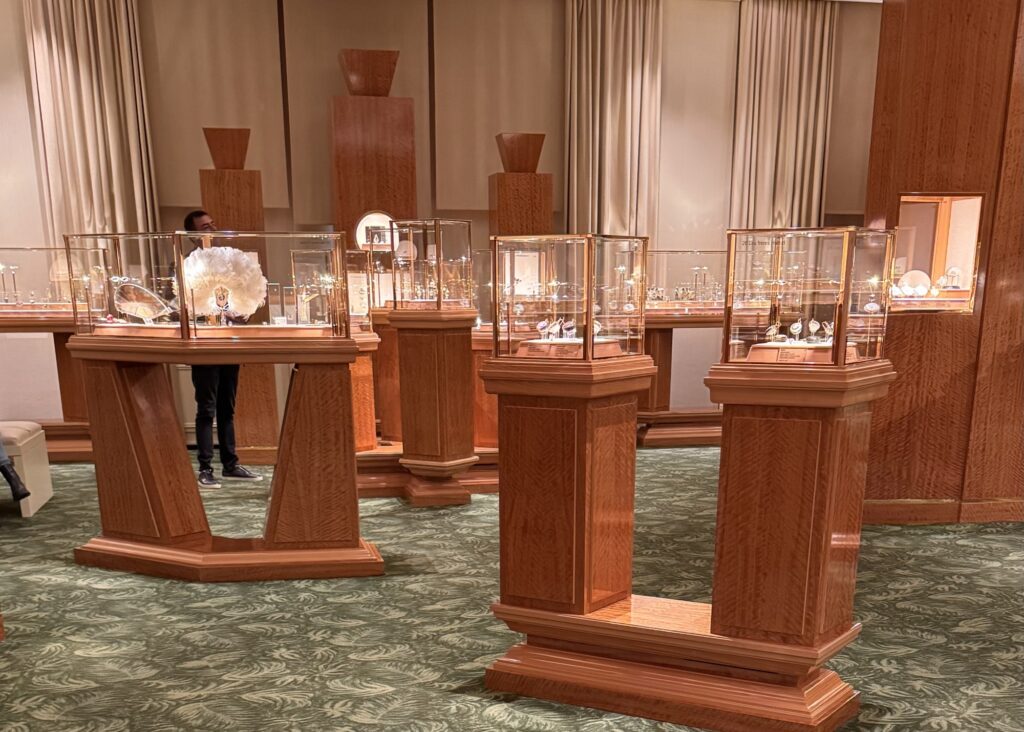
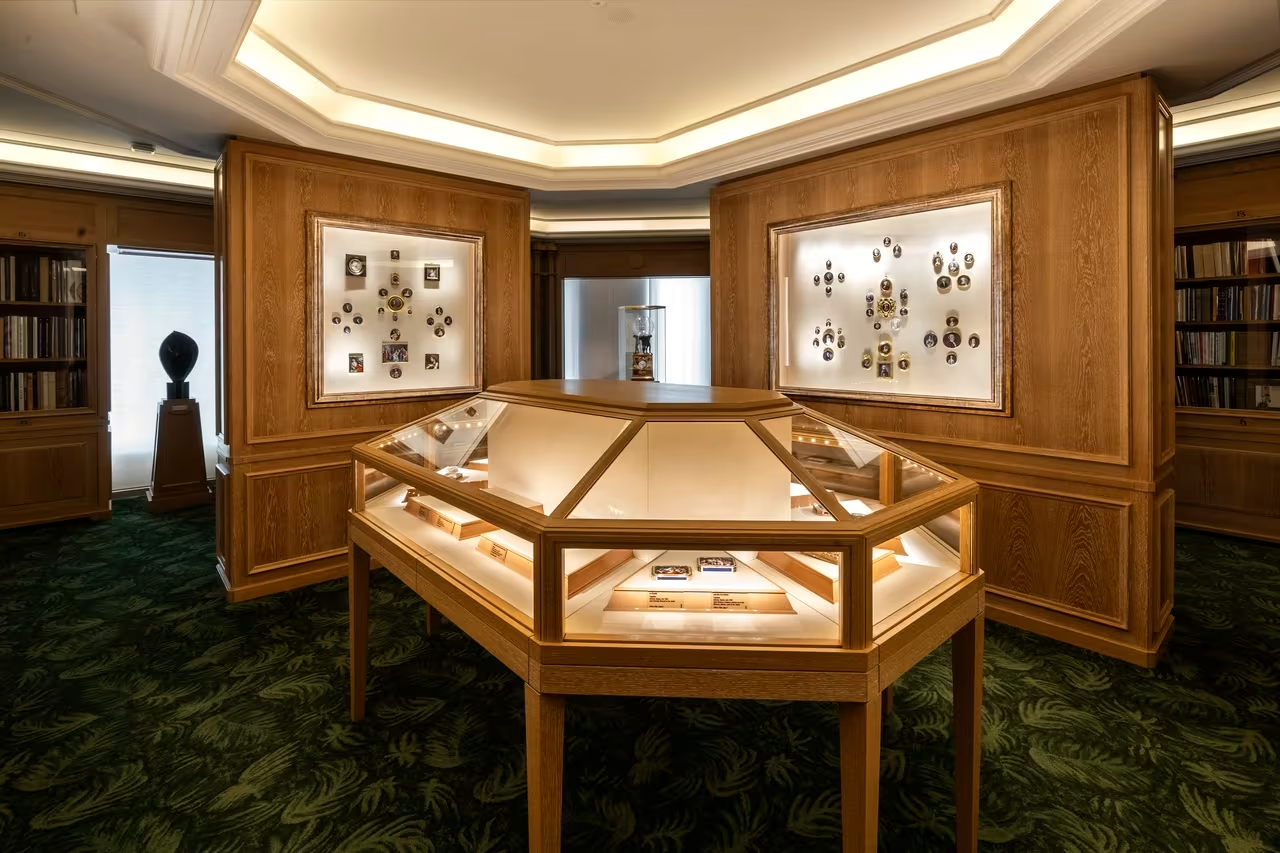
A gallery view of the Patek Philippe Collection, where freestanding vitrines let visitors circle individual pieces. Photo by Adam Levy.
A visit here will give any collector a new frame of reference. You leave understanding not just what Patek Philippe makes, but why the manufacturer occupies the position it does. You see the depth of the antique tradition they descend from — the centuries of Genevan and broader Swiss craft that preceded them. You understand complications not as marketing language but as genuine technical achievements, each representing years of unsolved problems before becoming possible. And you absorb the specific Patek Philippe philosophy: that a watch is not owned but held in trust for the next generation. Walk through these four floors and that famous line from their advertising becomes something you have seen with your own eyes.
If you are visiting Geneva — whether for business, travel, or a dedicated watch trip to the Vallée de Joux — the Patek Philippe Museum is not optional. It is the context that makes everything else make sense. Reserve your ticket in advance, set aside at least two to three hours, and go.