Why the Black Forest workshop behind the Calibre 40 still builds every chronograph and stopwatch as a precision instrument first
Hanhart‘s house line fits on a watch dial: “Others show the time, Hanhart measures it.”
The distinction is real. CEO Simon Hall returns to the same vocabulary every time he describes the brand: functionality, reliability, precision, robustness, serviceability, and technical integrity. The framing isn’t about how a watch looks at dinner. It’s about how it performs when it has to.
That language tracks with what the workshop actually produces. For more than 140 years, the Hanhart manufactory — currently based in Gütenbach in Germany’s Black Forest — has built mechanical chronographs and stopwatches for people who needed to measure elapsed time accurately: scientists, sports officials, rally drivers, pilots, and doctors.
The watches available today are the direct descendants of timing tools the company has produced, without interruption apart from a postwar pause, since the 1920s.
A Stopwatch, an Annoyed Athlete, and the Workshop That Followed
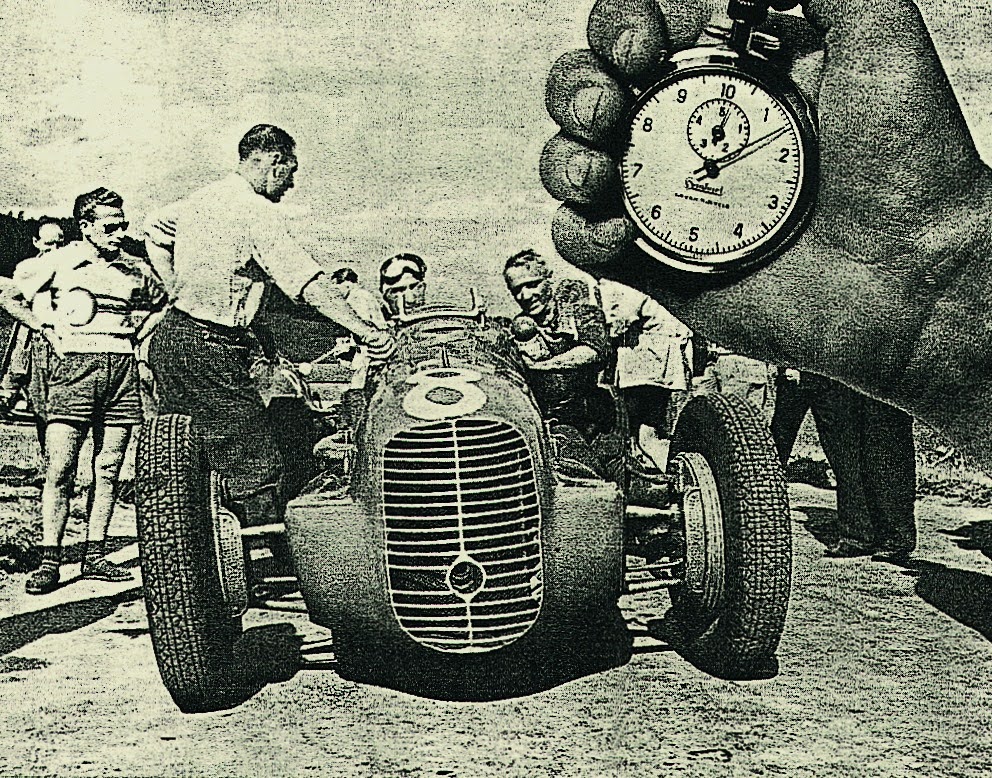
A Hanhart stopwatch photographed at a motor racing event in the late 1930s. Within a decade of Willy Hanhart’s 1924 model, the company’s stopwatches were timing competitions across Europe.
Most heritage watch brands trace their origin to a watchmaker’s bench. Hanhart traces its to a track and field meet.
The company itself goes back further. It was founded on July 1, 1882, in Diessenhofen — a small Swiss town on the Rhine — by a 26-year-old watchmaker named Johann A. Hanhart, who would later serve as the town’s mayor. In 1902, the operation relocated across the border to Schwenningen in southern Germany, then the largest watchmaking town in Europe. For its first four decades, the business was primarily retail and reassembly work.
The break came in 1923. Johann’s youngest son Wilhelm Julius Hanhart — Willy — was 21, sports-mad, and increasingly involved in the family business. He attended an athletics meet where the organisers struggled to find four working stopwatches of consistent quality. The only mechanical stopwatches available at the time were Swiss, essentially handmade, and priced beyond what most sporting clubs could justify.
Willy went home irritated. He partnered with a watchmaker, and the following year the first affordable mechanical stopwatch on the market entered production.
That single product transformed the company. Within a few years, Hanhart had expanded from retail and reassembly into full-scale manufacturing of timekeeping instruments. In 1934, a second factory was built in Gütenbach, deeper in the Black Forest. That building still operates as the manufactory today — workshop, museum, and headquarters all in the same place.
When Hall says Hanhart’s most-prized expertise is “the development of mechanical chronographs, dating back to the 1920s,” this is what he’s pointing to. The wristwatch chronographs the brand is now best known for grew out of a stopwatch operation that had already been producing precision timing instruments at scale for over a decade before the first Hanhart chronograph reached anyone’s wrist.
The Calibre 40, and the Watch That Defined the Catalogue
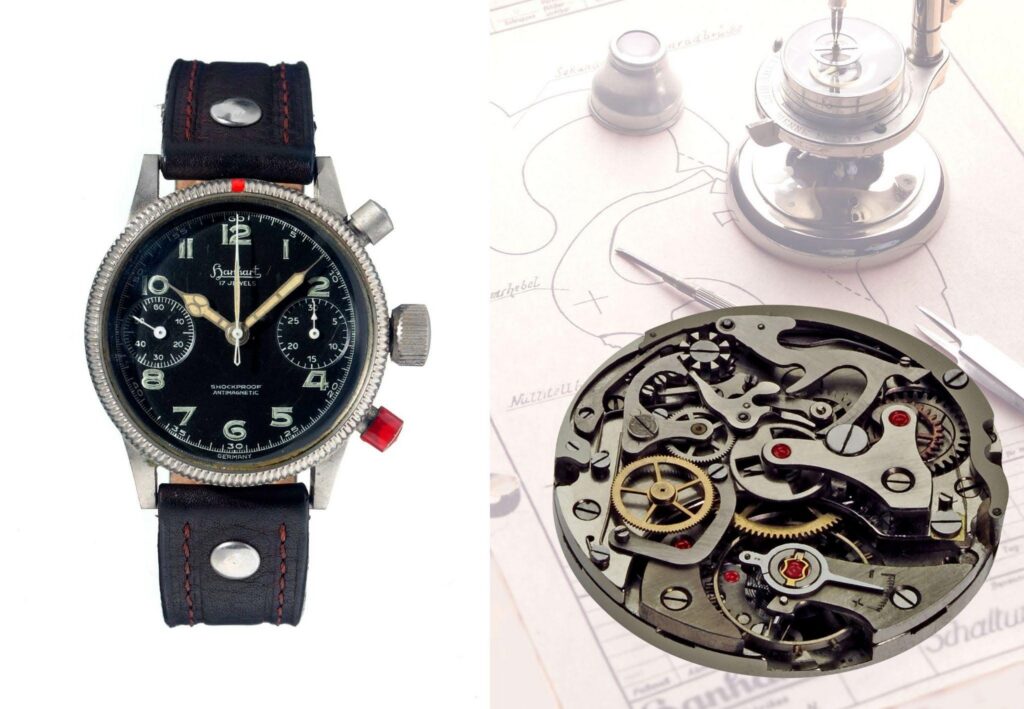
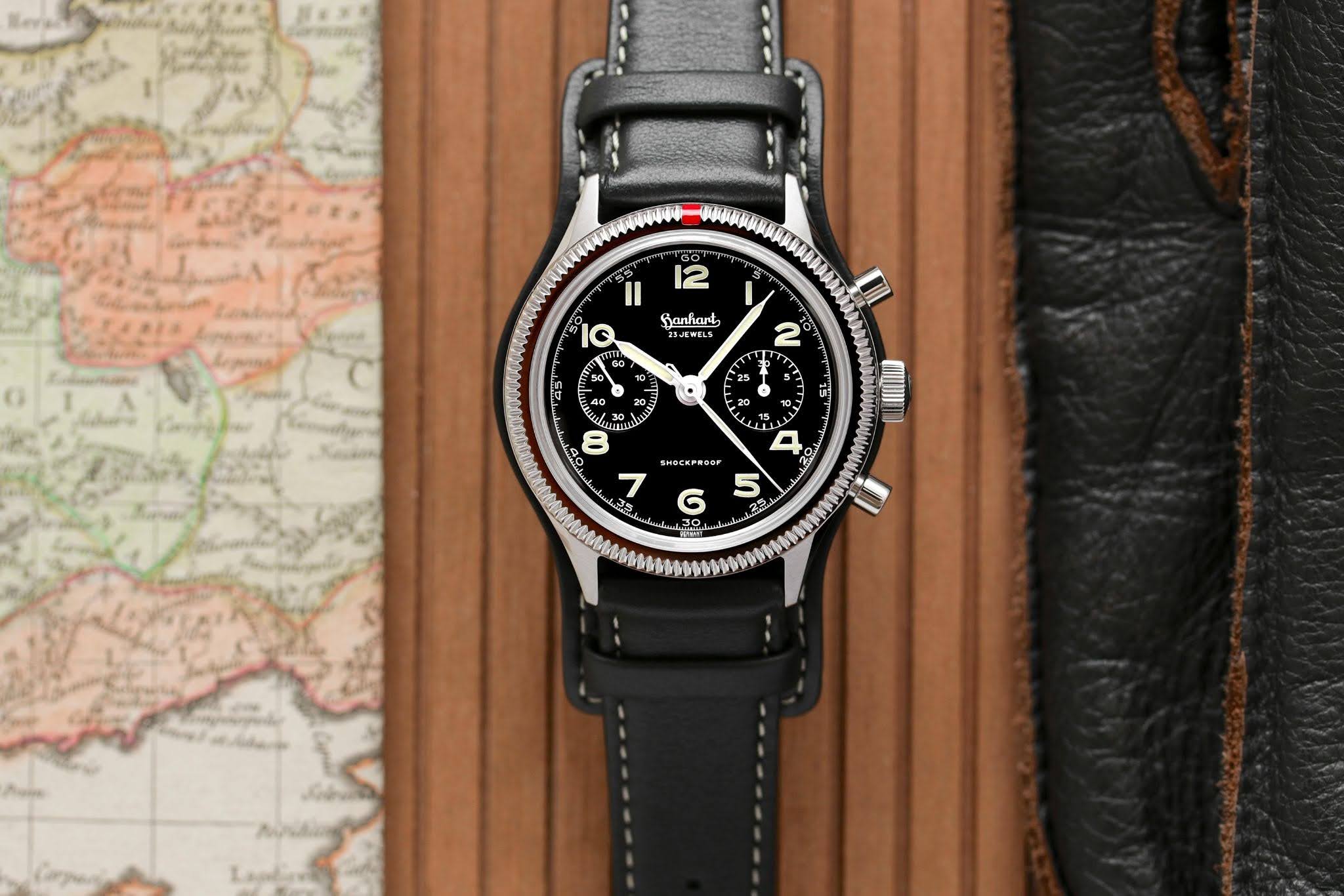
A vintage Hanhart pilot’s chronograph alongside the historic Calibre 41 movement on its original technical drawings. The red reset pusher, fluted bezel, and asymmetric crown position introduced in 1938 still define every heritage-line Hanhart in the current catalogue.
By 1938, Hanhart was ready to put a chronograph on the wrist. The first was the single-pusher Calibre 40; the two-pusher Calibre 41 followed in 1939.
Both were designed for professional use, with engineering signatures that set them apart from the Swiss chronographs of the same period:
- Asymmetric pusher placement — set off-axis from the crown so start/stop and reset could be located by feel, without looking down
- A fluted rotating bezel with a red reference marker for elapsed-time tracking
- Oversized crowns for gloved-hand operation
- A red lacquered reset pusher to visually distinguish reset from start/stop — so the operator wouldn’t erase elapsed-time data by reaching for the wrong button
The Calibres entered service with both military and civilian users through the 1930s and into the war years, including with the German Luftwaffe. After the war, with Hanhart’s factories in the French occupation zone dismantled, the company paused chronograph production from 1945 until 1948.
A second pilot’s chronograph followed in 1954: the reference 417, powered by Hanhart’s in-house Calibre 42 — this time with a flyback function added. The stainless steel version was designated the 417 ES (Edelstahl, German for stainless steel) and was issued to the newly reformed German Air Force from 1954 to 1958, in a production run of approximately 500 pieces.
The 417 ES became the most recognisable watch in Hanhart’s history. The 1939 design signatures all carried into it: asymmetric pushers, fluted bezel, red marker, red reset pusher. The watch later found its most famous wearer outside the cockpit when Steve McQueen acquired one and wore it in his personal life through the 1960s, including at the 1964 International Six Days Trial motorcycle event.
The 417 ES is the watch every reissue in Hanhart’s current heritage line traces back to.
What “Honest Watchmaking” Means in the Workshop
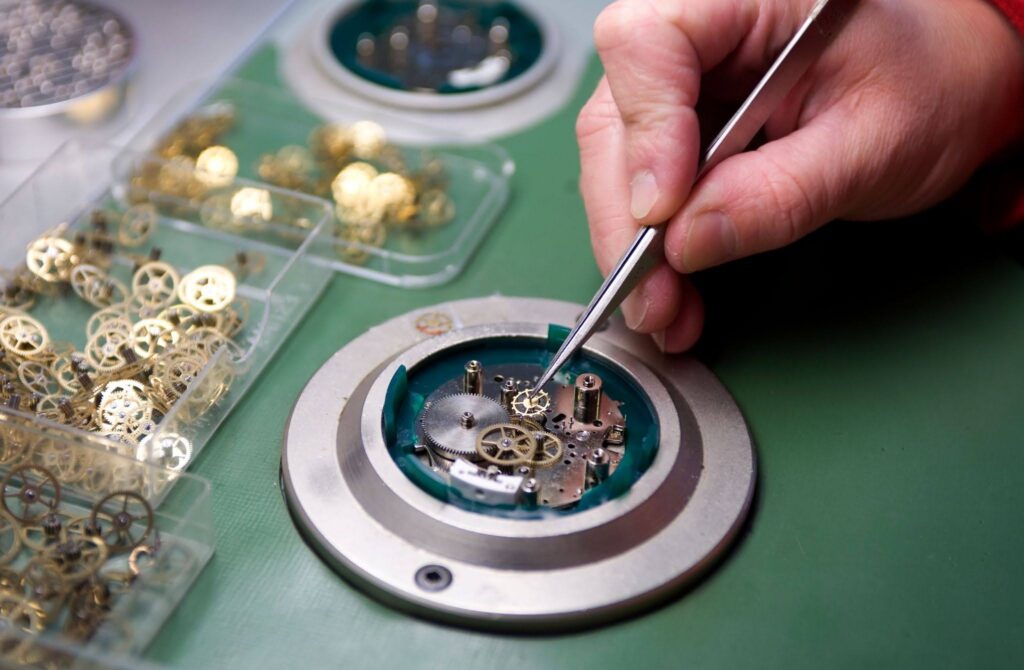
Movement assembly at the Hanhart manufactory in Gütenbach. The workshop produces its own gears, plates, and components onsite before final assembly happens in the same building.
Hall describes Hanhart’s operating philosophy with a phrase that sounds simple until you ask what it requires. He calls it “honest watchmaking” — and defines it through three properties every watch must meet before it leaves the manufactory.
“Hanhart stands for honest watchmaking. For us, that means clear readability, technical refinement, and true robustness. Only when a watch meets all of these requirements do we present it to the public.”
— Simon Hall, CEO, Hanhart
Clear readability is a measurable property. Every Hanhart chronograph dial is built on the same logic that governed the 1939 originals: large, high-contrast Arabic numerals; clearly defined subdials; chronograph hands shaped to be located instantly; lume on hands and indices for legibility in low light. Decorative elements are minimised because they compete with the information the watch is meant to display.
Technical refinement, in Hanhart’s vocabulary, refers less to ornamental finishing than to mechanical integrity. The brand has historically used Swiss base movements — the Valjoux 7750 for many automatic references, the manually-wound Sellita AMT5100 M column-wheel flyback chronograph for the heritage flyback model — but the cases and many components around those movements are produced in-house. The Gütenbach manufactory houses a tool fabrication shop and a parts-making operation; the workshop mills, stamps, and erodes components onsite — including, for the stopwatch line, from the smallest gears up to base plates — before final assembly happens in the same building. That vertical integration is part of why a 5,000-piece-a-year manufactory can absorb the cost of holding its heritage design specifications precisely in production.
True robustness is the property Hall emphasises most when he describes what technically serious buyers recognise in the work: “well-considered construction… movement architecture designed for precise operation, robustness, and long-term serviceability — aspects often not visible at first glance.” That philosophy runs through every movement Hanhart touches. For stopwatch calibres built in-house in Gütenbach, it shapes the architecture from the ground up. For the Swiss-sourced movements used in the wristwatch line, it’s the bar a supplier has to clear. Either way, the assumption is the same: the watch will be opened by a watchmaker, eventually, by someone the brand may never meet, and it still needs to make sense to them.
The Stopwatch Line the Brand Never Abandoned
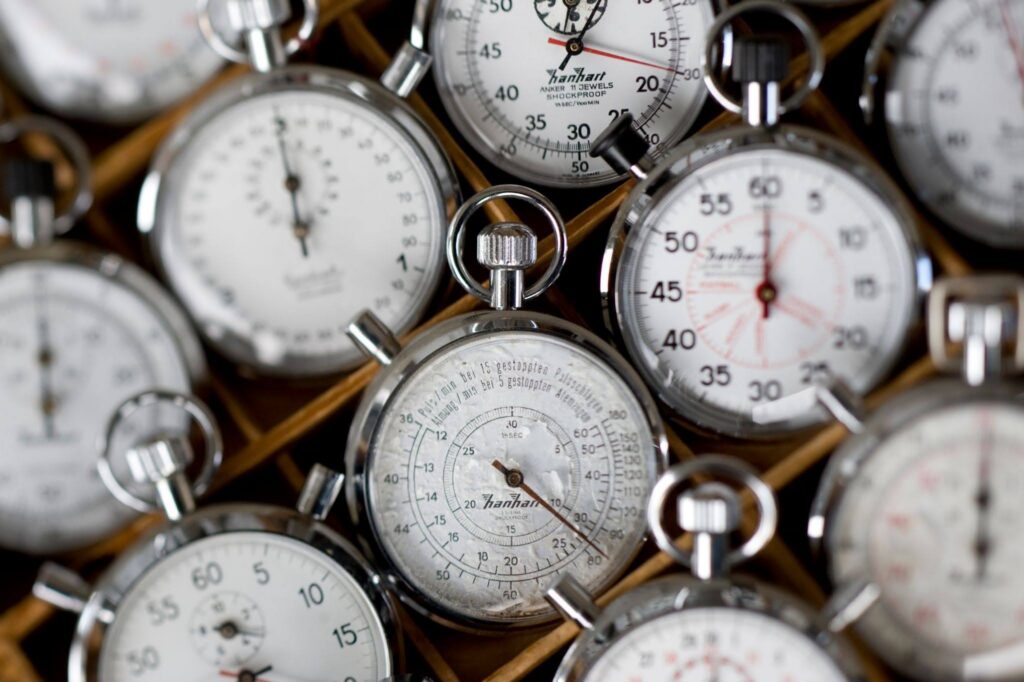
Mechanical stopwatches from across Hanhart’s production history, displayed at the manufactory in Gütenbach. Visible designs include pulse timers for medical use, sport timers, and rally chronometers — applications the brand has supplied for nearly a century .
If chronograph collectors recognise Hanhart for the 417, the broader timing-instrument world knows the brand for something else entirely.
Hanhart is Europe’s largest manufacturer of mechanical stopwatches — a position the company has held since the 1950s and continues to hold today, alongside the wristwatch business.
The current ClassicTimer collection, produced in the same Gütenbach workshop on Hanhart’s own movements with Swiss lever escapements, covers everything from basic addition timers to split-seconds chronographs and long-distance hour counters. They are the working tools of vintage rally drivers, sports officials, and laboratories that need timing instruments not dependent on a battery or a wireless signal.
The line descends directly from Willy Hanhart’s 1924 stopwatch, and the brand has continued making mechanical timers through every decade when the rest of the industry pivoted to quartz.
This is what continuity actually looks like in this category. A company that built its identity by making the stopwatch affordable in 1924 has spent a century not abandoning the product, through every commercial pressure that would have justified moving on. The wristwatch is the visible half of the brand. The stopwatch is the foundation on which it rests.
What’s on the Drawing Board
The conversation about Hanhart usually centres on heritage. But Hall is clear that the workshop is also actively developing new technical features. Current projects include:
- A new bracelet clasp with integrated micro-adjustment
- Work on new case materials
- Development of new movement features
Each fits the brand’s instrument-watch philosophy — clasps and micro-adjustment matter for daily wearability, case materials matter for durability and weight, and movement architecture matters for precision and long-term serviceability.
The recently released 417 TI Desert Pilot, in Grade 5 titanium with a sandblasted matte finish, is one expression of that direction. The 417 case in a modern material chosen for scratch resistance and lighter weight on the wrist isn’t a redesign so much as the same watch reconsidered for a buyer who actually wants to wear it through a desert rally rather than reserve it for a display case.
That position recurs through everything Hall says about how Hanhart thinks about its customers. The watches “are made not only to be appreciated, but to be actively worn in everyday life — true to their original purpose.”
The Catalogue, Today
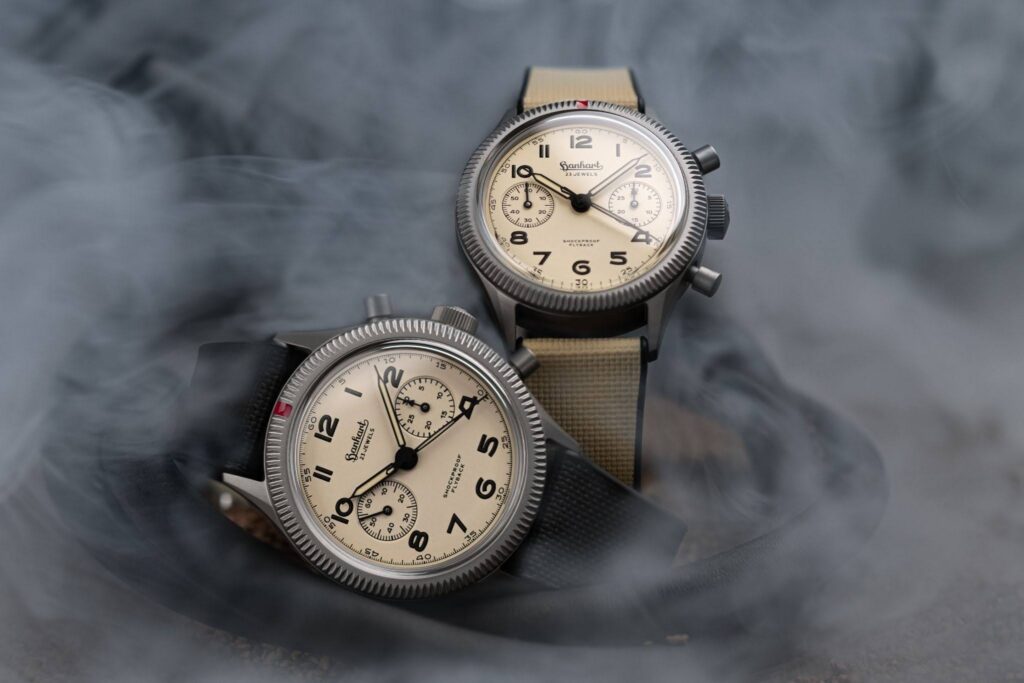
The 417 TI Desert Pilot in 39 mm and 42 mm — the most recent release in the catalogue, with both sizes drawing on the 1954 reference 417 housed in modern titanium.
The current Hanhart lineup is built around four wristwatch families:
- 417 ES and 415 ES — the heritage chronograph references, including the 417 TI Desert Pilot and the 417 ES Moby Dick, the modern reissue of the rare white-dial civilian variant from the 1950s
- Pioneer — a slightly more contemporary design vocabulary, including the Preventor HD12 with its dual-time bezel
- Primus — named in homage to the 1938 Calibre 40, occupies the upper-segment sport-chronograph category.
- Aquasphere covers the dive watch segment — the only family in the catalogue that isn’t a chronograph by primary function.
Annual production runs around 5,000 watches. The company distributes through authorised retailers and direct via its own online shop, with primary markets in Germany, the rest of the EU, and North America, where Hanhart works with the Watchbuys distributor network.
Why the Line Matters
Almost 90 years after the Calibre 40, the operating principle behind Hanhart’s catalogue hasn’t moved: build timekeeping instruments that solve real problems for the people using them.
Every signature design element on a current Hanhart wristwatch — the asymmetric pushers, the fluted bezel, the high-contrast dial, the red reset pusher, the flyback function — descends from a specific use case and a specific original watch in the brand’s archive. They are not stylistic references to a heritage the company has lost. They are continuations of one who never stopped practising.
The watches are made to be worn. Hall returns to this point directly: every Hanhart timepiece is built for daily life rather than preservation as a collectible. That position has been consistent across more than a century of production. It is, in essence, what honest watchmaking has meant in Gütenbach since the 1920s.
Hanhart is headquartered in Gütenbach, in Germany’s Black Forest. The collection is shown at hanhart.com and sold direct through the brand’s online shop or via authorised retailers.
All images courtesy of Hanhart.