A converted chicken shed, a 3x markup rule, and the only Swiss-made sonnerie under $4,000
Christopher Ward’s pricing rule is one sentence long. Whatever a watch costs them to produce, they sell it for three times that figure. The watch industry’s standard markup runs anywhere from five times cost to ten and well beyond, with the difference covering authorised dealers, boutique rents, and advertising layers that most luxury brands rely on to reach the customer. Christopher Ward sells direct from a website, has done since 2005, and has never raised the multiplier.
The clearest illustration of what that constraint produces is a watch called the C1 Bel Canto. Launched in 2022, it is a Swiss-made chiming watch — the hammer strikes a tuned gong on the hour, every hour — and it sold for under $4,000. Comparable complications from traditional brands cost between thirty and several hundred thousand. The Bel Canto is what happens when a company spends two decades treating a 3x markup as a hard rule and then asks a Swiss watchmaker to design a sonnerie around it.
A Chicken Shed, an ETA Movement, and a Tasmanian
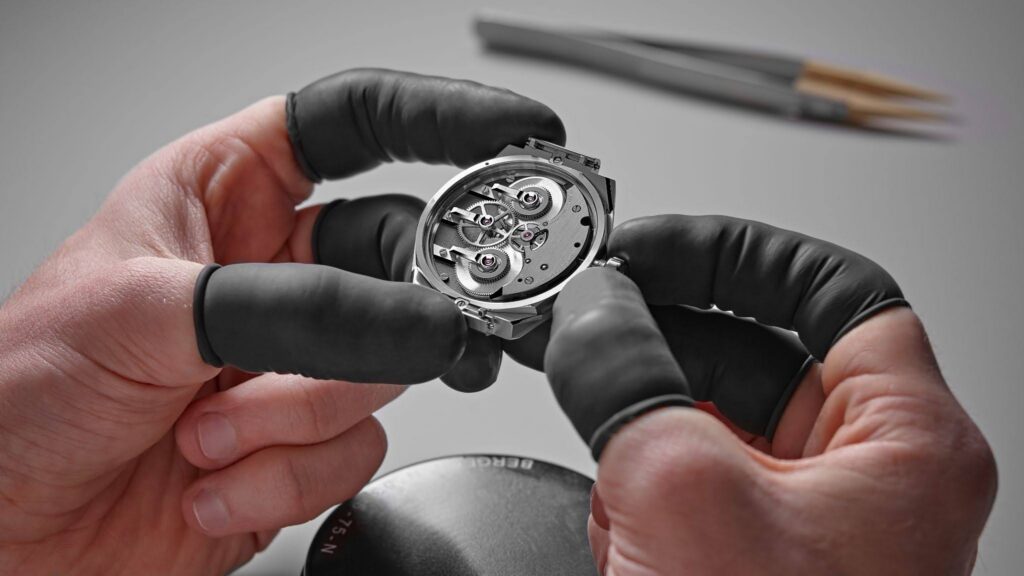
A watchmaker assembling a movement in the Biel atelier. Twenty years on from the Berkshire chicken shed, every Christopher Ward is still built by hand in Switzerland.
Christopher Ward launched on June 2, 2005, from a converted chicken shed on a farm in Berkshire. The three founders — Mike France, Peter Ellis, and the watch enthusiast Chris Ward, whose name was chosen because it sounded the most “quintessentially English” of the three — had backgrounds in retail and the conviction that watches were being sold through a chain of intermediaries no one needed. Their plan was to skip every link of it and sell directly online, which in 2005 was something nobody in Swiss watchmaking was doing.
They placed an ad in The Independent for the C5 Malvern Automatic and waited. Sales were quiet until a Tasmanian lecturer named Dave Malone bought one specifically to expose them. He suspected — reasonably — that no one could sell a Swiss-made watch with a genuine ETA 2824-2 automatic movement for £179 without something being wrong. The watch arrived. He posted his findings on TimeZone, the largest watch forum at the time. By Christmas, Christopher Ward was being discussed there more than Rolex.
The independent Christopher Ward Forum, launched and run for a decade by a Dutch enthusiast named Hans van Hoogstraten, became the brand’s de facto product feedback channel. Twenty years on, the showrooms at the Maidenhead headquarters are named Malone, Hoogstraten, and McEwen — for the customers who decided, before the company really had marketing of its own, that this thing was real.
What the 3x Rule Actually Buys
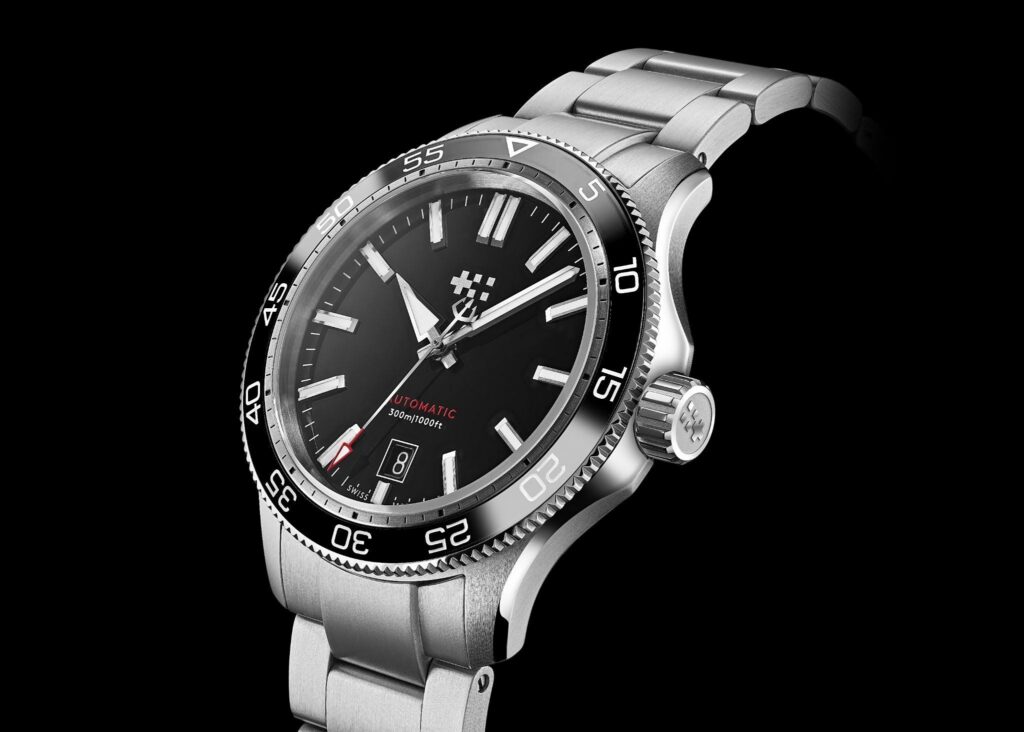
The C60 Trident Pro 300, the brand’s flagship dive watch and one of its most popular references. Swiss-made, 300m water-resistant, on the same Light-catcher case the Bel Canto wears.
The pricing rule sounds like a marketing position. In practice it is a manufacturing decision that runs through every product Christopher Ward releases.
A markup of 3x means production costs translate to retail prices roughly half of what a comparably specced watch from a traditional brand would carry. As Mike France has put it: “We mark up by three times in an industry that marks up anything from six to… lots.” It also means there is no conventional distribution layer to absorb shocks: no authorised dealers taking margins, no boutique rents subsidised by gross profit, no advertising budgets that would normally be funded by inflated MSRPs. Christopher Ward sells direct online, with appointment-only showrooms in Maidenhead and Biel handling customers who want to see the watch in the metal.
The constraint has shaped what gets built. To put a movement, dial, case, finishing, and after-sales coverage into a watch at one-third the typical industry markup, the brand has to be ruthless about where money goes. Most competitors operating at this price point use modified ETA or Sellita base movements without much modification beyond branded rotors. Christopher Ward does this for many references too, but it has also built a parallel track of more ambitious work — JJ-series modules developed in-house, a fully proprietary movement, and the Bel Canto.
Calibre SH21: The First British Movement in Fifty Years
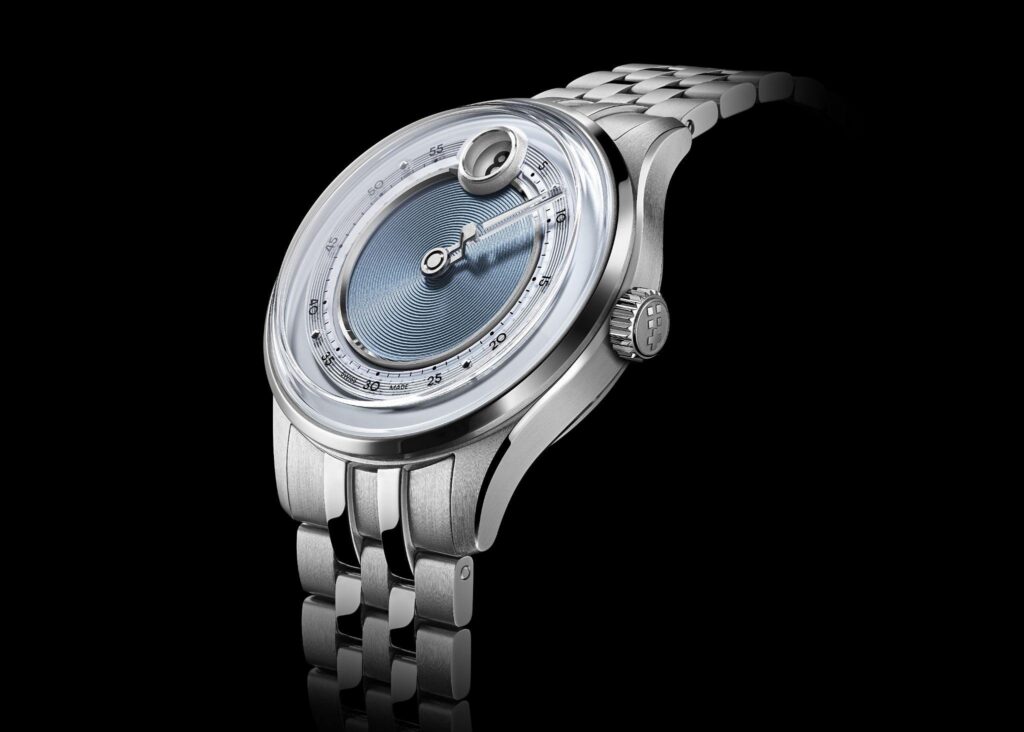
The C1 Jump Hour Mk V, powered by Christopher Ward’s JJ01 module. The same in-house complication that, years later, would supply the energy-management architecture for the Bel Canto’s chime.
In July 2014, on the brand’s tenth anniversary, Christopher Ward announced its first in-house movement: Calibre SH21. It was designed by Johannes Jahnke, the master watchmaker who had been working with the brand through its Swiss partner Synergies Horlogères, with whom Christopher Ward formally merged the same year.
SH21 was the first commercially viable mechanical movement produced by a British watch brand in over fifty years. Twin-barrel architecture gave it a 120-hour power reserve — five days off the wrist — while still meeting COSC chronometer certification, which requires accuracy within -4 to +6 seconds per day across fifteen days of testing in five positions. That performance places it in the top six percent of Swiss-made movements for accuracy, and the twin-barrel construction sidestepped the usual compromise on long power reserves, where extending the reserve by enlarging or weakening the mainspring tends to degrade rate stability.
The SH21 first appeared in the C9 Harrison 5-Day Automatic and has since been used selectively across the catalogue, including in the C63 SH21 Sealander released in 2023 — the first time the movement had been put into a watch under £2,000. That decision matters because it goes against how movements like SH21 are typically deployed. A brand could easily justify reserving an in-house chronometer movement for halo references at £4,000 and up. Putting it in a Sealander is a 3x decision: if the cost of including it brings the retail price to $1,925, that is what it sells for.
The Bel Canto, and What Three Years of Sound Engineering Looks Like
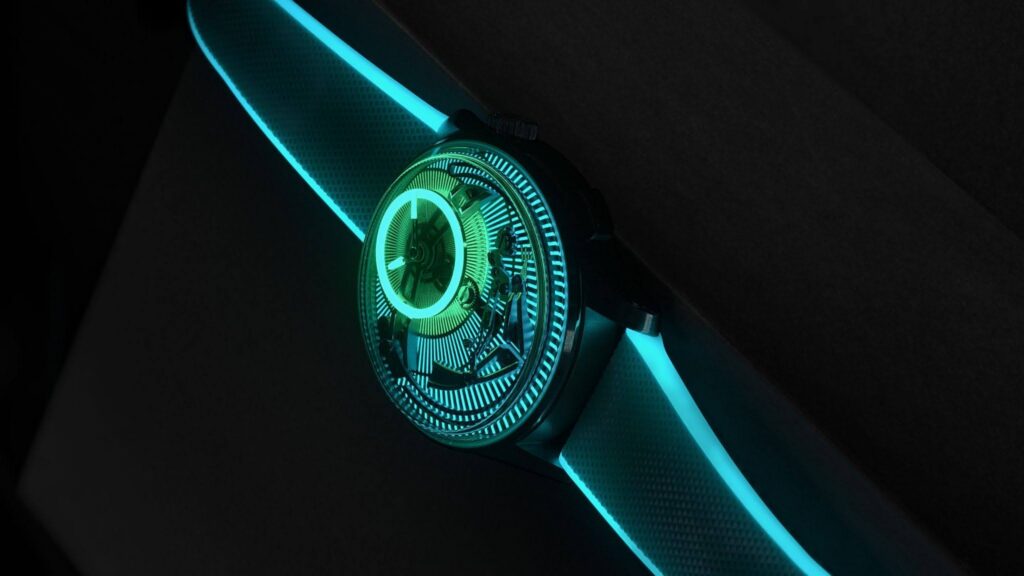
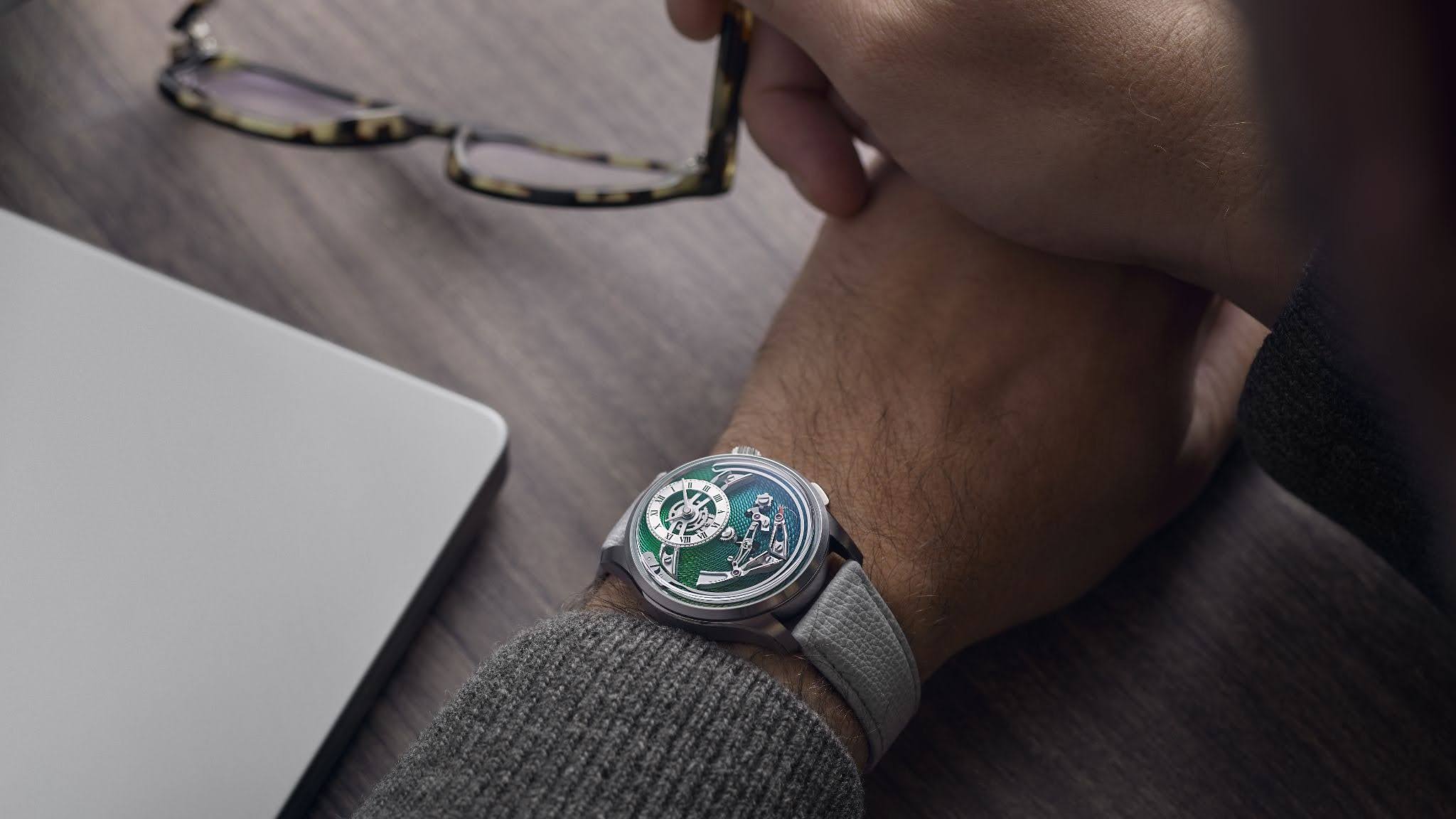
The C1 Bel Canto Lumière in low light. A Globolight ceramic ring above the smoked sapphire dial, two-tone Super-LumiNova on the platine, and a Grade 5 titanium case chosen to amplify the chime.
The C1 Bel Canto, launched in November 2022, is the watch that broke Christopher Ward into a part of the market most accessible-luxury brands never reach. The complication is a sonnerie au passage — French for “in passing” — meaning the watch chimes once on the hour, every hour, through a hammer striking a spring gong tuned to a specific musical pitch. Most watches with this complication start in the high tens of thousands and routinely climb into six figures.
The mechanism, designated Calibre FS01 after current technical director Frank Stelzer, took three years to develop. It is built on a Sellita SW200-1 base, with the chiming module derived from the JJ01 jumping-hour caliber Jahnke had designed years earlier — Stelzer reused the energy-management architecture that allowed JJ01 to spread the load of jumping hour wheels across the full hour, then redirected that stored energy to drive the hammer. Sixty additional components were added to make the chime work, and the development team tested approximately eighty different combinations of springs and hammer geometries before settling on the gong note.
The 41mm Light-catcher case, with its alternating brushed and polished surfaces and tight curvature to the wrist, was first introduced on the Grand Malvern range and inspired by the Aston Martin DB9. The same case shape now runs across the Trident, Sealander, and Twelve lines. Putting an exposed sonnerie module under the dial of the same case the brand uses for a sub-£1,000 dive watch is, again, the 3x logic showing up structurally.
The first 300-piece limited run sold out in eight hours. A second sold out in under two. Christopher Ward scaled production from 50 pieces a month at launch to 500 by September 2024.
The C1 Bel Canto Lumière, announced for delivery in mid-2026, extends the line rather than replacing it. The FS01 movement, the songbird hammer, and the D-note chime all carry over. What changes is light: a Globolight ceramic ring sits above the smoked sapphire dial, the platine is printed with two-tone Super-LumiNova in a sunray pattern that glows blue at the base and green at the top, and the on/off indicator shifts colour in the dark. The case material moves from Grade 2 to Grade 5 titanium — chosen, the brand says, to amplify the chime. Priced at $4,995, it sits inside the Atelier collection, the brand’s grouping for its most heavily finished work.
“Our philosophy has always been very simple. We want to make premium, Swiss-made watches as accessible as possible. The customer has always been our focus, and offering them something special drives all our decisions.”
— Mike France, Co-founder and CEO, Christopher Ward
The Atelier in Biel, and What “Swiss Made” Actually Means Here
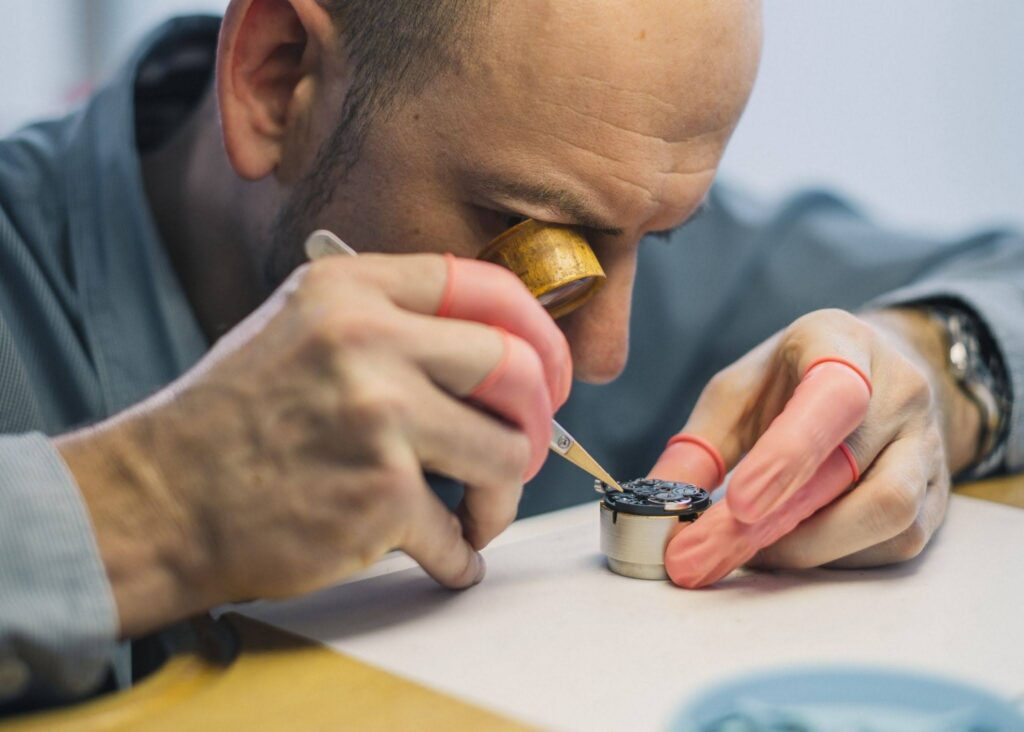
Inside the Biel atelier. The Swiss arm of Christopher Ward, formed through the 2014 merger with Synergies Horlogères, handles every assembly.
Christopher Ward’s design and product teams sit in Maidenhead. Every watch is assembled in Biel, the Swiss city that has been the centre of mechanical watch production for over a century and where the brand’s atelier — formed through the 2014 Synergies Horlogères merger — operates under the leadership of Jörg Bader Sr. The Bel Canto’s components were developed with a roster of named Swiss specialists: Armin Strom contributed the platine, Chronode produced the bridges, hammer, and gong, and Viquo Deco supplied the specialist wheels.
That kind of supply-chain transparency is itself unusual. Most Swiss-made watches at this price point disclose the base movement and leave the rest to imagination. Christopher Ward names suppliers, partly because the brand’s customers — who skew technically literate, organised on the Christopher Ward Forum and a separate private Facebook group called the Christopher Ward Enthusiasts — would catch any misrepresentation almost immediately. The forum has been functioning as a critical-feedback layer for nearly twenty years, and the relationship is not adversarial. The brand has acknowledged repeatedly that some of its sharpest product critics are also its most consistent customers.
What’s Changed, and What Hasn’t
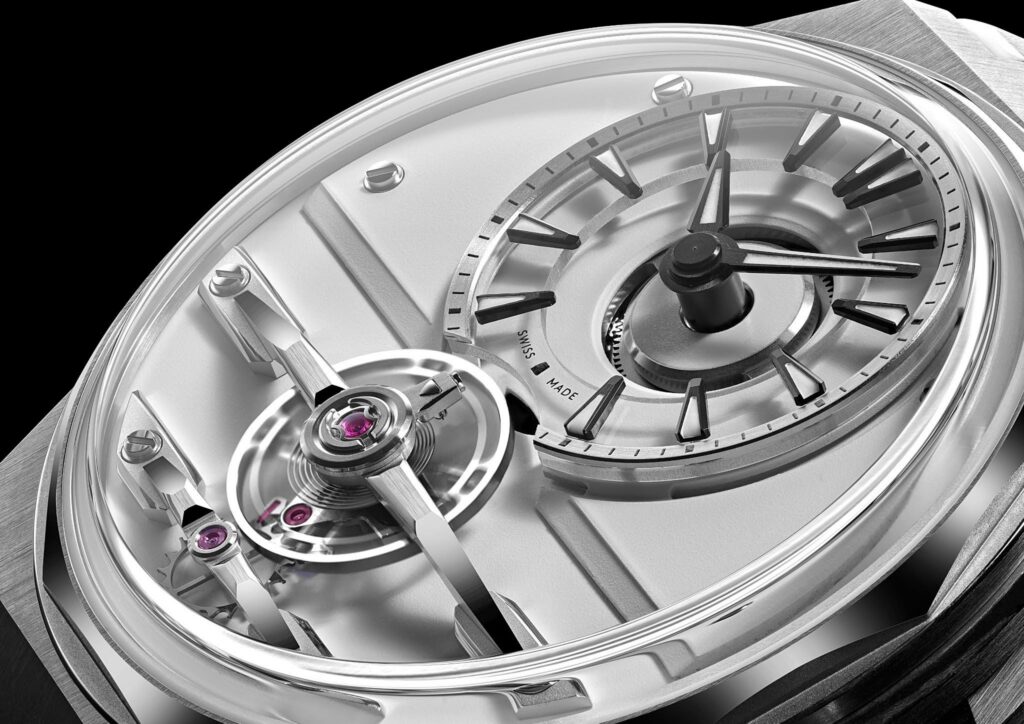
The C12 Loco, dial-side. A free-sprung balance suspended below the time display, powered by Calibre CW-003 — the brand’s second in-house movement and a re-engineered evolution of SH21.
Christopher Ward now ships approximately 40,000 watches per year. The original co-founder, Chris Ward, left the company in January 2020. The headquarters has moved out of the chicken shed into Maidenhead. The product range has stretched from a £179 three-hand automatic to chiming and open-balance watches above £3,500, including a moonphase that tracks lunar cycles for 128 years through the in-house JJ04 module and the C12 Loco, which debuted the brand’s second in-house movement, Calibre CW-003 — a re-engineered evolution of SH21 (now retrospectively designated CW-001) with a 144-hour power reserve and a free-sprung balance brought to the dial side.
The pricing rule has not moved. Mike France still describes it the same way he has for two decades: cost times three, in an industry that marks up between six and far higher. The atelier in Biel still assembles every watch by hand. The forum still tells the brand what it is doing wrong. The next watch is in development now, and the constraint that produces it is the same constraint that produced the first one.
Christopher Ward is headquartered in Maidenhead, England, with its Swiss atelier in Biel. The collection is shown at christopherward.com and sold direct, with appointment-only showrooms in both locations.
All images courtesy of Christopher Ward.