Some of the most iconic watches ever made weren’t designed to be icons. The Rolex Submariner debuted in 1953 as a tool watch for divers — utilitarian, unsexy, rated to 100 meters. Seventy years later, it’s the most recognized luxury watch on the planet, and spotting one on a stranger’s wrist feels like a secret handshake you didn’t know you’d joined. That gap between original purpose and cultural afterlife is exactly where a watch becomes a legend.
When a Brief Solves the Problem Before the Designer Does
The Jaeger-LeCoultre Reverso was born from a complaint. British officers playing polo in India kept cracking their watch crystals. The solution in 1931 was almost absurdly simple: a rectangular case on a sliding carriage that flips 180 degrees to protect the dial — no extra springs, no levers, just a precisely machined groove and a satisfying click.
Dr. Rebecca Struthers — the first watchmaker in British history to earn a PhD in horology — wrote in Hands of Time that “watches not only measure time, they are a manifestation of time — signifiers of the most precious thing we have.” The Reverso makes that case literally: the blank reverse side, designed purely as a shield, became a canvas for engraving and enamel work. The watch solved a problem and accidentally invented a genre — and Jaeger-LeCoultre still produces it in largely the same proportions today.
When Stripping Everything Away Is the Bold Move
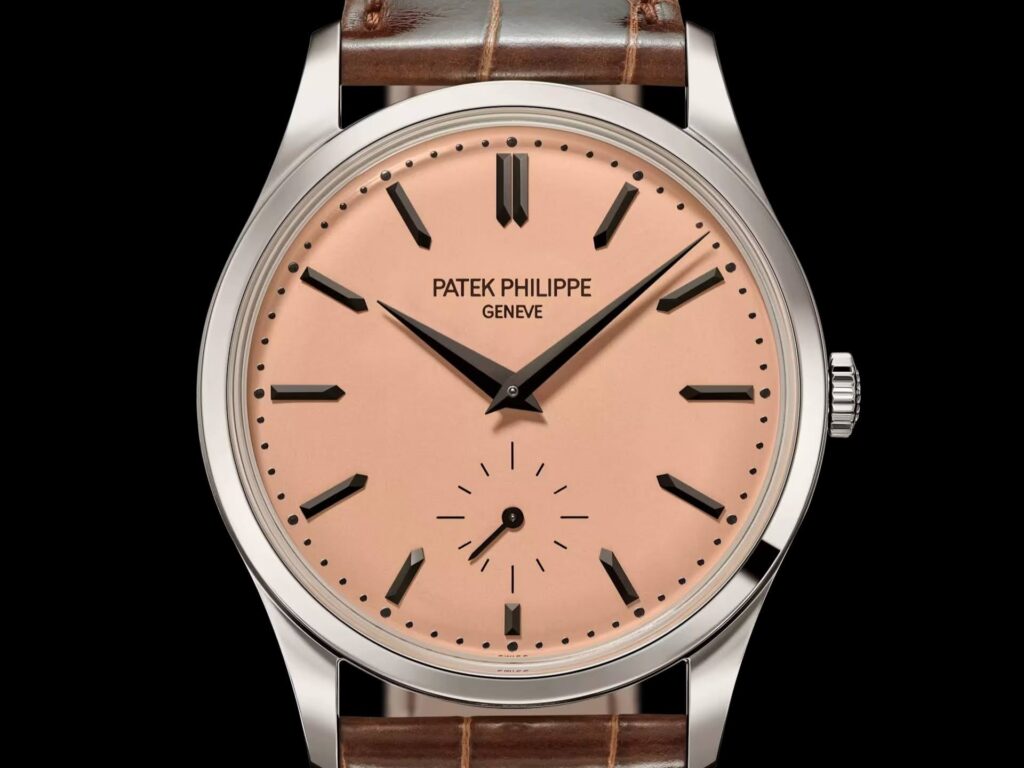
Calatrava 5227G-015 White Gold
The Patek Philippe Calatrava, launched in 1932, went the opposite direction. No complications, no date window, no applied indices beyond slim batons. The reference 96 housed a movement so clean that its finishing — beveled bridges, Geneva stripes, circular graining on the baseplate — became the entire argument for owning it. The Calatrava collection has been in continuous production ever since, with the reference 96’s proportions still visible in every iteration made today. That’s not nostalgia — that’s a design brief that was simply correct the first time.
When a Material Rewrites the Rules
In 1972, amid a quartz crisis dismantling the Swiss industry, Audemars Piguet released a stainless steel sports watch at a price that should have been impossible. The Royal Oak, designed by Gérald Genta in a single night, featured an octagonal bezel with eight exposed hexagonal screws and caliber 2121 — just 3.05mm thick. Steel had never been positioned this way. The Royal Oak nearly bankrupted the brand, then saved it, then changed what luxury sports watchmaking meant entirely.
That same year, the Swiss industry was still reeling from what Seiko had done on December 25, 1969 — placing the Quartz Astron on sale in Tokyo at 450,000 yen, roughly the price of a new car. Its caliber 35SQ was accurate to ±5 seconds per month, about 100 times better than the finest mechanical movement available. The Swiss industry shed approximately 60,000 jobs across the following decade. What saved mechanical watchmaking wasn’t better engineering — it was the argument that accuracy had never been the point.
When a Wrist Makes a Watch Worth Millions
Paul Newman — Academy Award-winning actor, racing driver, and one of the most recognizable faces of 20th-century Hollywood — had his Rolex Daytona reference 6239 sold at Phillips in 2017 for $17,752,500, the highest price ever paid for a wristwatch at auction at the time. The movement inside was a Valjoux 722, manually wound, nothing unusual for its era. What the market was pricing was daily wear across decades, an engraving from his wife — fellow Oscar-winner Joanne Woodward — reading DRIVE CAREFULLY ME, and the photographic record of a specific wrist. The bidding opened at $10 million and lasted twelve minutes.
These historic timepieces don’t hold their position because they’re the most accurate or the most complicated. The Submariner can’t match a modern dive computer. The Reverso is objectively impractical. What each of them did was solve something no one had formally named yet, and solve it so cleanly that revisiting the answer never became necessary. The legendary watch models that endure aren’t the ones that chased permanence — they’re the ones that weren’t thinking about it.