How a Pforzheim watchmaker built a near-hundred-year catalogue on restraint, legibility, and the refusal to chase trends
There’s a version of the STOWA story that starts with a wartime contract and ends with a flieger watch still in production. That version is accurate. But it’s only part of the picture.
The whole story is about a German workshop that has held to the same idea since 1927: legibility, proportion, and honest construction are the things a watch needs to get right first. That idea has survived multiple owners, a world war, a quartz crisis, and nearly a century of pressure pulling in every other direction.
STOrz, WAlter
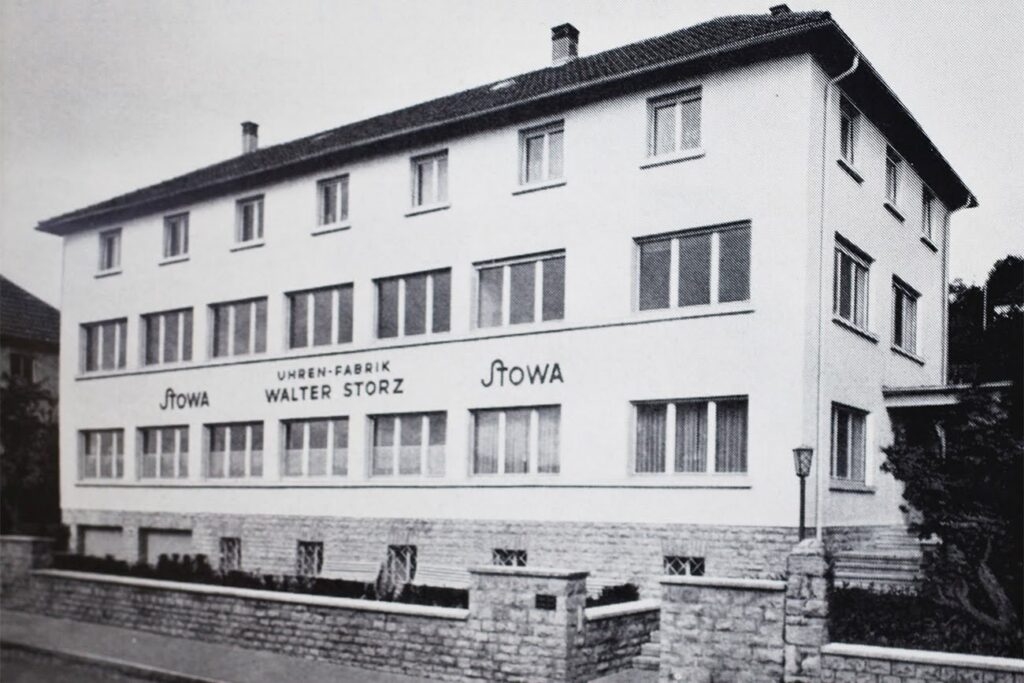
The Uhren-Fabrik Walter Storz on Bismarckstraße, Pforzheim, ca. 1938.
Walter Storz founded his watch company in Hornberg, in Germany’s Black Forest, in 1927. He named it by collapsing his own name, STOrz, WAlter. Three years later, he moved production to Pforzheim, a city with a watchmaking tradition stretching back to the 18th century.
By 1938, STOWA had its own factory and was producing clean, unornamented watches built around the principles of the Bauhaus. It wasn’t a design statement. It simply made functional sense.
That factory was destroyed in the Allied bombing of Pforzheim in 1945. Storz rebuilt, production continued, and his son Werner ran the company until 1996. With no successor in place, Werner sold to Jörg Schauer, a watchmaker who went straight back to the archive, revived the flieger line, and introduced the Antea based directly on those 1937–1938 originals.
In 2021, STOWA became part of Tempus Arte GmbH & Co. KG, a Munich-based group that also owns Uhrenmanufaktur Lang & Heyne Dresden. Production has stayed in Pforzheim throughout.
Nearly a century of ownership changes, a war, a quartz crisis and the same design logic running through all of it.
One of Five
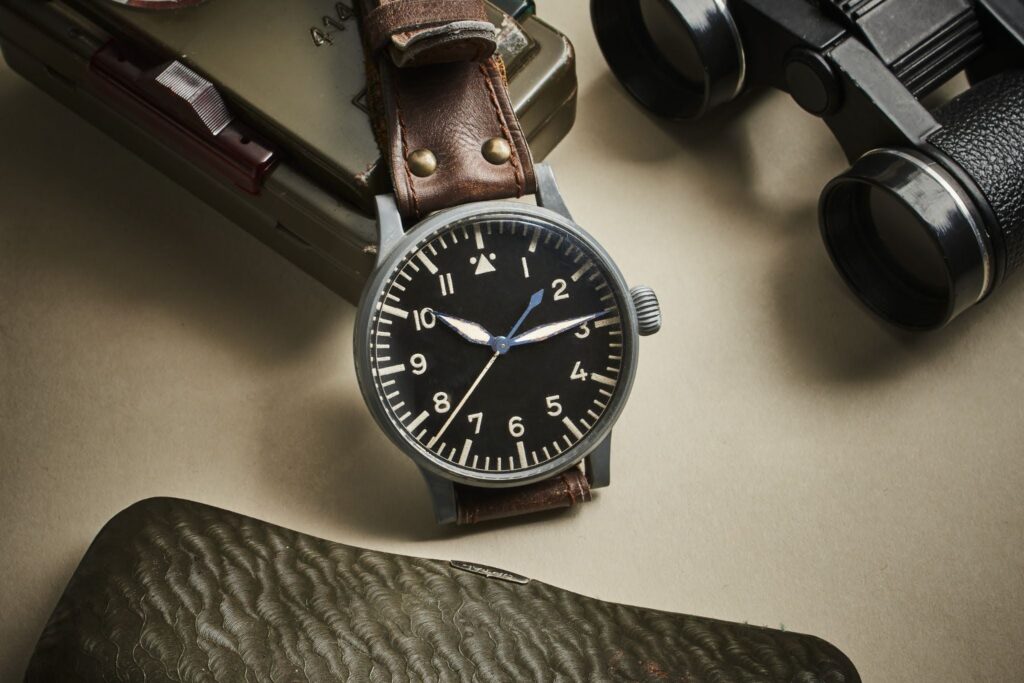
An original STOWA B-Uhr, ca. 1940. One of approximately five manufacturers contracted by the German Air Ministry under the Beobachtungs-Uhr specification
Around 1939–1940, the German Air Ministry issued contracts for one of the most exacting watch specifications of the 20th century: the Beobachtungs-Uhr, or B-Uhr. That translates to “observation watch”, built to equip the navigators of the Luftwaffe, Germany’s air force.
The spec left nothing to interpretation:
- Minimum 55mm case
- Crown at 12 o’clock for gloved-hand operation
- Matte black antimagnetic dial
- Triangular marker at 12, flanked by two dots
- Arabic numerals, syringe hands
Before delivery, every single watch had to be tested across six positions and three temperatures and certified by the German Naval Observatory.
Only five manufacturers received the contract: A. Lange & Söhne, Wempe, Laco, IWC, and STOWA. STOWA used the Swiss-made Unitas calibre 2812 with a swan-neck fine adjustment, Guillaume balance, and hacking stop-seconds. The watches belonged to the Luftwaffe, not to the individual navigators. They were issued before each mission and returned after.
That contract is the foundation of the contemporary Flieger collection. But the connection isn’t only historical. The original specification was, at its core, a legibility brief: a watch that could be read instantly and accurately in a dark cockpit under pressure. The current flieger lineup applies the same logic with modern materials and movements. What has changed is engineering. What hasn’t is the argument the dial is making.
Bauhaus, Before It Was a Category
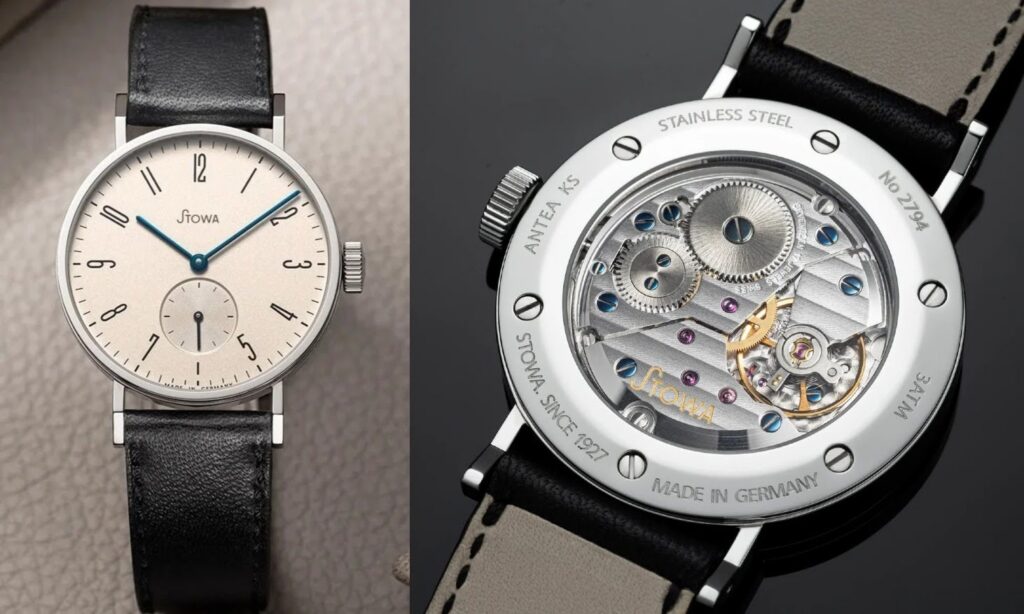
Antea KS. Stainless steel / silver dial / leather strap black. Dial and open caseback.
STOWA began producing Bauhaus-influenced designs in 1937. Not as a trend response because the aesthetic solved a real problem. Clean dials, clear indices, legible type, no ornament without purpose. These were engineering decisions before they became a sales category.
When Jörg Schauer revived the Antea in the late 1990s, Bauhaus watchmaking hadn’t become the reference point it is today. The revival came from the archive, not the market. Designer Hartmut Esslinger (founder of Frog Design and an early collaborator on the Apple design language) later worked with Schauer to develop the Antea line further.
Today the Antea is made in 35.5mm, 36.5mm and 39mm cases with manually-wound movements. Some variants use the Peseux 700, a calibre with decades of proven production behind it. Straight lugs, slim bezels, dials that look exactly like what they are: watches from a tradition that has never needed to reinvent itself. The design dates to 1937. It still doesn’t look dated.
When the Spec Says 100 ATM
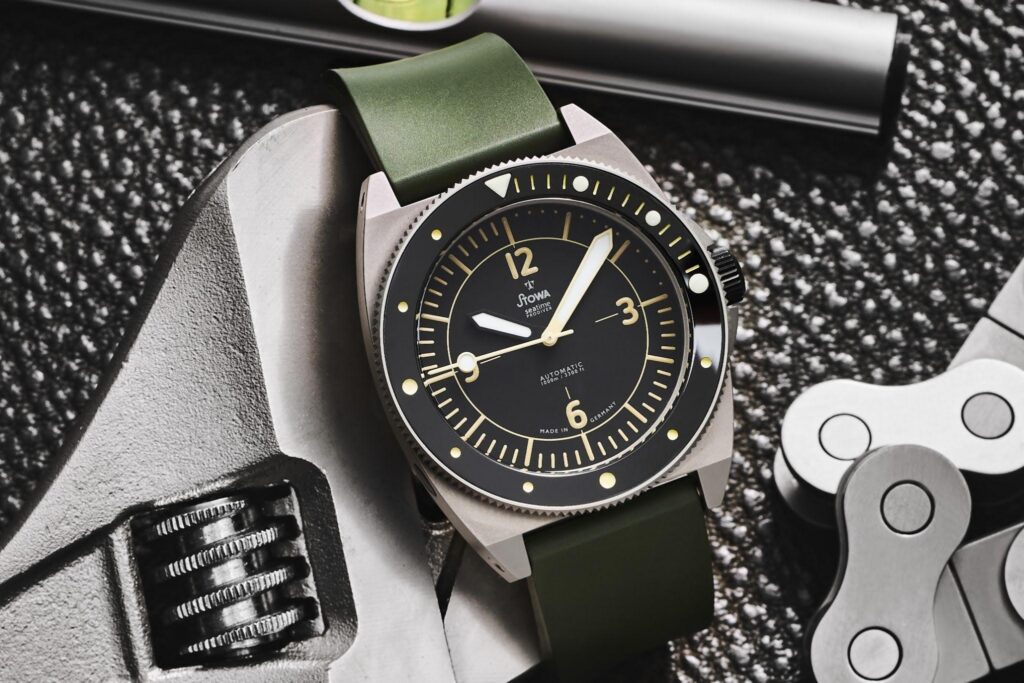
Seatime Prodiver. Titanium / Black / 1000m
The Prodiver is the exception in the STOWA catalogue. It’s the watch that tests how far the brand’s instrument-first logic can stretch before it breaks. It doesn’t break.
At 100 ATM of water resistance (equivalent to 1,000 meters of depth), it won the watchtime.net readers’ vote for best diving watch for 10 consecutive years (2013-2022).
The spec tells the story:
- 42mm titanium case with glass-bead-blasted matte finish
- Screw-down crown and helium escape valve
- Unidirectional ceramic bezel
- Sellita SW 200 automatic movement
- Solid caseback
The Superluminova on hands and indices is calibrated for underwater visibility, not ambient lighting. The clarity that defines the Flieger and the Antea shows up here too, just in a different form. Not typographic. Structural.
The Third Element
Fieldwatch Terra. Three versions: Desert, Forest, Soil.
STOWA built its name on air (the Flieger) and water (the Marine, the Prodiver). The Fieldwatch Terra, released in 2026, is the brand’s first watch explicitly designed for land.
Three versions, Desert, Forest, and Soil share the same foundation:
- 38mm stainless steel case with matte grey PVD coating
- Crown guards
- Sellita SW 200 automatic movement
- 200 meters of water resistance
- Magnetic field protection to 80,000 A/m
- No date window
A 24-hour inner ring and Arabic numerals keep the dial full of information without feeling crowded. The 5-minute markers show red in daylight and glow orange at night. No manual needed.
The Terra doesn’t look like the Flieger or the Antea. But the brief is the same: make the information readable, then get out of the way.
Nearly a Century of the Same Argument
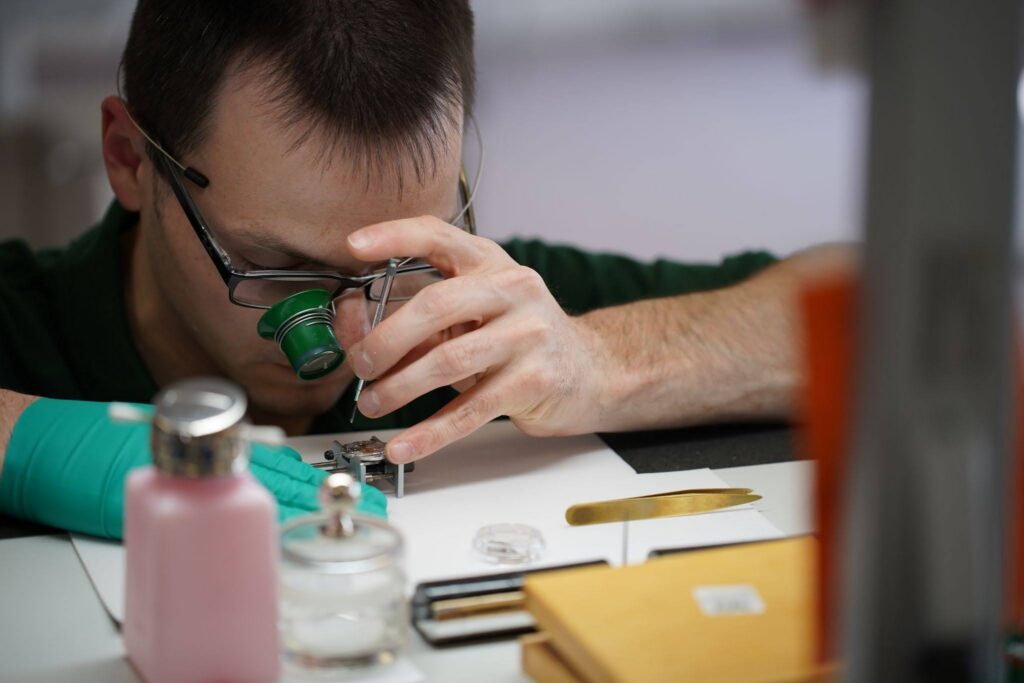
Assembly and quality control at the STOWA manufactory, Pforzheim.
STOWA produces around 3,500 watches per year. They’re sold direct and through a small number of selected dealers in Germany. Service and repair is handled exclusively at the Pforzheim manufactory.
The models in the catalogue today trace back to specific historical briefs: the Flieger to the B-Uhr specification, the Antea to the 1937 Bauhaus designs, the Marine to the naval observation watch tradition.
With the centennial approaching in 2027, the brand is developing anniversary designs. Kevin Müller, General Manager of STOWA told us that they’ll “feature our history and also new approaches.” That sentence describes exactly how STOWA has operated since Schauer opened the archive in 1996.
The watches that come out of Pforzheim don’t try to be current. They try to be right. That’s a different brief and it has survived everything the last hundred years threw at it.
“At STOWA, we believe that true quality is defined by clarity in design, in craftsmanship, and in the way we interact with our customers. Our watches combine a clean and timeless aesthetic with a strong focus on durability and precision, always aiming to offer an exceptional price-performance ratio. For us, innovation means refining what already works while staying true to the principles that have defined STOWA for nearly a century.”
— Kevin Müller, General Manager, STOWA
STOWA is based in Pforzheim, Germany. The collection is shown at stowa.de and sold direct through the brand’s online shop and through selected dealers in Germany, and select international markets.
All images courtesy of STOWA