A Visit to the Vallée de Joux, Where Ten World Records Were Born
There are places in the world where the air itself seems to hum with precision. The Vallée de Joux, tucked into Switzerland’s Jura mountains, is one of them. I traveled there to visit one of Bvlgari’s watchmaking manufacturing facilities located in Le Sentier — and what I found was a story I wasn’t expecting. Not just one of technical mastery, but of a Roman jewelry house that essentially dared the Swiss watch establishment to take it seriously. And then backed it up with ten world records.
Bvlgari has transformed from a jeweler into one of haute horlogerie’s most technically ambitious manufactures, holding those ten world records for ultra-thin watchmaking across a single collection: the Octo Finissimo. The brand’s journey from sourcing movements from Swiss houses to producing virtually all components in-house — culminating in the 2021 GPHG Aiguille d’Or, watchmaking’s highest honor — is one of the industry’s most compelling modern narratives. And that story is rooted in Le Sentier, a village in the undisputed heartland of complicated watchmaking.
From Roman Jeweler to Record-Breaking Manufacture
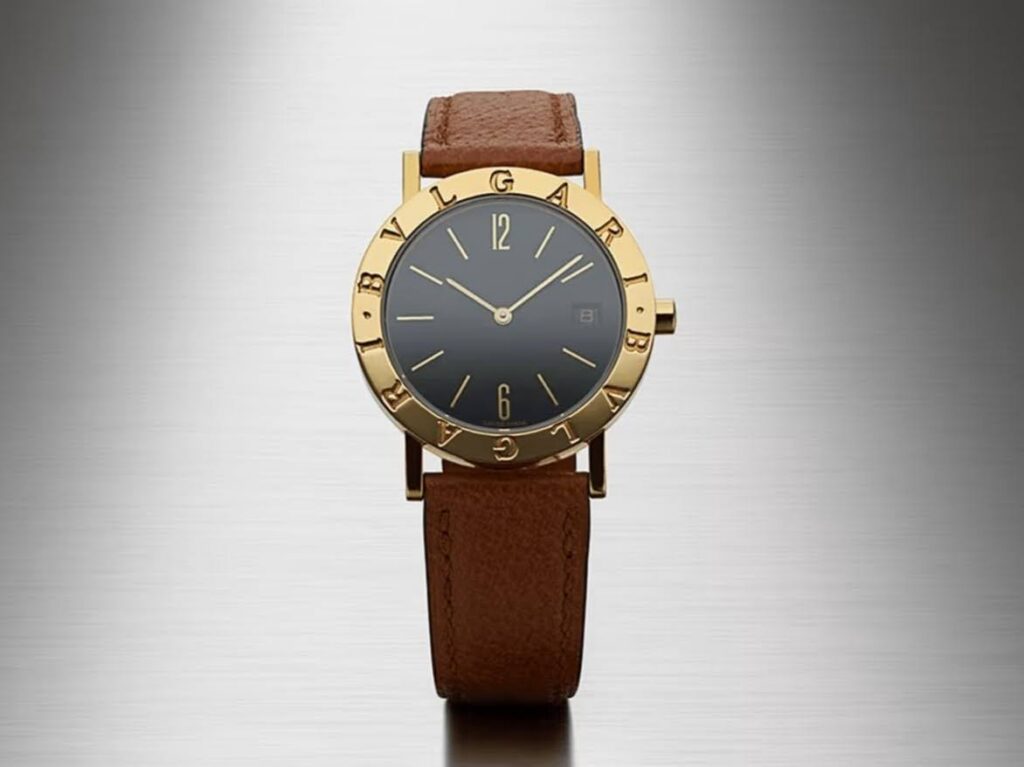
Bvlgari Bvlgari watch, ca. 1977. Photo by Barrella – Studio Orizzonte Gallery
Sotirio Bulgari founded his company in Rome in 1884, and the brand began producing jewelry wristwatches in the 1920s, sourcing movements from the likes of Jaeger-LeCoultre, Vacheron Constantin, and Movado. The iconic Serpenti bracelet-watch appeared around 1948, using the Tubogas coil technique that would become one of the brand’s defining signatures. But the pivotal moment for the watch division came in 1977 with the Bvlgari Bvlgari — a flat, 5mm-thin gold watch that placed the brand logo as the primary decorative element. It was a bold move, and it became a design icon.
Bvlgari formalized its Swiss watchmaking presence in 1982 with Bulgari Time S.A. in Neuchâtel. The 1988 Diagono introduced a sport line, and 1998’s Aluminium watch pushed unconventional materials. But the true inflection point arrived in 2000, when Bvlgari acquired legendary watchmaker Gérald Genta and master craftsman Daniel Roth, along with their manufacturing facility in Le Sentier, for 37.6 million Swiss francs. This acquisition brought tourbillon, minute repeater, and grande sonnerie expertise directly under Bvlgari’s roof. It was, as I see it now, the moment everything changed. LVMH later acquired Bvlgari in 2011 for approximately €3.7 billion, but the watchmaking DNA had already been planted in the valley.
The Octo and Its Ten World Records

Octo Finissimo Titanium Black.
The modern Octo Finissimo collection launched in 2012 (not 2014 as sometimes cited), redesigned by Fabrizio Buonamassa Stigliani, Bvlgari’s Product Creation Executive Director. The 41.5mm case features 110 polished and satin-finished facets, powered by the in-house BVL 193 caliber. When the Octo Finissimo line debuted at Baselworld 2014 with a record-setting tourbillon, the streak began — and it hasn’t stopped.
I’ll be honest: when I first heard “ten world records,” I was skeptical. That kind of claim usually comes with caveats. But walking through the manufacture and seeing the calibers up close, the numbers speak for themselves. Here’s the full run:
- 2014 — Thinnest tourbillon (movement: 1.95mm, case: 5.00mm).
- 2016 — Thinnest minute repeater (movement: 3.12mm, case: 6.85mm).
- 2017 — Thinnest automatic watch (movement: 2.23mm, case: 5.15mm).
- 2018 — Thinnest automatic tourbillon (movement: 1.95mm, case: 3.95mm).
- 2019 — Thinnest chronograph GMT (movement: 3.30mm, case: 6.90mm).
- 2020 — Thinnest chronograph tourbillon (movement: 3.50mm, case: 7.40mm).
- 2021 — Thinnest perpetual calendar (movement: 2.75mm, case: 5.80mm).
- 2022 — Thinnest mechanical watch, the Octo Finissimo Ultra (case: 1.80mm).
- 2024 — Thinnest COSC chronometer, the Ultra COSC (case: 1.70mm, reclaiming the record from Richard Mille’s RM UP-01 at 1.75mm).
- 2025 — Thinnest tourbillon watch, the Ultra Tourbillon (case: 1.85mm).
A Closer Look: The 2021 Perpetual Calendar
The 2021 Octo Finissimo Perpetual Calendar deserves particular attention. Its in-house caliber BVL 305 measures just 2.75mm thick with 408 components, including a micro-rotor for self-winding — all within a 5.80mm sandblasted titanium case. It displays hours, minutes, retrograde date, day, month, and retrograde leap year indication, requiring no adjustment until February 2100 if kept wound. This is the watch that won the Aiguille d’Or at the 2021 Grand Prix d’Horlogerie de Genève, validating Bvlgari at watchmaking’s highest competitive level. It was available in titanium (€60,000) and 950 platinum with blue lacquered dial (€90,000).
The 2022 Ultra: Engineering at the Edge
The Octo Finissimo Ultra pushed boundaries even further. At 1.80mm total thickness, the caseback literally serves as the movement’s mainplate. The BVL Calibre 180 is just 1.50mm thick, runs at 4 Hz with a 50-hour power reserve, and required eight patents. Limited to 10 pieces at €400,000, it was developed with Swiss movement specialist Concepto. Holding something that thin in your hand is genuinely disorienting — your brain doesn’t quite accept that it’s a mechanical watch.
Italian Design Meets Swiss Mechanical Mastery

Taken during a visit to the Bvlgari manufacturer in Le Sentier. Photograph by Watch Professor.
Bvlgari’s philosophy is captured in the phrase L’Estetica della Meccanica — the aesthetics of mechanics. Technical achievement and visual impact must be inseparable. Buonamassa Stigliani frequently invokes the Italian concept of sprezzatura: making extraordinary complexity appear effortless. As he puts it: “We work in Switzerland, but we are not Swiss. We have a different attitude; we see things in a different way.”
That tension — Italian sensibility channeled through Swiss precision — is something you feel throughout the manufacture. The approach to record-breaking thinness involves eliminating separate architectural layers and rearranging all functions on the same horizontal plane. Key innovations include using the caseback as the baseplate, suspended barrel construction without upper bridges, ball bearings instead of jewels, micro-rotors replacing full-size rotors, and flexible bridges for shock protection. It’s not just about making things thinner; it’s about rethinking what a watch movement can be.
Being taken seriously as a watchmaker was Bvlgari’s central challenge. The 2000 acquisition of Genta and Roth brought manufacturing credibility. The Finissimo record campaign from 2014 onward made the case impossible to ignore. CEO Jean-Christophe Babin put it plainly: “We have now broken three world records in four years through necessity and by doing that we have also shown the world that we are at the frontier of watchmaking.” At Watches & Wonders 2025, Bvlgari exhibited for the first time inside the main fair — a symbolic acceptance into horology’s top tier that felt long overdue.
Manufacturing Runs Deep Across Three Swiss Sites

Taken during a visit to the Bvlgari Manufacture in Le Sentier. Photograph by Watch Professor.
One of the things that struck me most during my visit was just how vertically integrated Bvlgari’s operation is. With approximately 500 employees across three Swiss facilities, they produce virtually all key components in-house — from gold alloy casting to movement assembly, case machining, dial production, and bracelet finishing. In an industry where many brands outsource more than they’d like to admit, this level of self-sufficiency is remarkable.
Le Sentier, Vallée de Joux
This is the Manufacture de Haute Horlogerie, acquired through the 2000 Genta/Roth purchase. Movements are developed and built here — from the three-hand BVL 191 to the 923-component Grande Sonnerie. All movement components (wheels, gears, pinions, plates, bridges) are manufactured on site, checked to 1/10,000th of a millimeter. Grande complication models can take up to six months from start to completion. The facility produces over 30 in-house calibers. Walking through these rooms, watching a single watchmaker spend an entire afternoon on a component smaller than a grain of rice, redefines your understanding of patience.
Neuchâtel
This serves as Bvlgari Horlogerie’s headquarters, established in 1982. Around 160 employees work in design, engineering, final assembly (emboîtage — where movements, cases, dials, and hands come together), quality control, and after-sales service. Buonamassa Stigliani himself relocated here from Rome to be closer to production, which tells you something about the seriousness of their commitment.
The Hôtel des Horlogers: Luxury Hospitality in Le Brassus

Hôtel des Horlogers, Le Brassus, Switzerland.
A quick note on where to stay, because it’s part of the experience. The Hôtel des Horlogers soft-opened on April 1, 2022, in Le Brassus, filling a long-standing gap: the world capital of haute horlogerie had lacked a design hotel worthy of its prestige. The property is commissioned and owned by Audemars Piguet, though it operates independently and welcomes all visitors. It sits steps from the Musée Atelier Audemars Piguet and AP’s historic headquarters.
The hotel occupies the site of the former Hôtel de France, founded in 1857 as a stop on the Chemin des Horlogers — the historic path watchmakers walked to carry finished timepieces from the valley to Geneva. Audemars Piguet purchased the property in 2003, briefly reopened it in 2005, then closed it in 2016 for a complete reimagining. If you’re making the trip to the Vallée de Joux, this is where you want to be.
Final Thoughts
I’ve spent years visiting producers — distillers, cheesemakers, olive oil millers — and there’s always a moment when you realize the product you’re holding is the result of something much deeper than a production process. That moment hit me at Bvlgari’s Le Sentier manufacture. The Octo Finissimo isn’t just an exercise in thinness; it’s the culmination of a 25-year journey from outsider to record-holder, built by people who clearly love what they do.
Whether you’re a seasoned watch collector or someone just beginning to appreciate what goes into a mechanical timepiece, a visit here is a visual masterclass in watchmaking.