The Swiss watch industry exports roughly $24 billion in watches each year. Nearly all of that revenue flows through a handful of conglomerates — Richemont, Swatch Group, LVMH — and a small number of independently held houses large enough to operate their own manufacturing campuses. What gets lost in that accounting is a much smaller group: workshops producing anywhere from a few dozen to a few hundred watches annually, setting their own technical and aesthetic standards with no brand management layer to answer to.
Here are five worth adding to your radar.
F.P. Journe
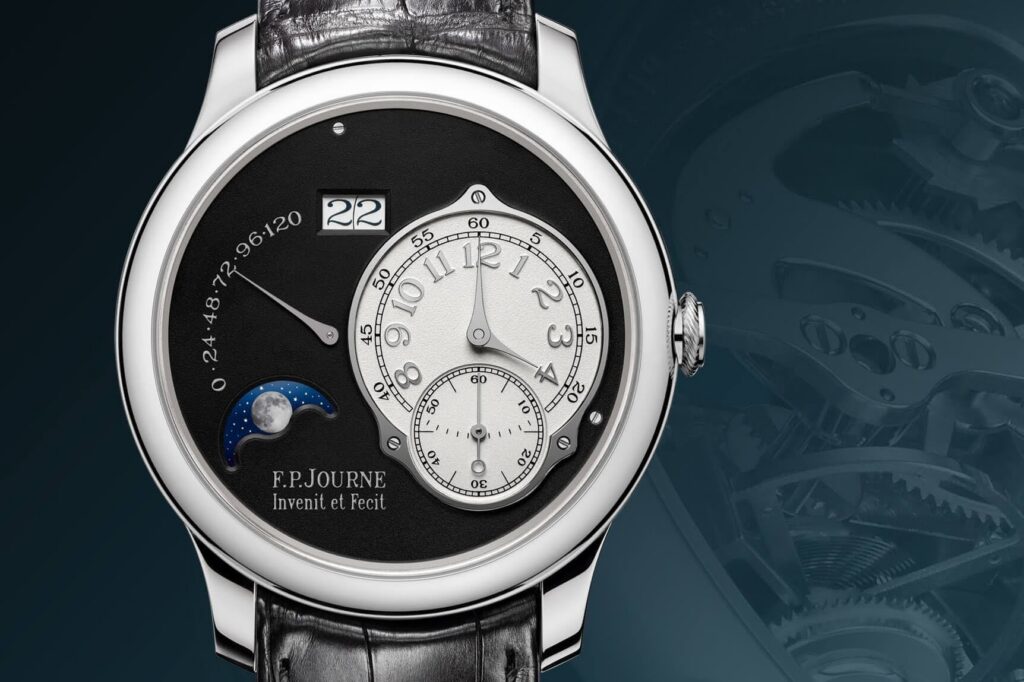
Lune Black Label – Ref. LN Calibre 1300.3
Founded in 1999 in Geneva, François-Paul Journe’s manufacture produces every caliber in-house, including the mainsprings — a level of vertical integration almost no other independent attempts. Movement plates and bridges are made from brass in the traditional Genevan manner, finished by hand to standards that exceed the Geneva Seal’s requirements.
Journe’s most technically significant piece remains the Chronomètre à Résonance, which uses two separate balance wheels oscillating in mechanical resonance to improve rate stability. The two balances synchronize their oscillations through air and the movement’s structure, averaging out their individual errors. Executing it in a wristwatch-sized movement took Journe most of the 1980s and 1990s to solve.
Annual production sits at roughly 900 pieces. Waiting lists for most references extend several years, and the secondary market routinely prices Journe watches above retail — not by design, but as a consequence of genuine scarcity.
Philippe Dufour
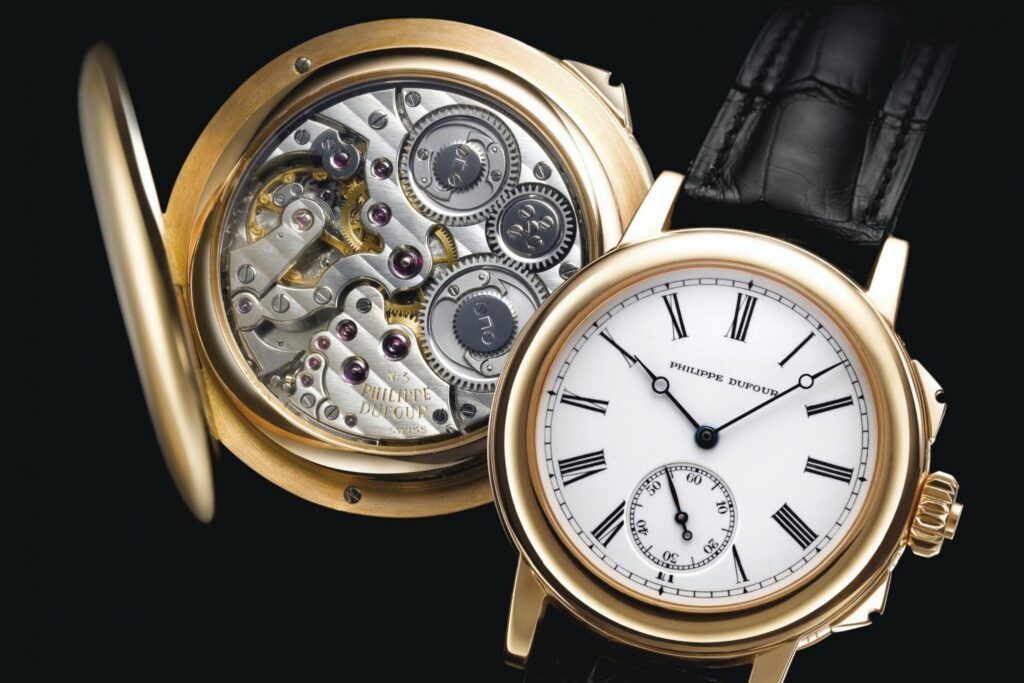
Grande Sonnerie Wristwatch No. 1
Philippe Dufour has made fewer than 300 watches in a career spanning five decades, working almost entirely alone in his workshop in Le Solliat in the Vallée de Joux. His output barely registers statistically, yet his influence on finishing standards across Swiss fine watchmaking is documented and widely acknowledged.
His Simplicity, a time-only wristwatch introduced in 2000, is studied by watchmakers for its hand-finishing rather than its complications. Every surface — bridges, plates, bevels — is finished using traditional hand tools and gentian-wood laps unchanged since the 19th century. The anglage on each bridge component is cut and polished individually by hand, adding hours of labor per part with no measurable effect on timekeeping.
His Duality houses two balance wheels connected by a differential that distributes power evenly and averages their rates. Dufour remains in active production, and his annual output can be counted on two hands.
Kari Voutilainen
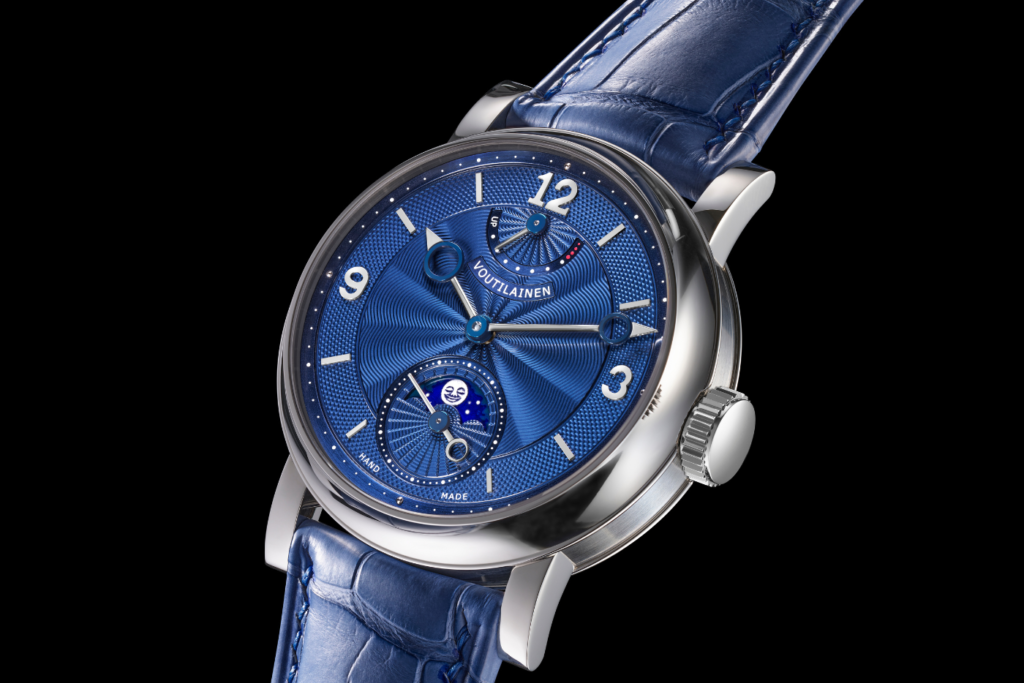
Vintgt-8 – 28MPR
Kari Voutilainen trained as a restoration watchmaker before establishing his atelier in Môtiers, canton of Neuchâtel — a background that shaped both his finishing standards and his preference for historical construction methods. His Vingt-8 uses a direct-impulse escapement that delivers energy more efficiently than the lever escapement standard in most Swiss movements, requiring individual hand-adjustment of 26 components to function correctly.
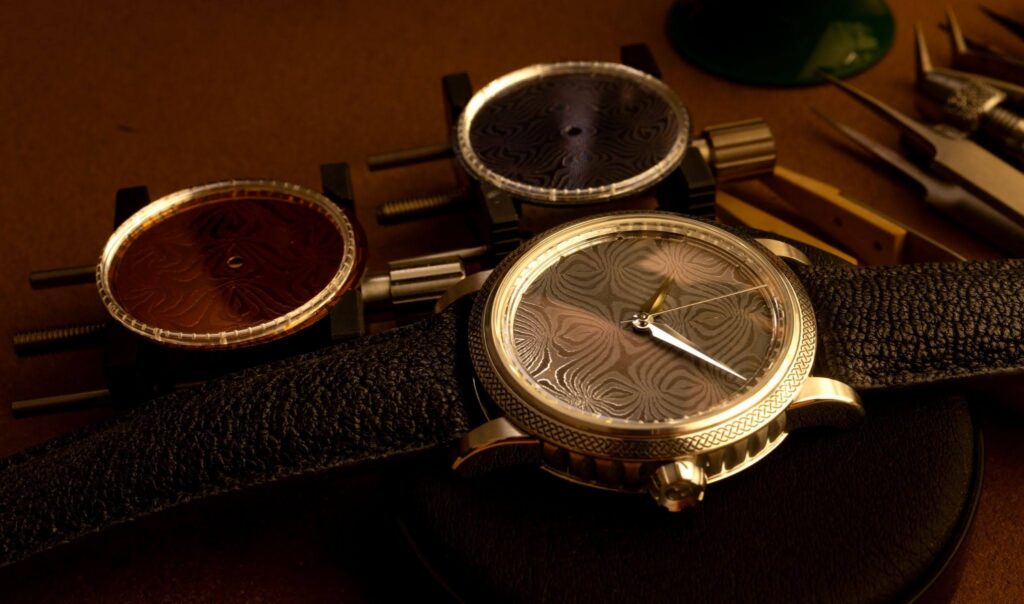
The dials are produced in-house on a rose engine lathe, a 19th-century machine that creates guilloché patterns by rotating the dial blank against a cutter while advancing it along a geometric path. The patterns are not printed or stamped, and no two are geometrically identical.
Production runs to roughly 50–60 watches per year. Voutilainen takes commissions for unique pieces alongside a small consistent catalogue, making his work accessible without the multi-year allocations common at larger independents.
Akrivia
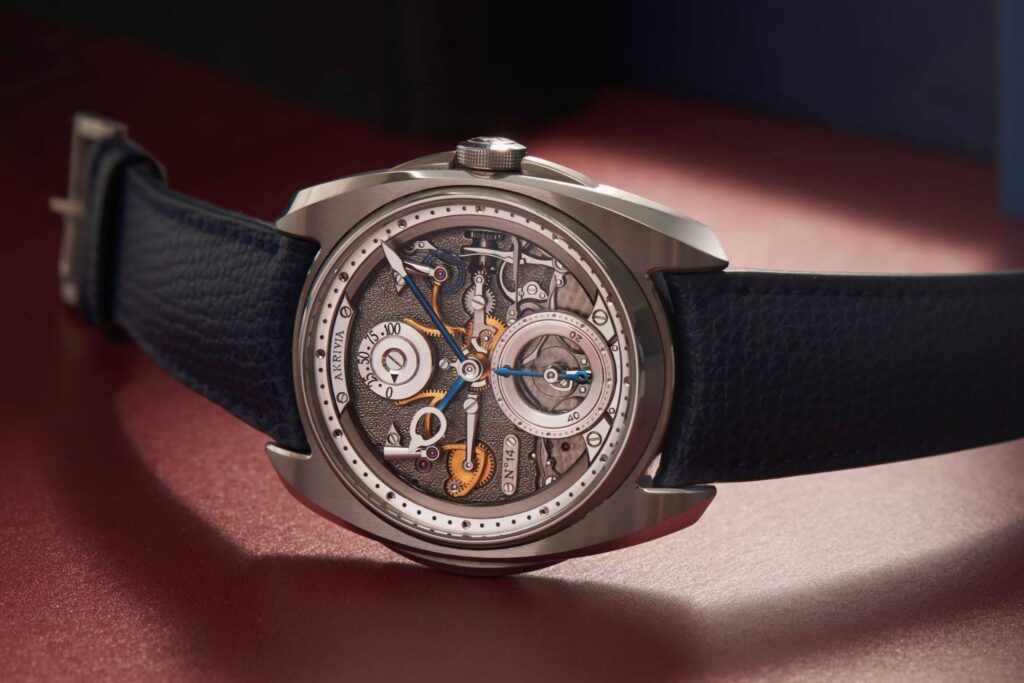
AK-06 – Stainless Steel
Rexhep Rexhepi began his watchmaking career at 14, trained at WOSTEP in Neuchâtel, and led the complications department at BNB Concept before establishing Akrivia in Geneva in 2012 at the age of 24.
His movements are finished to Geneva Seal standards and beyond, with black-polished steel components, straight-grained surfaces, and hand-beveled edges throughout. The AK-06 caliber, housed in the Chronomètre Contemporain, features a monometallic balance wheel regulated by a proprietary stud holder — components that required several years of development before Rexhepi was satisfied with their performance across temperature and position variations.
What distinguishes Akrivia from older independents is not a rejection of tradition but a rigorous re-examination of it. Rexhepi has rebuilt classical mechanisms from first principles, identifying where historical design compromises were made for manufacturing convenience rather than performance. Production remains fewer than 50 pieces per year.
De Bethune
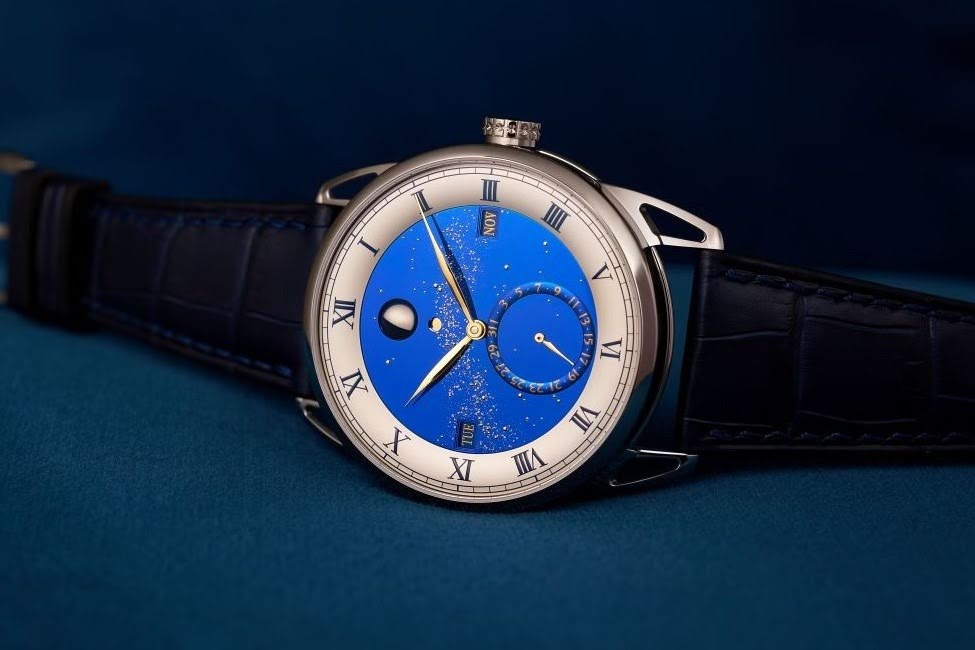
DB25 – Perpetual Sky. Ref: DB25SQPV2
De Bethune was founded in 2002 by Denis Flageollet and David Zanetta in L’Auberson, a village in the Vaudois Jura with a long history of ébauche manufacturing. The brand’s two most studied innovations — a titanium-platinum balance wheel and a spherical moon phase accurate to one day’s error in 122 years — both emerged from that industrial environment.
The titanium-platinum balance wheel uses two materials with different thermal expansion coefficients on the same balance arm. As temperature changes, the contrasting expansion rates adjust the balance’s effective diameter, compensating for rate variation mechanically rather than electronically.
The spherical moon phase on the DB25 uses a blued steel sphere with a gilded hemisphere rotating inside a domed aperture. The mechanism advances the sphere by the correct angular increment each day — no approximation, no manual correction for decades.
De Bethune produces fewer than 500 watches per year and manufactures movement components, cases, and dials in-house, giving Flageollet direct control over the tolerances his technical ambitions require.
What these five workshops share is less about aesthetics or price than about structure. None belongs to a conglomerate. Decisions about complications, finishing standards, and annual output are made by the people at the bench — not by a board reviewing market share projections. In an industry where that independence is increasingly rare, it shows in the work.