Where Watchmaking Meets Kinetic Art in the Heart of Geneva
There are watch brands, and then there is MB&F. Standing for Maximilian Büsser & Friends, MB&F is a Swiss luxury watch manufacturer that Büsser launched in Geneva in July 2005 — and from the moment you step inside their headquarters, it’s clear this is no ordinary watchmaker. I’ve visited distilleries, cheese caves, and chocolate workshops for our Professor publications, but nothing quite prepared me for the M.A.D. House.
From Harry Winston to a Dream of His Own
Before founding MB&F, Büsser was a key figure at Harry Winston, where he conceived the now-famous Opus series — a project where the brand worked with a different independent watchmaker annually to build a very special limited-edition timepiece. It was an incredible creative experience, and each Opus became a collector’s event, but ultimately it wasn’t enough. When Harry Winston was sold to a larger group, Büsser seized the moment to strike out entirely on his own.
In 2005, he launched MB&F with a radical premise: that watchmaking could be treated as kinetic art, and that credit should be given to every collaborator who helped bring a piece to life. That second part might sound like a footnote, but it’s actually central to everything MB&F does. In an industry where brands routinely obscure who actually makes their watches, Büsser chose radical transparency from day one.
Two Collections, One Philosophy
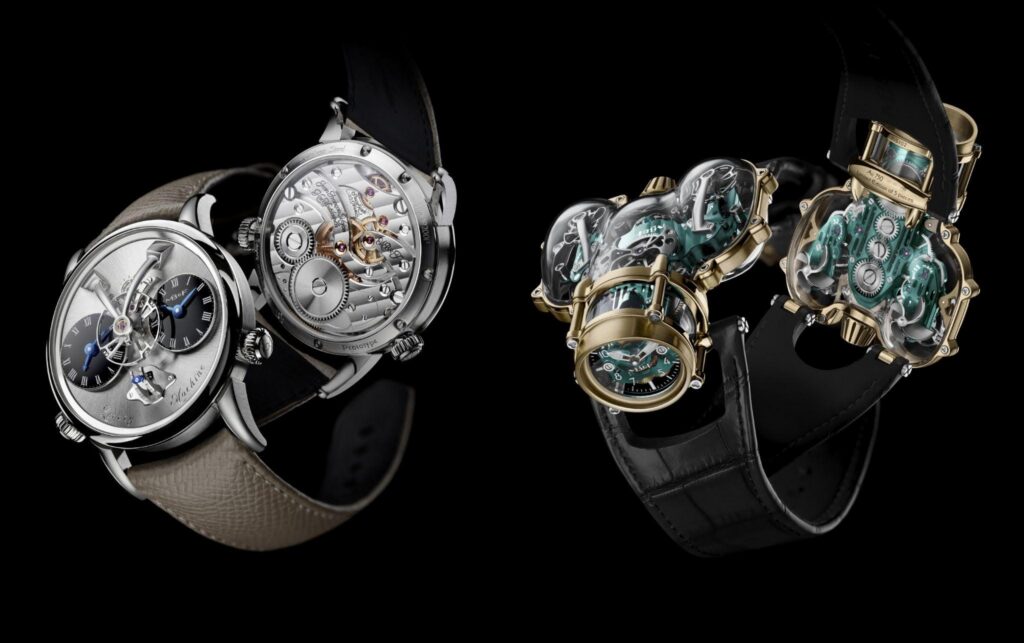
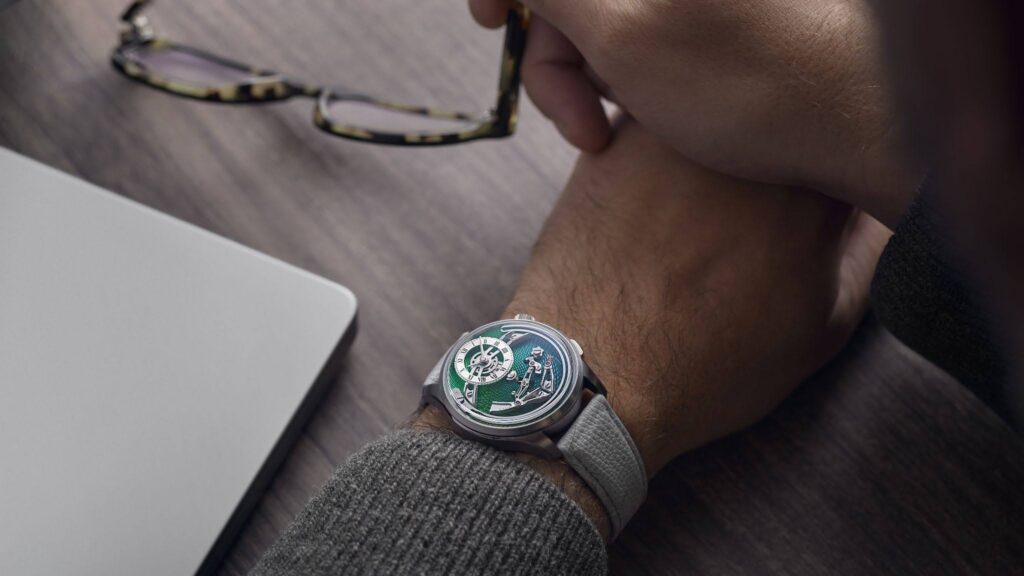
LM1 Longhorn and HM9 Yellow Gold Green.
MB&F operates across two distinct lines. The fiercely unconventional Horological Machines have explored themes as diverse as space and science fiction, aviation, supercars, the animal kingdom, and architecture. These are the watches that made the brand’s reputation — three-dimensional mechanical sculptures that happen to tell time. I remember the first time I saw one in person and genuinely couldn’t figure out where to read the hours. That’s the point.
Then, in 2011, MB&F presented Legacy Machine No. 1, the first in a collection of more traditional-looking, round-cased watches — Büsser’s tribute to the great horological innovators of the 19th century, reinterpreted through a distinctly modern lens. The two lines are intentional counterweights: one pushing into the future, the other honoring the past. Together, they define what MB&F’s philosophy is really about — not just making watches, but asking what a watch could be.
A Network of Friends
The “F” in MB&F isn’t just branding — it’s the entire operating model. On my visit, I learned that MB&F works with a network of approximately 120 external supplier partners — referred to internally as Friends — and draws on roughly 40 of them for any given creation, depending on the specific requirements of that project. Performance Art pieces are MB&F machines revisited by external creative talent, while Co-Creations are other types of machines engineered and crafted by unique Swiss manufacturers from MB&F’s ideas and designs. Notable examples include an ongoing partnership with clockmaker L’Épée 1839 and music box collaborations with Reuge.
Every year, MB&F develops a new in-house caliber — a process driven entirely by the brand’s internal team of 75 people, all based in Geneva. It’s a model that keeps MB&F constantly evolving. You never quite know what’s coming next, and that unpredictability is part of the appeal.
The M.A.D. House: Where the Magic Happens
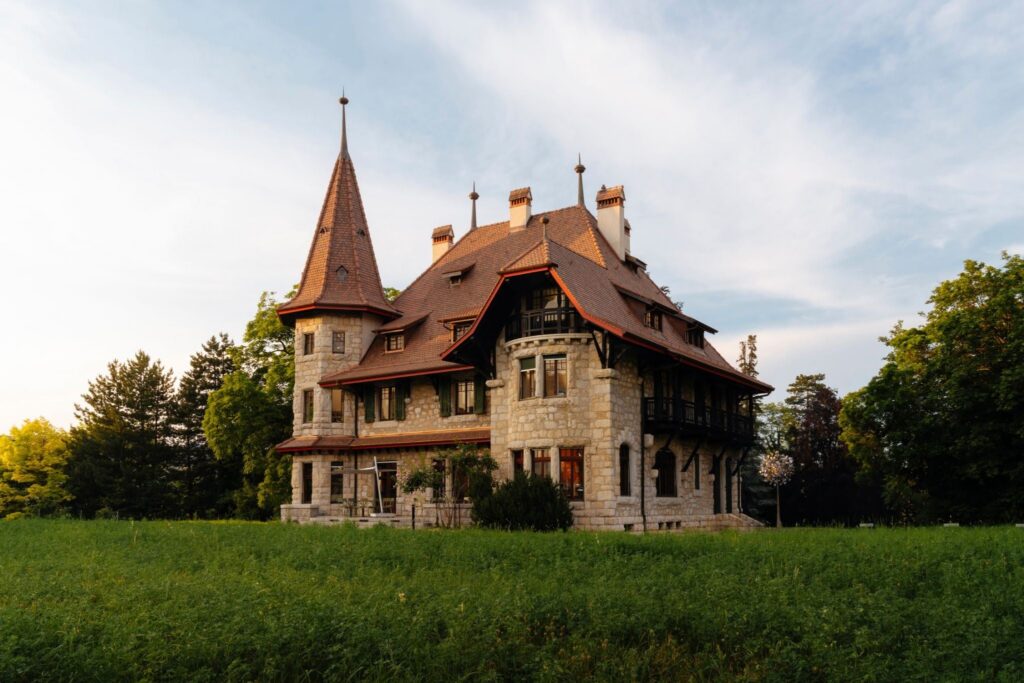
MB&F M.A.D. House.
MB&F’s headquarters is called the M.A.D. House — a building originally constructed in 1907 in the Carouge neighborhood of Geneva. The brand moved into it in September 2022 — following a full year of renovation after signing the contract in 2021, and stepping inside, the environment itself feels like an extension of the brand’s philosophy. The building is genuinely beautiful — a historic structure filled with natural light that floods the workshop floor, making it feel less like a factory and more like an atelier.
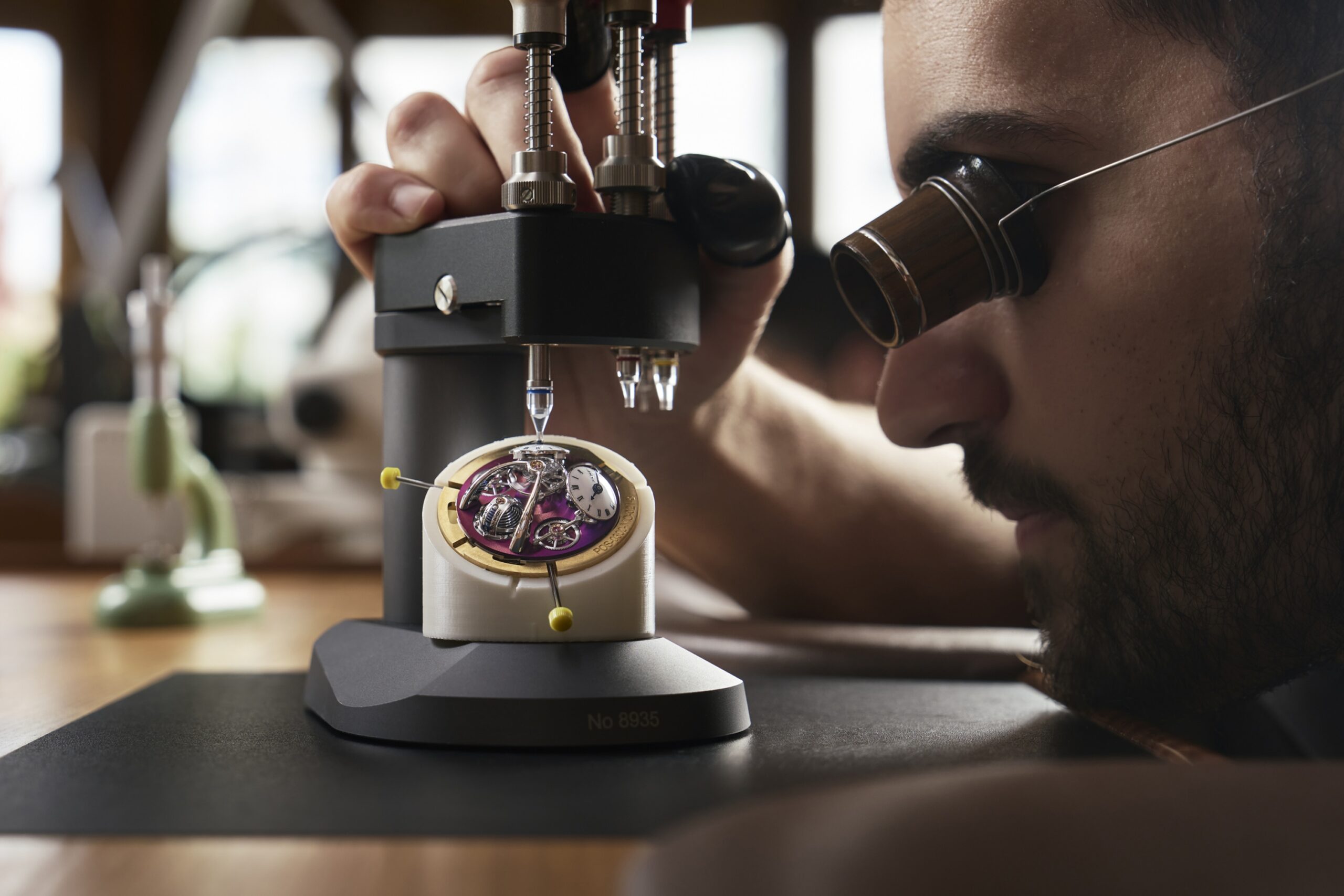
Watchmakers assemble movements at custom-built workbenches surrounded by original wood panelling and hand-painted ceramic tiles from the era the house was first built — a century-old backdrop for some of the most forward-thinking horology on earth. I’ve visited a lot of production facilities across our Professor publications, and the M.A.D. House is, without exaggeration, one of the most inspiring workspaces I’ve ever walked through.
What struck me most, though, wasn’t just the craftsmanship on display — it was the sheer coordination behind it all. Each watch contains anywhere from 200 to 600 individual components, sourced across that network of roughly 40 Friends selected for that specific project. Getting all of those parts to arrive in the right sequence, at the right time, for a watch that takes four to five years from concept to completion, is a logistical achievement as impressive as the watchmaking itself.
A single watchmaker is assigned to each piece, rotating across a small number of watches at a time, with full production running two to three weeks per watch. Watching it happen in real time, in that light-filled historic building, is something you don’t forget.
Made in Small Numbers, Built for Eternity
MB&F produces roughly 400 watches per year — a deliberately small number that keeps each piece genuinely rare. They usually only build 20 to 50 copies of any given timepiece each year, and often cease production of models within a few years of release. This isn’t scarcity for marketing purposes — it’s a direct consequence of how the watches are made. The brand has no interest in scaling up.
The goal, as Büsser has put it, is to create radical machines they are proud of — full stop. Having now seen the process firsthand, I can tell you it’s not a slogan. Every piece that leaves the M.A.D. House carries the DNA of the individual watchmaker who built it.
Come and See for Yourself
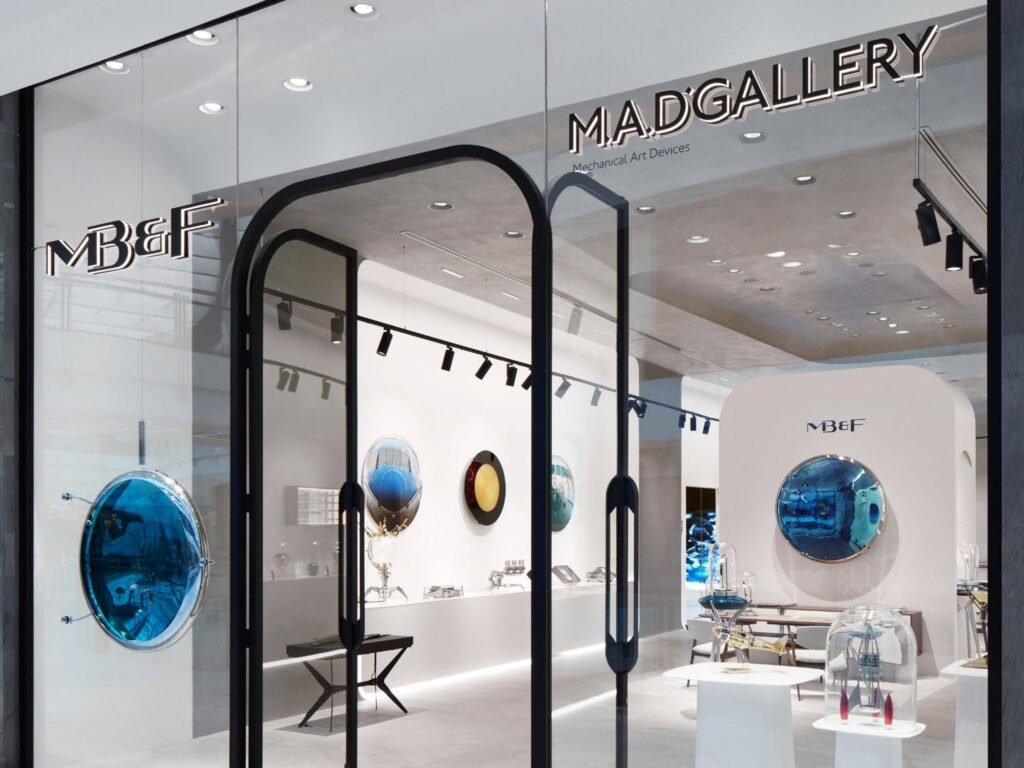
M.A.D. Gallery Dubai.
You don’t need a factory invitation to experience the MB&F universe. The first M.A.D. Gallery opened in 2011 in Geneva on Rue Verdaine, in the heart of the city’s Old Town, and it remains the most accessible way to immerse yourself in what the brand is all about. The gallery showcases MB&F Machines and Co-Creations alongside carefully curated artworks — Mechanical Art Devices — from around the world.
Beyond Geneva, there is a second M.A.D. Gallery in Dubai, and smaller MB&F Labs in Singapore, Taipei, Paris, Beverly Hills, and Silicon Valley. And for the truly dedicated: once a month, MB&F welcomes visitors to the M.A.D. House itself, with tours held every second Friday, limited to just 8 participants for an intimate look at the workshops and offices. Bookings can be made by emailing visit@mbandf.com.
Whether you encounter MB&F through a gallery visit or stumble across one of their pieces at a retailer, the effect tends to be the same — you stop, stare, and quietly reconsider everything you thought you knew about what a watch could be. I know I did.