How Atelier Wen turned a hunch about untapped craft into watches nobody else could have made
We asked Robin Tallendier, who co-founded Atelier Wen and runs it as CEO, what he’s proudest of, and he wouldn’t name a watch. He named a feeling. Not a single feature, he told us, but the ability to bring Chinese craftsmanship and modern watchmaking together in a way that’s authentic rather than superficial. It’s a careful word, superficial; the trap he’s spent nearly a decade steering around.
Because the easy version of a “Chinese watch” is a cliché with a dragon on the dial. Tallendier and his partner, Wilfried Buiron, wanted the opposite: watches where every Chinese element earns its place. The name they chose says as much. Atelier is French for workshop, wen is Chinese for culture. Two Frenchmen, both shaped by years living and studying in China, and betting that the world had badly underrated what Chinese craft could do.
Start With the Dial, Because That’s Where It Started
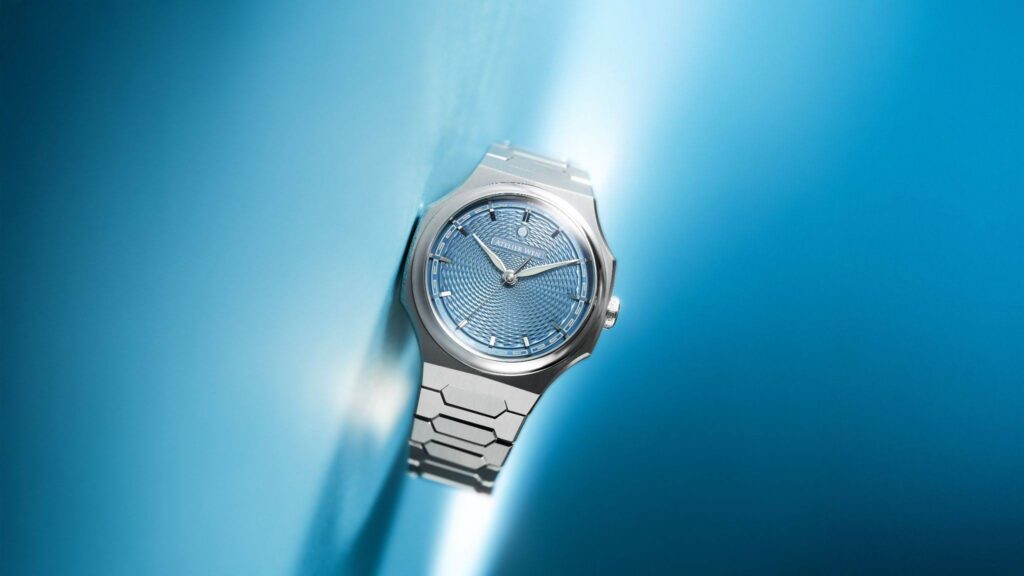
The Perception’s ice-blue guilloché dial. The fish-scale pattern is cut by hand on a rose engine, its radiating lines catching light differently as the wrist moves.
The watch that made people pay attention was the Perception, launched in 2022 and sold out in sixteen hours. What stopped collectors was the dial, a fish-scale guilloché pattern, cut by hand.
That matters more than it sounds. Guilloché is a precise geometric texture turned into metal, and most brands today produce it by stamping or CNC machine. Fast, cheap, identical every time. Atelier Wen does it the slow way, on a rose engine with a hand-cranked lathe in the workshop of Cheng Yucai, regarded as China’s first master of the craft. Cheng is so particular he built his own machines. Each dial takes hours of unbroken concentration, and a single slip means starting over.
You could read that as stubbornness. Tallendier reads it as the point. “Very few masters of guilloché remain in the world,” the brand puts it. Keeping one working by hand is the argument the watch is making before you’ve read a word about it.
Then There’s the Enamel, Which Fails Half the Time
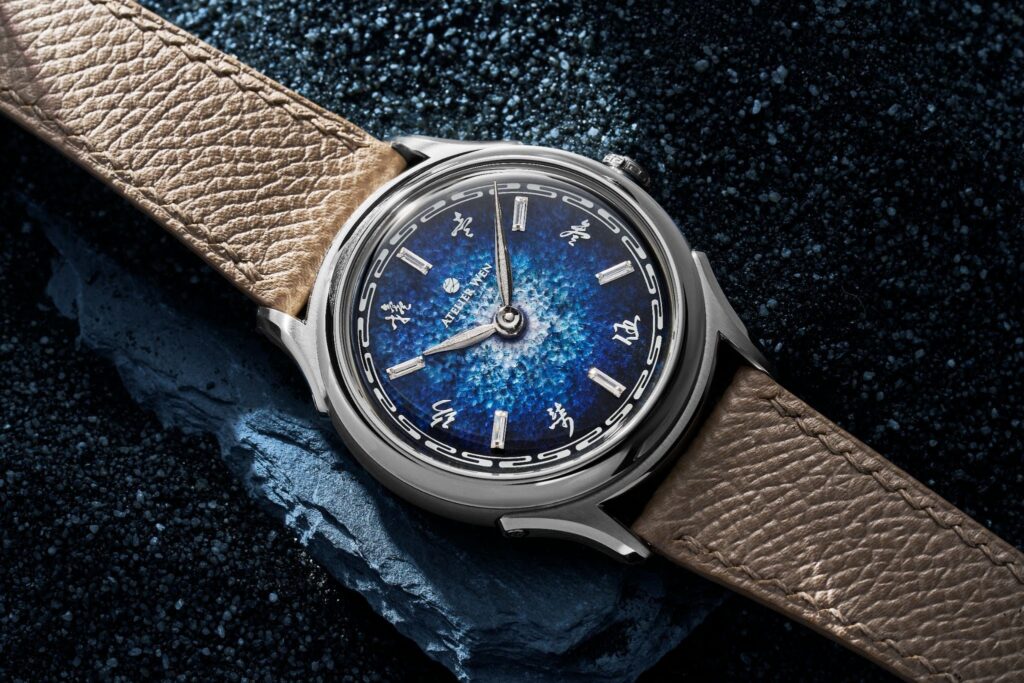
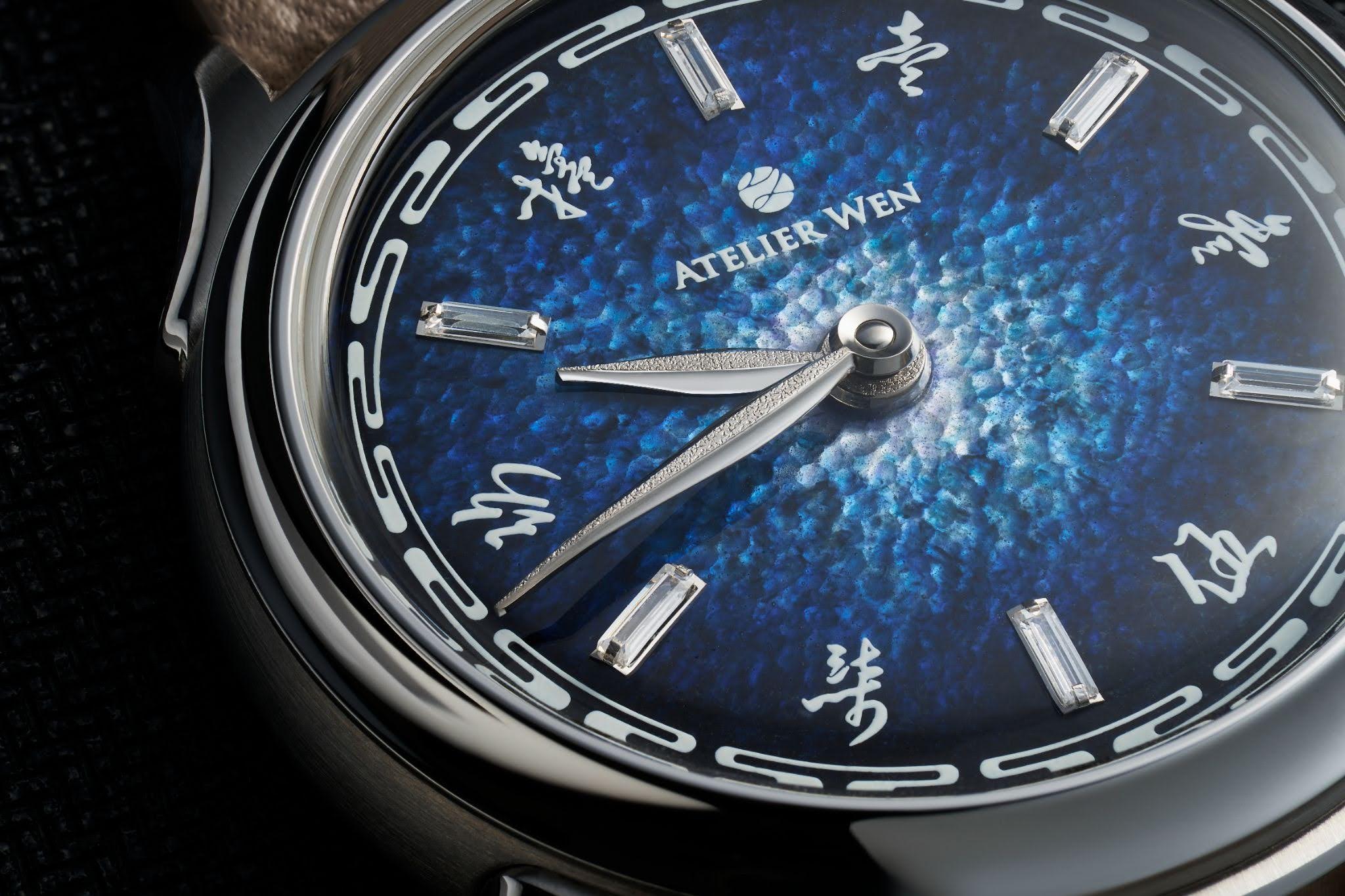
The grand feu enamel dial of the Ancestra Jiāo, fired in Kong Lingjun’s Beijing workshop. Because the enamel shifts unpredictably in the kiln, no two dials come out quite the same.
The other craft Atelier Wen leans on is grand feu enamel, and it’s even less forgiving.
Grand feu is glass. Powdered minerals are painted onto a metal dial in thin layers, then fired in a kiln at up to 850°C over and over, sometimes six times, with air bubbles worked out by hand between firings. Get the grain wrong and it cracks. Even in expert hands, roughly half the dials come out flawed and get thrown out.
The dials that survive come from the Beijing workshop of Kong Lingjun, named China’s best enameler in 2021 and formally designated the country’s enamel-watch manufacturing center. His work turns up across the range.
Three Collections, One Idea
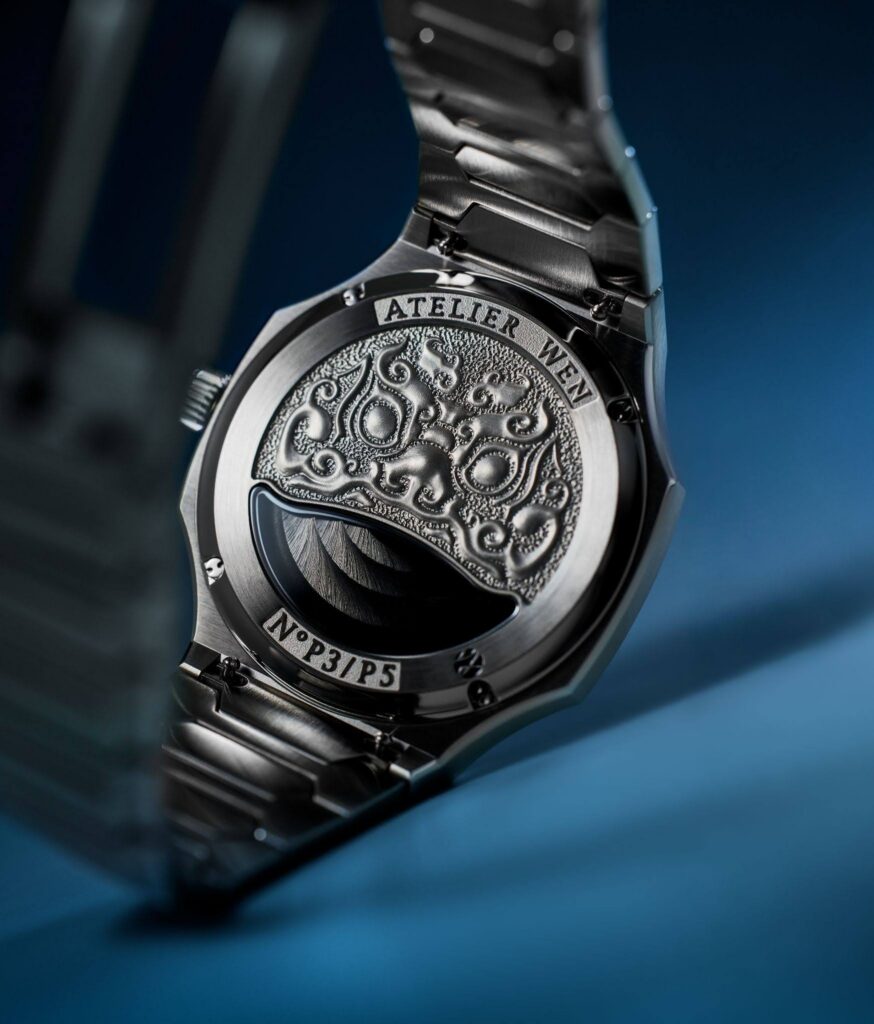
The engraved caseback of the Perception Millésime “Xuán.” The guardian lion — traditionally a stone statue set outside important Chinese buildings — is cut so the rotor aperture forms its mouth, appearing to open and close as the watch runs.
Atelier Wen builds around three lines, and Tallendier describes them as the foundation everything else grows from. Each takes the same crafts in a different direction.
The Perception is the collection that broke the brand through in 2022, and it’s still the flagship, a family of integrated-bracelet steel sports watches built around that hand-turned fish-scale dial. Across the line, the 904L steel cases and bracelets draw their angles from traditional Chinese architecture, from pagoda rooflines to latticed windows. The current V3 generation runs to three dials: ice-blue Piāo, salmon Xiá, and a new bamboo-green Yún, the first fresh color in four years. These are the most wearable, most accessible watches Atelier Wen makes, and where most owners start.
The Ancestra is the dress line, opened in 2025 by its debut model, the Jiāo. At 38mm these are slimmer, quieter watches, wearing hand-hammered silver dials finished in Kong’s grand feu enamel, fading from a pale silvery center to deep cobalt at the rim. The cases take their curves from the Hongshan jade dragon, among the oldest known dragon carvings in Chinese history, culture worn on the wrist rather than shouted.
The Inflection is the ambitious one. These watches are built almost entirely from tantalum, a dark, dense, bluish-gray metal most makers won’t touch because it’s so punishing to machines. The dials come in three grand feu enamel shades from Kong’s workshop, a limited fumé green alongside obsidian black and midnight blue, and the line stands as the clearest statement of how far the brand will push.
Three lines, three price points, one throughline: nothing is chosen for effect alone.
“Nothing Is Accidental”
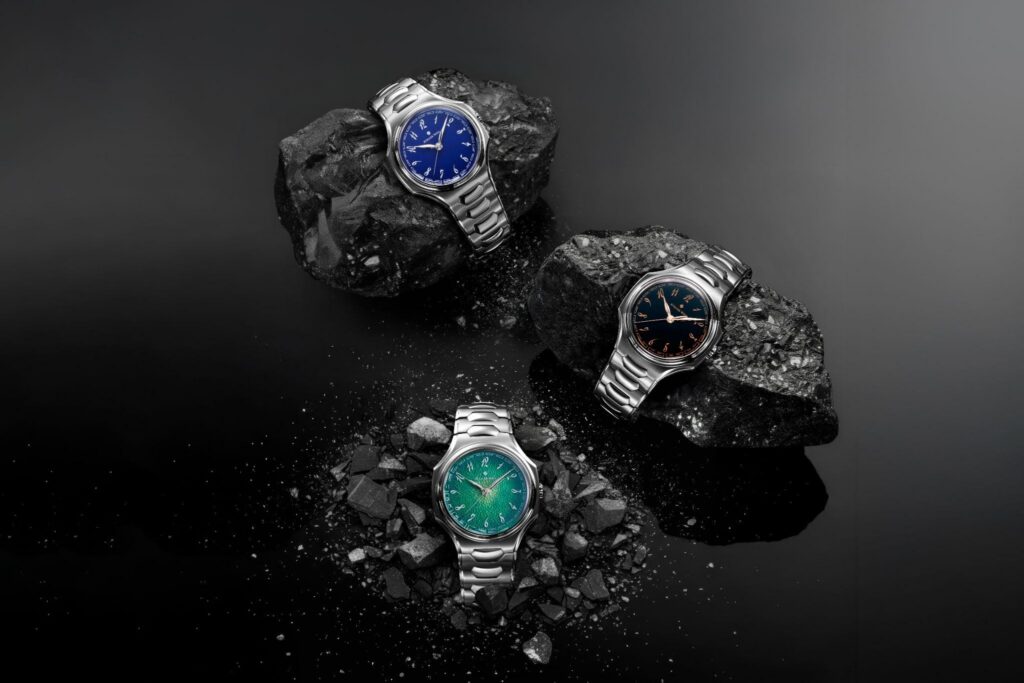
The Inflection trio in grand feu enamel — midnight blue, obsidian black, and a limited fumé green. Every case and bracelet link are cut from tantalum, a metal so hard to machine that few makers attempt it even for a case.
When we asked Tallendier what serious collectors notice first, he talked about “finishing”, the crispness of a bevel, the depth of the decoration, whether the brushing stays consistent across every link of a bracelet. But the thing he most wants owners to understand, he said, needs no technical background at all.
“Nothing in our watches is accidental. The choice of every material, every craft, every artisan carries a reason, cultural, technical, or both.”
— Robin Tallendier, Co-Founder, Atelier Wen
That’s the idea to hold onto, because it explains choices that otherwise look eccentric. Firing enamel that fails half the time, machining a metal that fights back, keeping a guilloché master turning dials by hand when a machine would be faster, none of it makes sense as cost-cutting, because none of it is. Each one is a deliberate bet that the harder path shows.
Even the hour markers carry the logic. On the Perception they aren’t glued down…each one drops into a cutout and is held by the ring above it, friction alone, a nod to old Chinese joinery. Small enough that most owners will never notice. Which is exactly the point.
Building Culture Into the Machinery
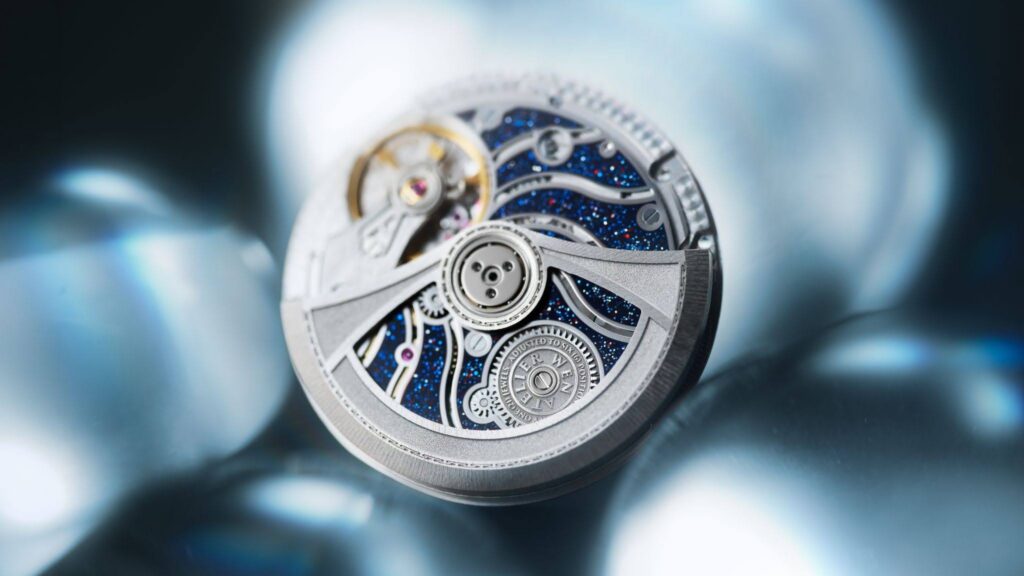
The customised Pequignet EPM03 seen through the Perception V3’s sapphire caseback. The bridges are shaped as the Chinese symbol for wind and filled with blue aventurine lacquer — decoration usually reserved for dials, rarely attempted on a movement.
Here’s where the “nothing is accidental” rule gets literal.
The movement, the mechanical engine inside, is the one part Atelier Wen doesn’t make itself. Like most independents of its size, it works with specialist manufacturers, in this case the French house Pequignet and the Swiss Girard-Perregaux. Tallendier is relaxed about that. “As a collector, I have never believed that a great watch is defined by its country of origin,” he says, “but rather by the thought, care, and creativity that went into its creation.”
What the brand does with those movements is the interesting part. It doesn’t just drop them in. On the Perception V3, released in 2026, the movement’s bridges are reshaped into the traditional Chinese symbol for wind and filled with mirror-polished blue lacquer flecked to look like a night sky, a finish so tricky that almost nobody attempts it. On the Ancestra, a bridge is micro-etched with 446 characters of Questions to Heaven, a classical Chinese poem thousands of years old.
So even the borrowed part of the watch ends up telling the same story. The engineering may be European but the language written across it is Chinese.
“We started Atelier Wen because we believed the world was missing something, watches that took Chinese culture and craftsmanship as seriously as the very best European houses take their own traditions. That belief has never wavered. Every decision we make, from the artisans we work with to the finishing techniques we develop, is in service of a single goal: to make watches that prove, beyond any reasonable doubt, that Chinese craft belongs at the very top of this industry. If our watches encourage people to look at Chinese watchmaking through a different lens, then we feel we have succeeded.”
— Robin Tallendier, Co-Founder, Atelier Wen
The Long Game
A closer look at the Perception V3, from the hand-turned dial to the engraved crown and clasp. Every surface carries a detail that rewards a second glance.
What struck us, talking to Tallendier, was how little the mission has shifted. The watches have grown more ambitious (from a sub-$3,000 steel sports watch to the tantalum Inflection) but the question at the start of every project is the same from Day One: does this meaningfully contribute to the vision? The brand has never made a watch just because the market wanted it and it doesn’t plan to start.
He’s not short of ideas about where it goes next. New complications, more of the decorative arts, fresh ways to express Chinese culture through a wristwatch. “We believe there remains an enormous amount of untapped creative potential within Chinese craftsmanship,” and after nearly a decade, the direction hasn’t wavered.
The goal was never to make a good watch that happens to be Chinese. It was to change what people expect when they hear the words. Judging by how fast each release now sells out, the world is finally looking.
Atelier Wen was founded in 2017 by Robin Tallendier and Wilfried Buiron, launching its first watches the following year. The independent brand produces in China, with its primary market in the United States. The collection is shown at atelierwen.com and sold direct and through authorized retailers.
All images courtesy of Atelier Wen.