Watches that start conversations, crack jokes and now and then, remind you that you will die.
Ask Crispin Jones, the fine-art graduate who founded Mr Jones Watches in 2007, what his company is proudest of, and precision turns out to be the frame, not the picture. Keeping exact time, as he sees it, is a job the screen in your pocket already does well.
“While your mobile phone might work for the purely functional part of telling the time, the watch is free to do something a bit different,” he told Watch Professor. His London company makes what he calls “fun, portable, miniature works of art.”
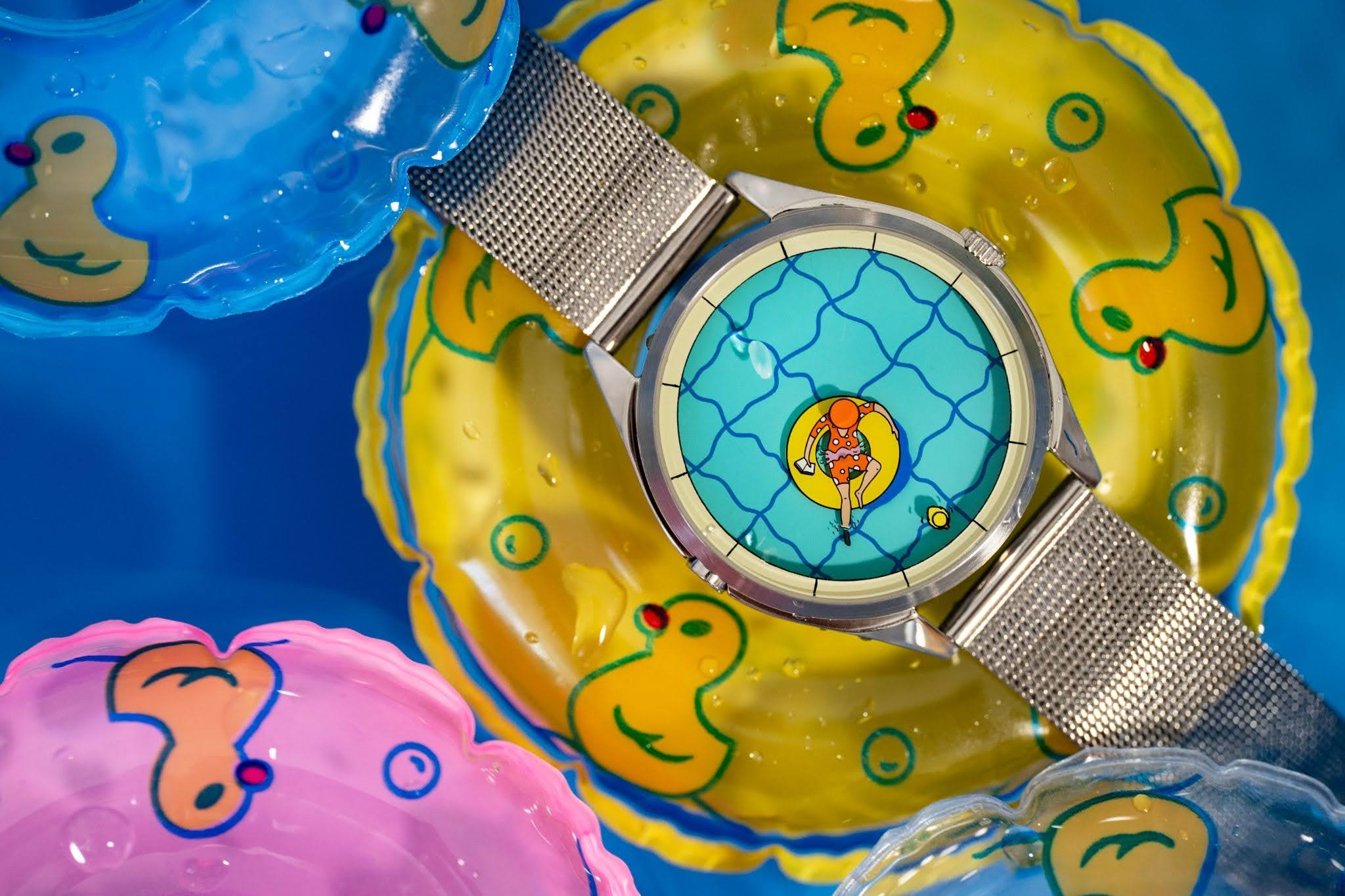
That freedom to create has a face, and in some watches it has taken the afternoon off. On A Perfectly Useless Afternoon, the brand’s most popular design, the round case becomes a swimming pool. A man lounges on a rubber ring with one leg stretched out to point at the hour. A rubber duck drifts around the edge and marks the minutes.
Belgian picture-book illustrator Kristof Devos built it around a line from the writer Lin Yutang: spend an afternoon in a perfectly useless manner and you’ve learned how to live. Your phone will tell you it’s 3:47. The duck says it’s roughly a quarter to four, and the water’s lovely.
From Exhibition to Edition
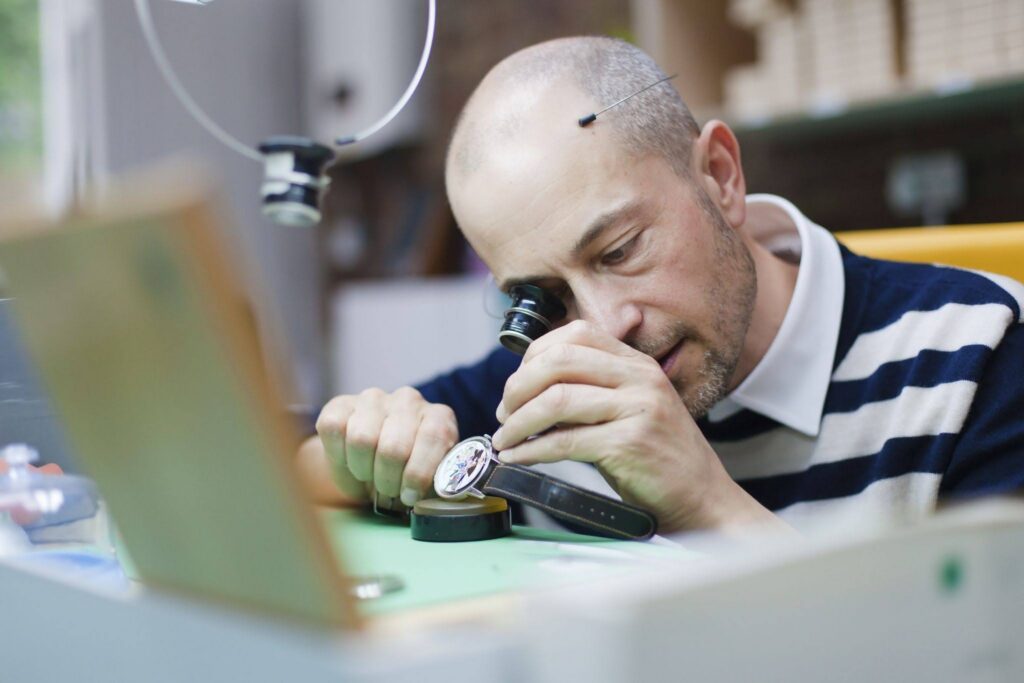
Crispin Jones checks a watch under the loupe at the workbench.
Long before the duck took to the water, Crispin was making art about technology. He trained in sculpture at Kingston University, then moved into computer-related design at the Royal College of Art.
For someone working between art and technology, the wristwatch made an obvious subject: a small machine people wear as a statement. In 2005 he made seven watches for an exhibition, not really functional, each poking at what a watch is for and at its old job as a status symbol.
The pieces were a success and they raised a practical question. Could the same ideas live in watches people actually bought? In the summer of 2006, he found a factory with a 500-watch minimum order that he could split however he liked.
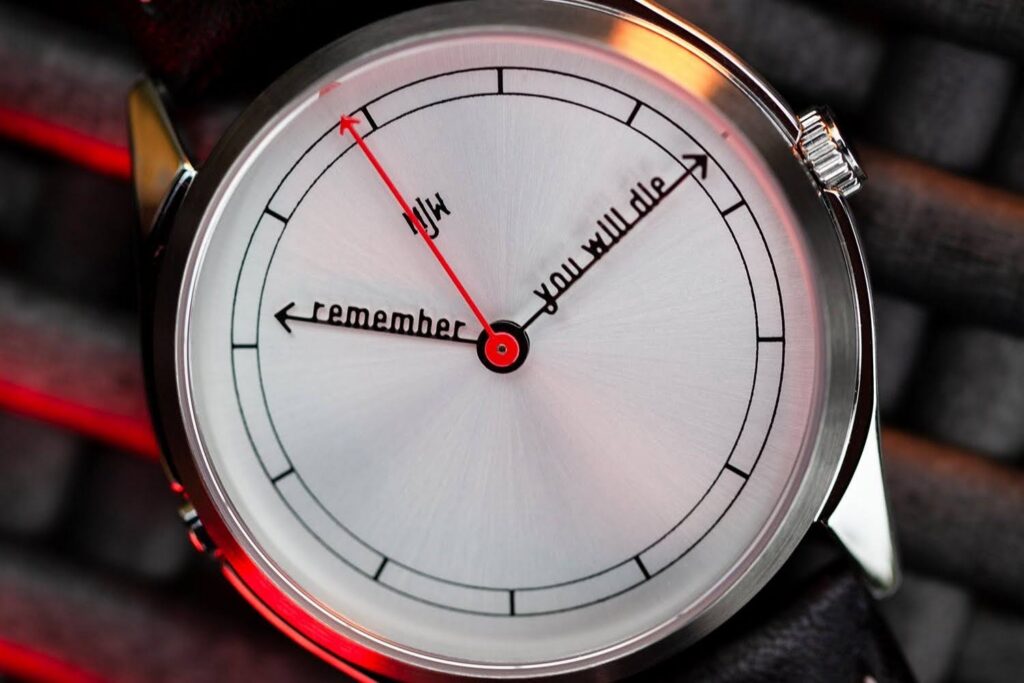
On The Accurate, the hour hand says “remember” and the minute hand finishes the thought.
He made five designs, each a numbered edition of 100. Among them were The Accurate, which reminds you that you will die every time you check the time, and The Decider, a sly dig at how readily we let technology decide for us.
Crispin launched Mr Jones Watches in 2007 with a website and an email to his exhibition contacts. The editions sold out within a couple of months, and people kept asking for more. Nothing stopped him from making a design again.
“Rather by accident, I stumbled on the basic model that we still use today,” he says. Twenty years on, it works the same way. A new design launches as a numbered edition, usually of 100 pieces. If it proves popular enough, it gets refined and returns as part of the permanent collection.
A London Print Studio for the Wrist
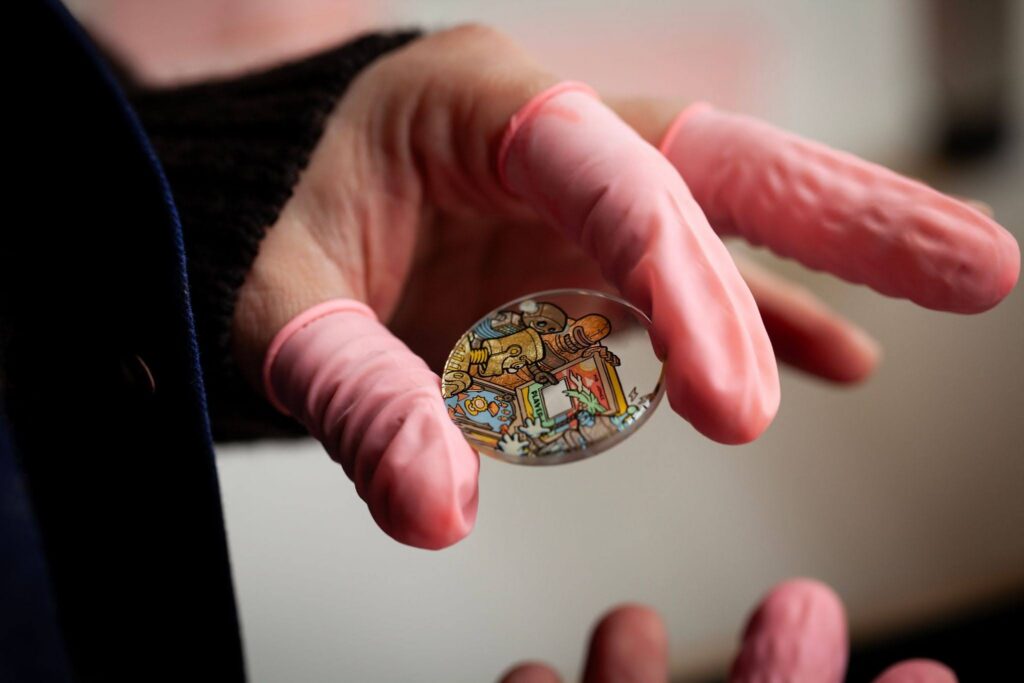
A printed Ricochet crystal, handled in finger cots to keep it free of fingerprints.
Those first five were all Crispin’s own work, and for a while every design was. He enjoyed it, he says, but working with artists “who have no previous knowledge of watchmaking and the production process really challenged us and helped us to develop our technical skills.”
Today the roster mixes established names with artists at the very start of their careers. Ricochet, drawn by American comics artist Ryan Claytor, puts three robots around a pinball machine whose scoreboard shows the time. Each robot is gilded by hand in a different precious-metal foil: palladium, 20-carat citron gold and 22-carat rose gold.
Getting a design right takes rounds of samples, and the early watches came from workshops in China and Hong Kong, where each sample took about three months. In 2011, the company decided to bring most of its production to the UK, and a year later it began sampling and short runs in-house. The team took on more as its skills grew. By 2017, every Mr Jones watch was printed and assembled in London, and it has stayed that way.
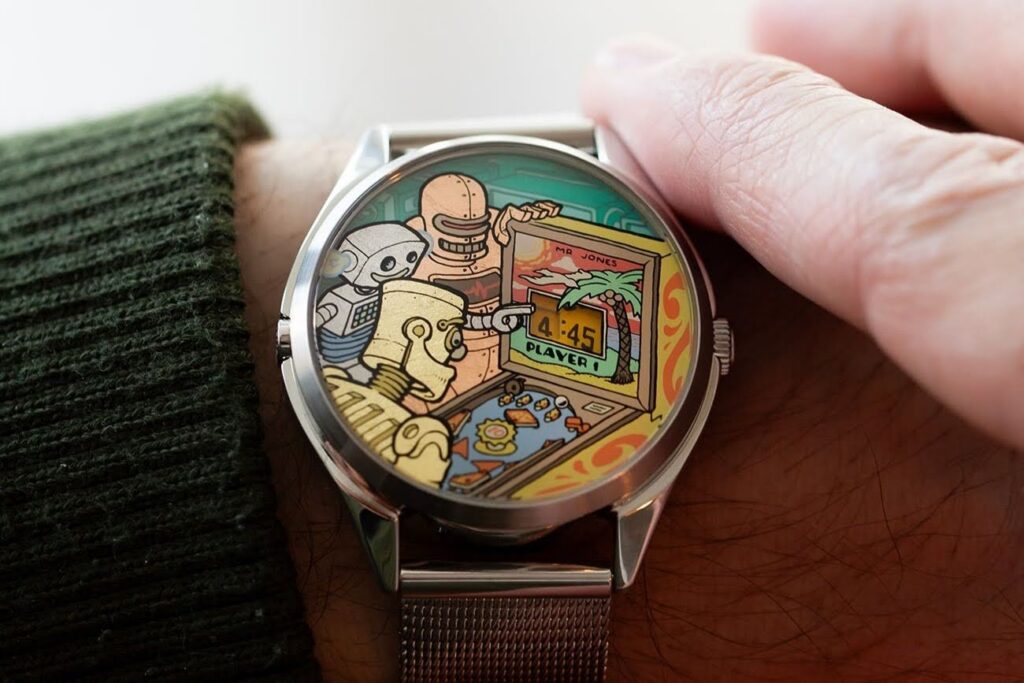
Ricochet on the wrist: 4:45 on the scoreboard, and Player 1 is still in the game.
The workshop uses pad printing, the industry’s standard way of putting numerals on a dial. A soft silicone pad lifts ink from an etched plate and presses it onto the part. At Mr Jones, each color is mixed by hand and laid down one layer at a time, sometimes onto the crystal itself.
“We work really hard to produce original and interesting designs. Our interest is not, nor will it ever be, in producing something that looks like a Rolex. Rolex already does that job rather well in our opinion! Rather, our interest is in producing something distinctive that is unique to Mr Jones Watches.”
— Crispin Jones, founder and managing director, Mr Jones Watches
Priced for His Peers
Mr Jones Watches tells its own story on film.
Original designs and a London workshop could carry a luxury price tag. Crispin went the other way. When we asked what serious buyers should understand about his work, his answer was about who gets to wear it.
“We really believe in keeping our watches as affordable as possible,” he says. “I’ve always wanted to sell watches to my peers and not only to very wealthy people.”
The watch he prizes most tells a similar story. It’s a 1945 Smiths, “a rather modest one,” and he values it for its history above anything else. Smiths led the effort to rebuild a British watch industry after the Second World War and ended production at its Cheltenham factory in 1971. To Crispin, his watch “represents the rebirth of watchmaking in England.”
A Perfectly Useless Afternoon costs $325 with a quartz movement. Some designs also come with a Swiss-made automatic movement on show through a glass caseback, including an automatic version of this one, for nearly three times the price.
Design and creativity, Crispin says, “can (and should) be available to as broad an audience as possible.” Each new design still starts life as a numbered edition. Whether it comes back is up to the people who buy it.
Mr Jones Watches is based in London, England. The collection is shown at mrjoneswatches.com, and watches are sold directly through the brand’s website and its shop in Covent Garden.
Images courtesy of Mr Jones Watches.