A bare dial, a hidden movement, and centuries of Malay women’s weaving translated into steel.
Dahliah Kamaru Zaman left a corporate marketing career at 30 to found Waktu Horology in April 2025. Most independent watch brands begin with a design idea; hers began with an obligation. “As Singapore’s first female founder bringing Malay heritage into the microbrand scene, I carry a responsibility to represent my culture with authenticity and care,” she told Watch Professor.
The industry usually discharges that duty on the dial. A printed motif, a woven texture, something handsome holding still under the crystal. Instead, she went for the parts that move.
“While most brands express cultural heritage through the dial, I wanted to embed our identity directly into the moving heart of the timepiece: the hands,” she says.
The dial of the Klasik: Hitam is black and completely bare. No numerals, no minute track, not one hour marker to tell you where five o’clock sits. The brand’s own description calls it a stage, and only two things get to stand on it.
Two Motifs, Cut in Steel
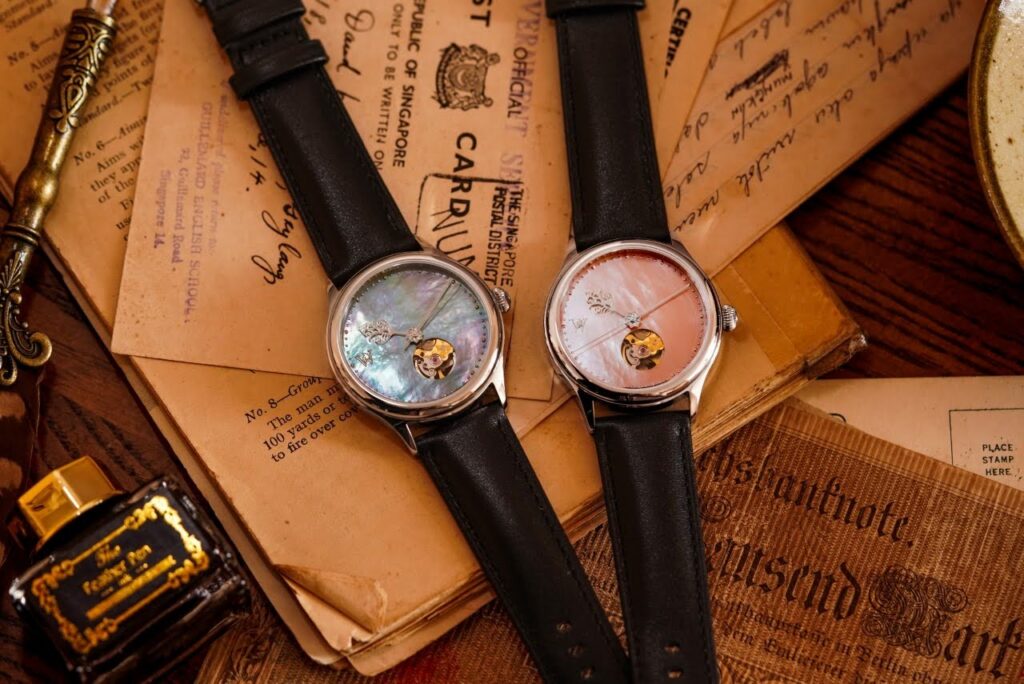
Kalbu: M.O.P. in Puteh and Mawar, mother-of-pearl dials with the balance wheel left open at six.
The hands take the spotlight, both in inherited shapes. The hour hand is a pucuk rebung, a bamboo shoot. It tapers upward: growth, resilience, a new beginning. The minute hand is a bunga pecah lapan, an eight-petaled flower read as balance.
They come off songket, the handwoven cloth UNESCO inscribed as intangible cultural heritage in 2021. Malay women in Terengganu weave it on a floor loom called a kek, running gold or silver thread between the base threads so the pattern floats over the ground. In the past, only rulers and court dignitaries were allowed to wear it.
Floating thread is a forgiving medium; steel is not. Waktu says the forms took repeated attempts to get right, and the cost turns up in the arithmetic: each Kalbu: M.O.P. variant, Gelap, Puteh and Mawar, is held to 100 pieces worldwide, a ceiling the brand puts down to machining those two shapes.
Inside is a Japanese automatic made by the thousand. Everything scarce about the watch is on the front of it, enjoying the spotlight.
Symbolism, Rated to 100 Meters
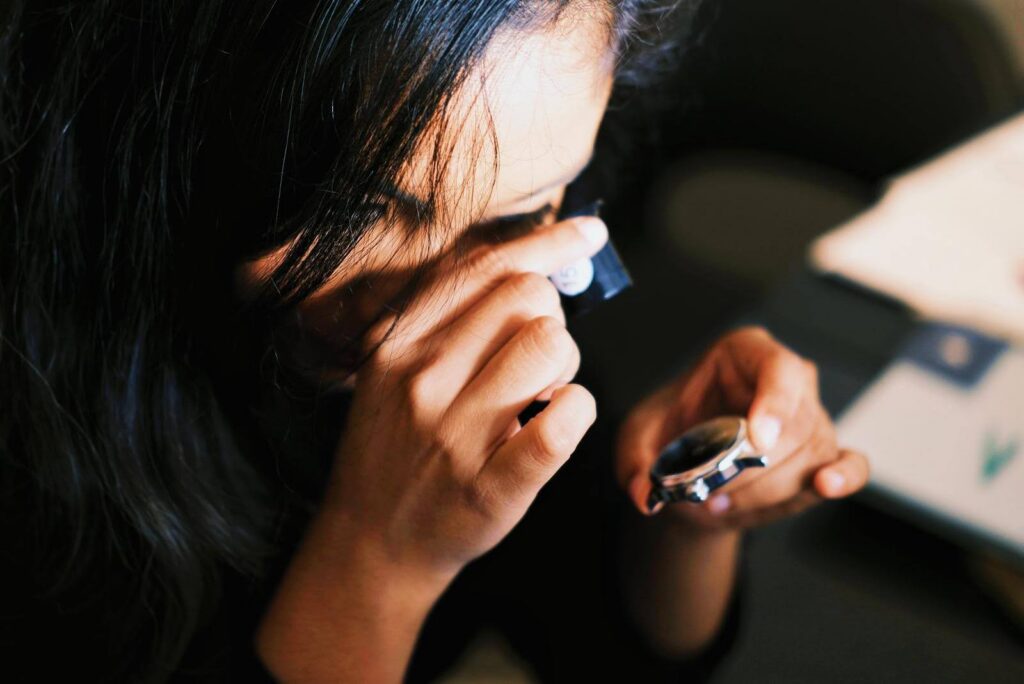
Dahliah Kamaru Zaman inspecting a component under a loupe in Singapore.
Underneath the storytelling, Dahliah is a specifications person. “Even though our pieces lean towards elegant dress watches, I insisted on incorporating a screw-down crown to achieve a robust 10 ATM (100m) water resistance for real-world durability,” she says.
Dress watches usually settle for 30 meters and a push-pull crown, on the reasoning that nobody swims in a dinner jacket. At $539 Singapore dollars, roughly US$420, the Klasik screws down anyway.
Both models run the Miyota 90S5: 24 jewels, 28,800 vibrations an hour, 42 hours of reserve. She chose it over Swiss alternatives for its slim profile and because it has no date mechanism at all. Plenty of dateless watches still carry the machinery inside, and you can feel it: the crown’s first click does nothing. Hers has nothing to hide.
It is also an open-heart movement, cut to be seen through a dial aperture. On the Kalbu it is. On the Klasik: Hitam it sits behind a solid caseback and an unbroken dial, admired by nobody. The hands don’t share.
A Watch With Footnotes
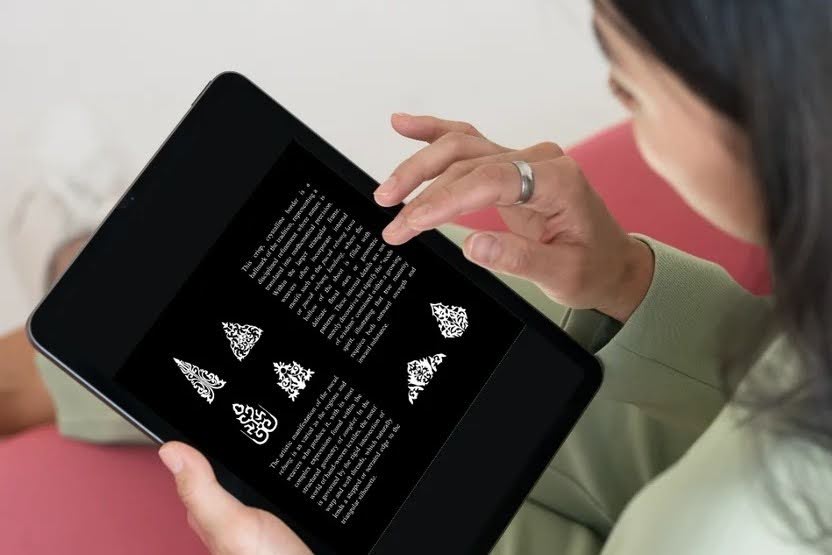
Tides of Heritage, the digital monograph issued with the Kalbu collection. The triangular forms on screen are pucuk rebung.
Waktu has put out two collections. Whether that is quick depends on who is counting.
“Despite constant market pressure to rush production cycles or release a new watch every six months just because other brands do, I firmly refuse to operate on a fast-fashion model,” Dahliah says. “Microbrand watchmaking should be intentional; if you succumb to artificial hype, you risk losing the genuine passion for the craft that started the journey in the first place.”
A collection here is not only a watch. Each one ships alongside a monograph, the Kalbu’s running 28 pages at S$20. Behind those sits a history page tracking the Malay Peninsula from Paleolithic Perak to British Malaya, with inline citations to Tweedie, Braddell and Wheatley, mid-century scholars of the Royal Asiatic Society’s Malayan branch.
Everything ships direct, as far as Britain, Australia and Kazakhstan. The company is independent, and Dahliah is its founder, its designer and the one doing the archive reading. The release schedule is the speed of that arrangement, which she has no interest in compromising.
The Motifs Have Not Changed Hands
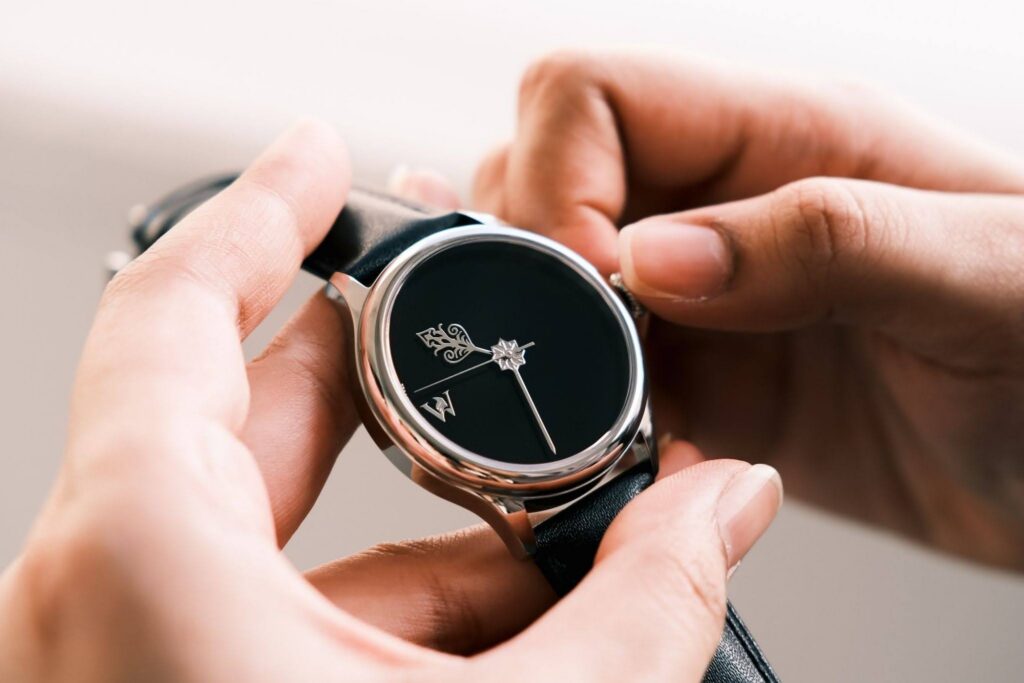
The Klasik: Hitam. The W at nine o’clock is drawn from the tanjak, the Malay headdress.
Dahliah’s watch box is small and sentimental, and the piece that explains the most arrived with her first large work bonus. She bought herself a Black By Blue Brave Cherry Blossom, she told Watch Professor, and the same watch in white for her mother.
The craft on her dials moves the same way. UNESCO’s file records songket weaving as firmly in the hands of women, with men building the looms. The pucuk rebung and the bunga pecah lapan were women’s work long before anyone cut them in steel.
“I want women to embrace watch collecting with the same expressive joy they bring to beauty; a timepiece isn’t just about telling time, just as a lipstick isn’t just about colour. It is a personal statement of identity, history, and confidence that you wear for yourself.”
— Dahliah Kamaru Zaman, founder, Waktu Horology
For the future of the brand, she is weighing two ideas drawn from the same tradition. One is the keris, the dagger Malay families keep as an heirloom, which she wants cut into a hand. The other is a series on Malay warriors, the women included, figures she says mainstream horology overlooks.
On a Waktu, the culture never sits on the dial, only sweeps across it.
Waktu Horology is based in Singapore, where its watches are designed; production is in Hong Kong. The collection is shown and sold direct at waktuhorology.com.
Images courtesy of Waktu Horology.