Zach Weiss spent 15 years reviewing everyone else’s watches. Now the verdict is out on his.
For most of his career, Zach Starr Weiss was the person doing the judging. He co-founded Worn & Wound in 2011, one of the most-read watch publications, spent years reviewing other people’s watches, designed more than 60 collaboration pieces, and launched the Windup Watch Fair. If a brand cut a corner, his was one of the desks where it got noticed.
In early 2026 he did the far more exposed thing. He launched his own brand, OraOrea, and put a single watch on the table for everyone else to judge. When we asked him what he wanted people to feel picking it up, he didn’t hedge. “I want people to say ‘wow’ when they pick up my watches for the first time,” he told us, “which, so far, I have been achieving.”
That’s a bold thing to say about a brand that’s a few months old. The interesting question is whether the watch backs it up.
The Watch That Has to Prove It
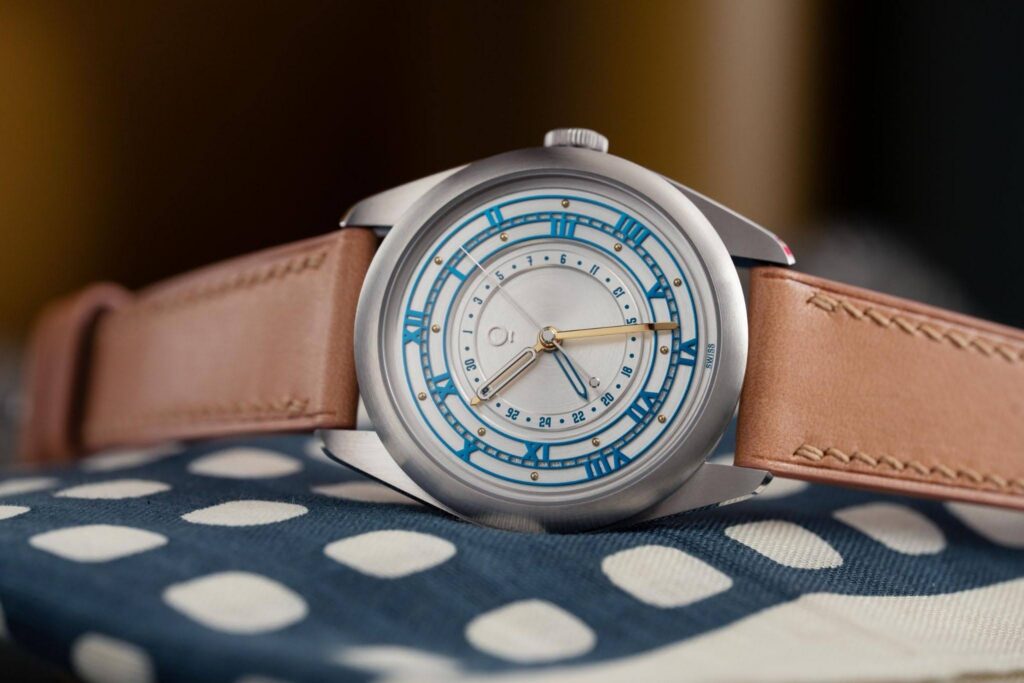
The Coriolis Pointer Date in Skyline Silver. Shown at an angle, the layered dial and multi-part case catch the light along their brushed and polished surfaces.
OraOrea’s debut is the Coriolis Pointer Date, and it does not look like a first watch from a first-year brand.
The name comes from the Coriolis force; the effect of the Earth’s rotation on anything moving across it, and it describes what the dial does to your eye. Weiss started the whole design with the hour markers, an arrangement he calls the “oscillating index”; Roman numerals staggered above and below a central railroad minute track, each one punctuated by a small applied hemisphere of solid 18k gold. The numerals alternate high and low around the dial, and the effect is a kind of visual motion, pulling your gaze clockwise, in step with the hands.
It’s a mid-century idea (alternating numerals and studs turn up on old chronometer dials) executed with tools those watchmakers never had. The entire index is a single piece of steel, cut with a femtosecond laser, detailed on a CNC machine, then hand-polished and applied to the dial. Old vocabulary, current handwriting.
Details You’re Not Supposed to Notice
Here’s the tell that this was designed by someone who spent 15 years looking closely at other people’s work: the parts most owners will never inspect are the parts that got the most attention.
Take the hands. On most watches at any price they’re stamped and called done. On the Coriolis, the hour hand is milled from two parts, beveled inside and out, polished and finished in two tones. The seconds hand is curved at the tip so it sits closer to the dial and reads more cleanly. It’s the kind of detail you only bother with if you’ve spent years being irritated by watches that didn’t.
The case tells the same story. It’s built in multiple parts rather than machined as one, specifically so the surfaces between the lugs can be finished properly; an awkward, more expensive way to make a 38.5mm steel case, chosen because it lets the finishing reach places a one-piece case can’t.
“Every component has been considered from multiple angles and executed to the highest standard I could achieve.” — Zach Starr Weiss, Founder, OraOrea
None of this is visible in a catalog photo. That’s the point. Weiss is betting on the owner who turns the watch over, tilts it to the light, and finds the brand sweated a detail nobody asked about.
Three Dials, One Watch
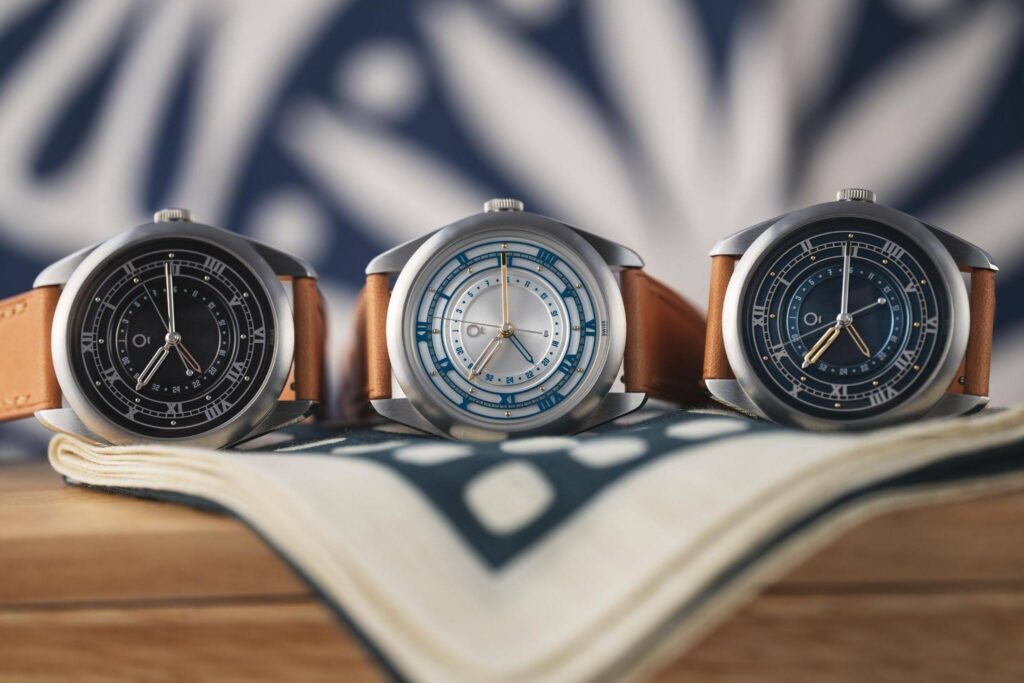
Left to right: Dark Rhodium, Skyline Silver, and Venetus Teal. The case, movement, and strap are identical across all three — only the dial changes.
That layered dial comes in three flavors, and they change the watch’s whole character.
Skyline Silver is the bright one – a pale silver base with circular brushing, and the surprise is the color: the index runs in a vivid teal that shifts toward electric blue in direct light, warmed by yellow gold hemispheres. It’s the least expected of the three, silver read through a splash of color.
Venetus Teal takes its name from the Latin for “sea-colored,” and it earns it – a deep teal that leans blue with a veiled green undertone. Against that inky base sit a polished silver index and yellow gold hemispheres, so the whole dial reads subtle up close and complex the longer you look. It’s the moody one.
Dark Rhodium is the classic – black with rhodium plating and circular brushing for a metallic sheen, kept almost entirely monochrome save for a single rose-gold accent on the date hand. It’s the one that disappears under a shirt cuff and behaves itself.
Same 38.5mm steel case, same movement, same strap across all three. Only the dial changes — which, on a watch built entirely around its dial, is the only variable that matters.
The Engine Nobody Else Had Used Yet
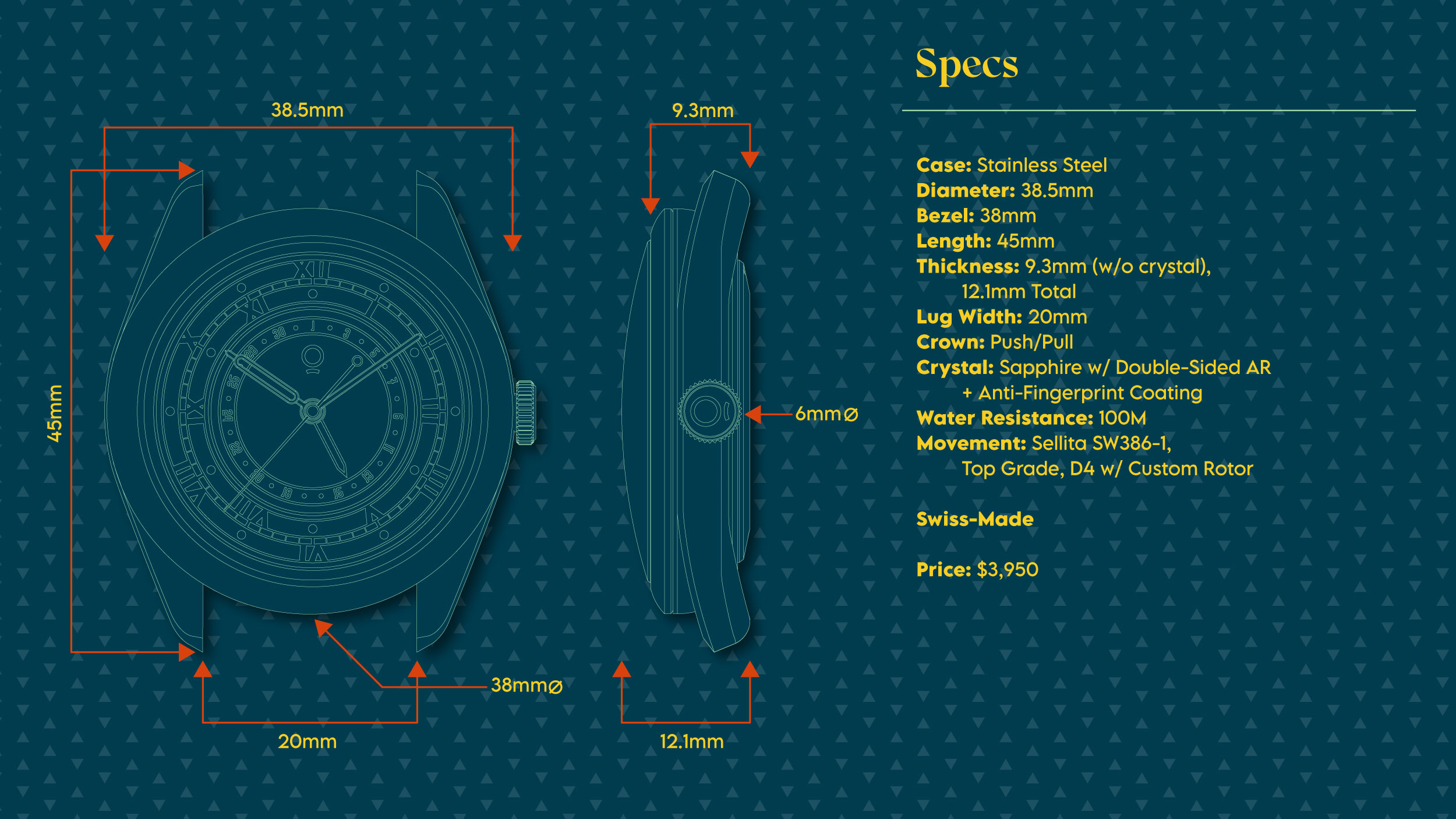
The Coriolis by the numbers: a 38.5mm steel case, 12.1mm thick, on the Swiss-made Sellita SW386-1 in top grade.
Inside is the Sellita SW386-1, a Swiss automatic. Sellita is one of the industry’s major movement suppliers, and this particular caliber only joined its catalog in late 2025. OraOrea was the first brand to put it in a watch.
Weiss chose it for a specific reason: the pointer date. A conventional date needs a window cut into the dial, and cutting a hole through the oscillating index would have wrecked the thing the whole watch is built around. A pointer date, a central hand that sweeps to the date on a ring, adds the function without touching the design. Problem solved by picking the right movement rather than compromising the dial.
He ordered it in Sellita’s top grade, the highest non-chronometer tier: regulated in five positions to a mean of roughly ±4 seconds a day, with perlage, blued screws, and a custom rotor carrying the OraOrea glyph. The first 100 of each color get a rotor marked “OraOrea Founder’s Edition”, a small thank-you to the people willing to buy a debut watch from a brand with no track record.
What “Keeper” Actually Means
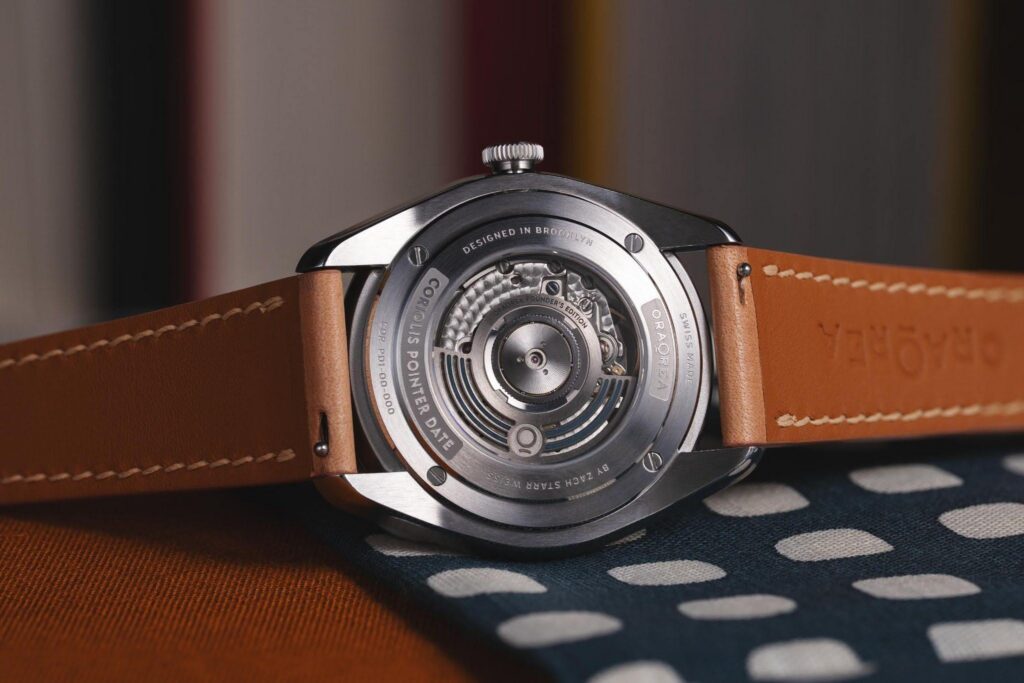
The Coriolis caseback: “Designed in Brooklyn,” Swiss-made, and signed by Zach Starr Weiss. The first 100 of each color are marked “OraOrea Founder’s Edition.”
Ask Weiss what OraOrea is for and one word keeps coming up: keeper. Not the watch you buy and flip a year later, but the one you never quite get tired of.
He has a specific idea of what earns that status. A keeper, in his telling, is the watch that impresses at first glance and then keeps giving you something more the longer you own it; striking head-on, but just as interesting from the side or the back. That single belief explains the whole Coriolis: the layered dial and the over-built hands exist to pack in more detail than anyone can take in at once, so there’s still something to notice in year three.
It’s a standard he came to as a collector, not a marketer. The watches he treasures, he told us, are ones he loves for reasons no spec sheet captures; a Habring² regulator, a one-off Garrick commissioned for his 40th birthday, and a 1990s Chronoswiss that belonged to his late father, the man who got him into watches as a boy. That’s the feeling he’s chasing in his own brand: the sense, as he puts it, that a watch’s best qualities live in small things, the interaction of colors, the curve of a hand, an unexpected reflection, and that finding them is the reward.
Old Idea, New Name
There’s a neat symmetry in the name. OraOrea comes loosely from the Latin for golden hour — the low, warm light photographers chase at the end of the day — and Weiss picked it for the feeling rather than the watch. It’s a brand named after a mood, making watches designed to be lived with rather than traded.
Which is the quiet argument underneath the whole project. The watch industry leans hard on heritage, founding dates, dynasties, century-old serial numbers, and a brand launched in 2026 has none of that to sell. OraOrea’s answer is that heritage was never really the point. What makes a watch worth keeping is whether someone thought hard about every part of it. Weiss spent 15 years learning exactly what that looks like from the outside. The Coriolis is the first test of whether he can do it from the other side of the bench.
On the evidence of the first watch, the critic can take his own notes.
OraOrea is an independent brand founded in 2026 by Zach Starr Weiss, co-founder of Worn & Wound, and produced in Switzerland. Its debut, the Coriolis Pointer Date, is sold primarily direct to consumers, with limited in-store consignment. The collection is shown at oraorea.com.
All images courtesy of OraOrea.