Fifty years of quiet invention in the Jura, and a refusal to keep it rare
Somebody in Saignelégier once asked whether a gear really has to be round and it’s a fair question with a stubborn answer; wheels work because every tooth meets the next at the same distance from the center so power flows evenly. Put corners on a wheel and that distance keeps changing – the whole thing lurches.
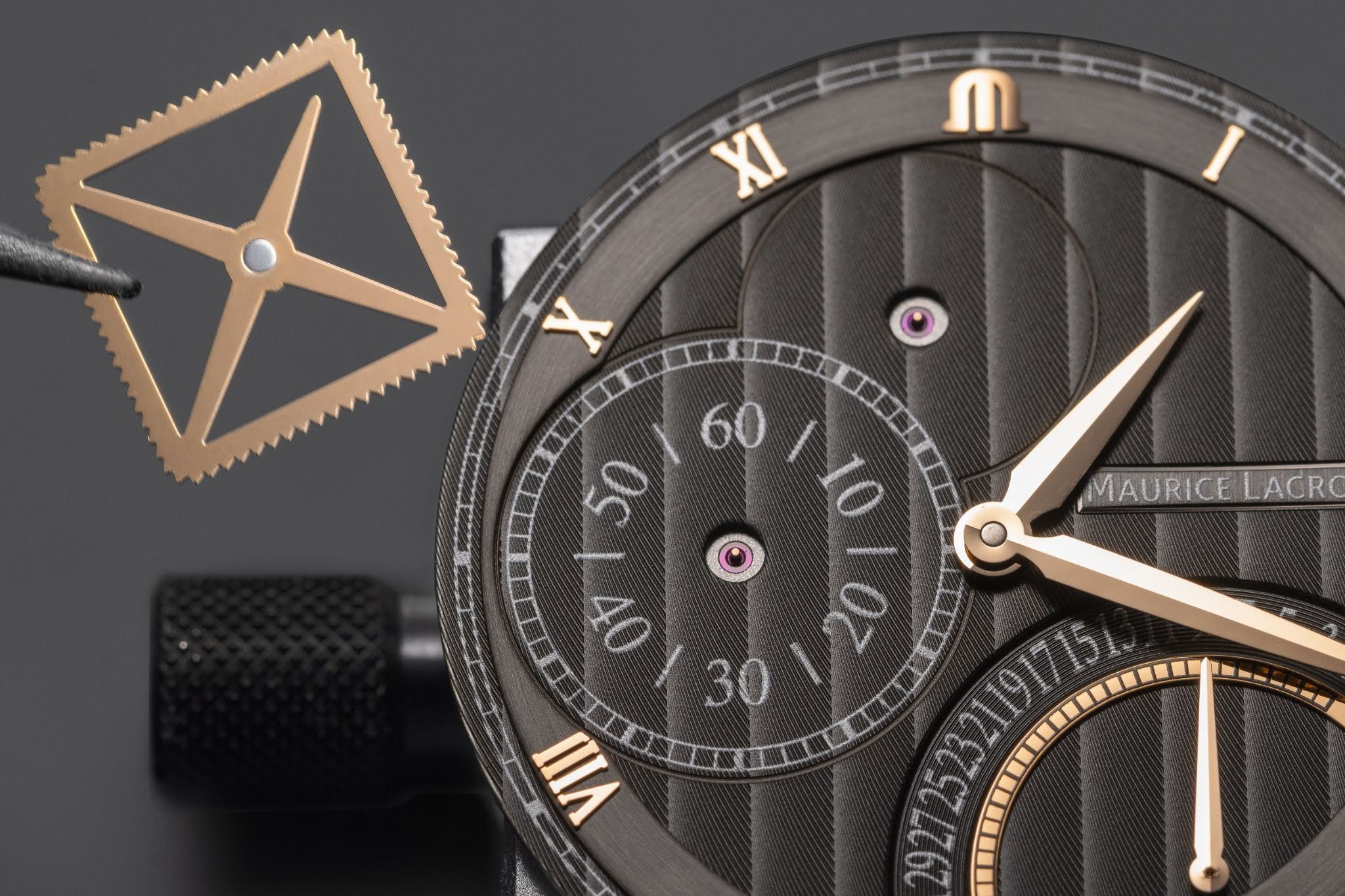
Maurice Lacroix made one work and it’s still for sale. The Masterpiece Square Wheel carries a four-cornered gear at six o’clock that turns steadily and counts the seconds.
That watch costs $9,900, still, the brand built its reputation well below that. Ask Samuel Guélat who runs international marketing at Maurice Lacroix from Saignelégier after eight years at Longines, what the square wheel actually did for the company, and the answer has nothing to do with sales; “These watches pushed our creative and technical limits,” he told Watch Professor, “and that know-how still shapes our designs today.”
A Gear With Corners
Inside the Saignelégier workshop, where the square wheel goes from loose component to finished dial.
Maurice Lacroix took the problem next door. Michel Vermot, who ran movement development, brought it to engineers at the Haute École Arc in Le Locle, a school whose roots go back to the watchmaking classrooms of the 1860s. The fix turned out to be in the teeth; if the wheel can’t be regular, each tooth has to be shaped to make up the difference and keep the power arriving at a constant rate.
Ordinary machining isn’t fine enough for that. The parts were cut using LiGA, a photolithographic process normally reserved for silicon components.
A clover-shaped wheel drives the square one. Watch it for a minute and you stop thinking about any of the above, which is the whole trick.
The Watch in the Drawer
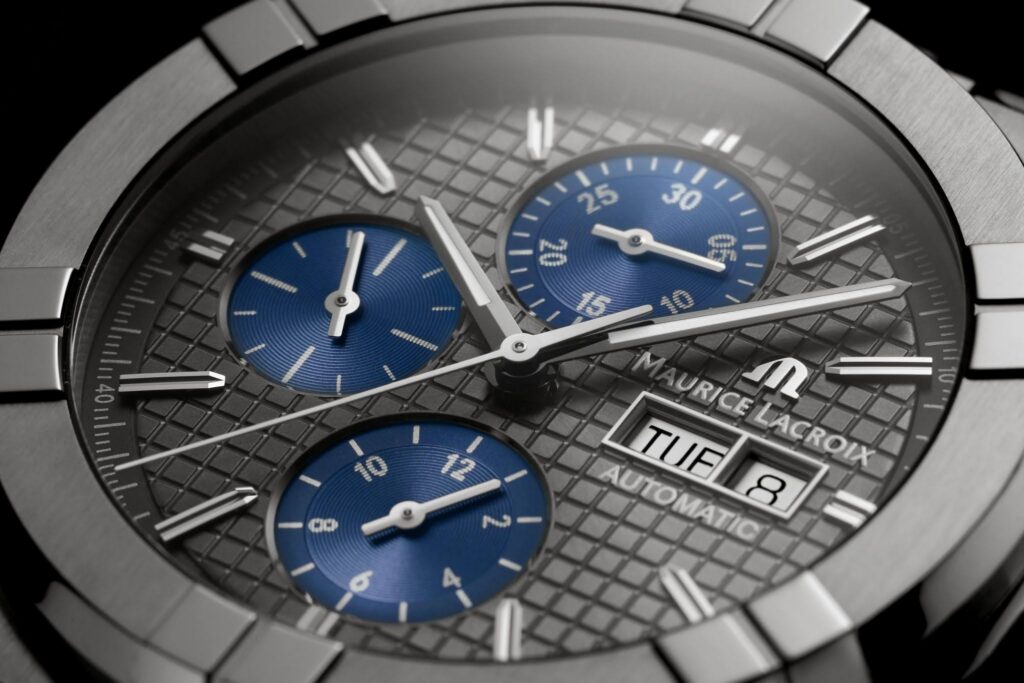
Six double-width arms clamped over the bezel, the AIKON’s clearest inheritance from the Calypso, dropped in 2003 and revived in 2016.
Companies that ask whether a gear has to be round usually have a watchmaker somewhere in the founding story. This one started with a factory.
A Zurich trading house bought an assembly plant in Saignelégier in 1961 and spent 14 years building watches with other companies’ names on the dial. The Maurice Lacroix name went up in 1975 and by 1980 the outside work had stopped.
The 1990’s brought the Calypso, a steel watch with six arms gripping the bezel. Europa Star, digging through its own archives, put its best years above 100,000 pieces annually. Then the company dropped it and aimed higher.
It got there on merit; Maurice Lacroix had built twelve calibers in-house by 2013, Red Dot design prizes came steadily from 2007, 13 of them inside a decade, and the patents matter more.
The brand was also spread thin. In the early years, Guélat says, the company “explored a wide range of references and even ventured into high-end, complex watchmaking.” “Ventured” is his word and it’s the right one because pulling back took the better part of a decade.
So in 2014 the design team went back through the archive and found the Calypso waiting. It returned in 2016 as the AIKON, quartz first, automatics two years later. By the brand’s count, it’s been the best-selling collection ever since.
Guélat sums up the mission in three parts; “Swiss craftsmanship, iconic design, and accessible excellence.” Plenty of brands can promise the first two.
Everything Within 40 Kilometers
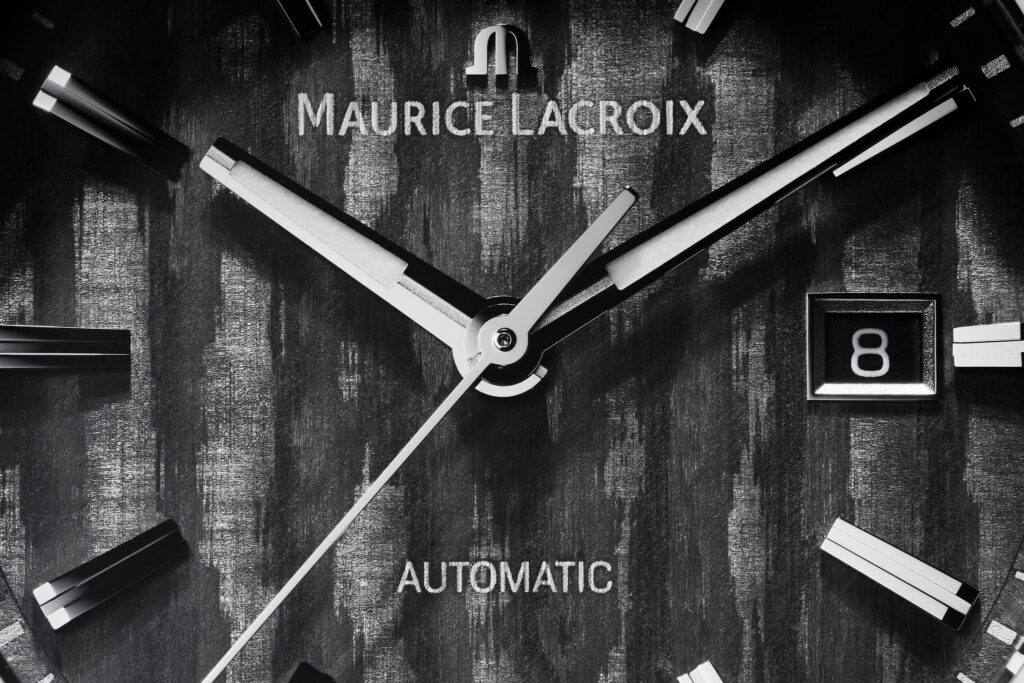
Carbon fibers are laid north to south rather than woven, which is why no two AIKONIC dials come out alike.
Which brings us to a carbon dial.
Carbon on a dial usually means woven fiber, cross-hatched like a tiny basket. The AIKONIC, launched in August 2025, runs its fibers in one direction instead, top to bottom, so the gray and black striping falls slightly differently on every dial. Maurice Lacroix had it made by a carbon specialist about 40 kilometers away, a firm better known for ice hockey sticks.
The movement came from closer still. The ML1000 was developed with Soprod, a movement maker less than 10 kilometers down the road. It keeps to an average of ±4 seconds a day, holds 60 hours, and shows blued screws, perlage and Côtes de Genève through the caseback.
The company’s own announcement notes that carbon dials normally belong to haute horlogerie, and says it has “democratised” them. Strip the flourish, and the claim stands up, because that watch is $3,500.
The real shift is easy to miss. Maurice Lacroix used to own its casemaker, Queloz, and a component workshop beside it. It sold one and closed the other. What replaced them wasn’t a bigger factory. It was the neighbors.
Nobody Has to Wear It
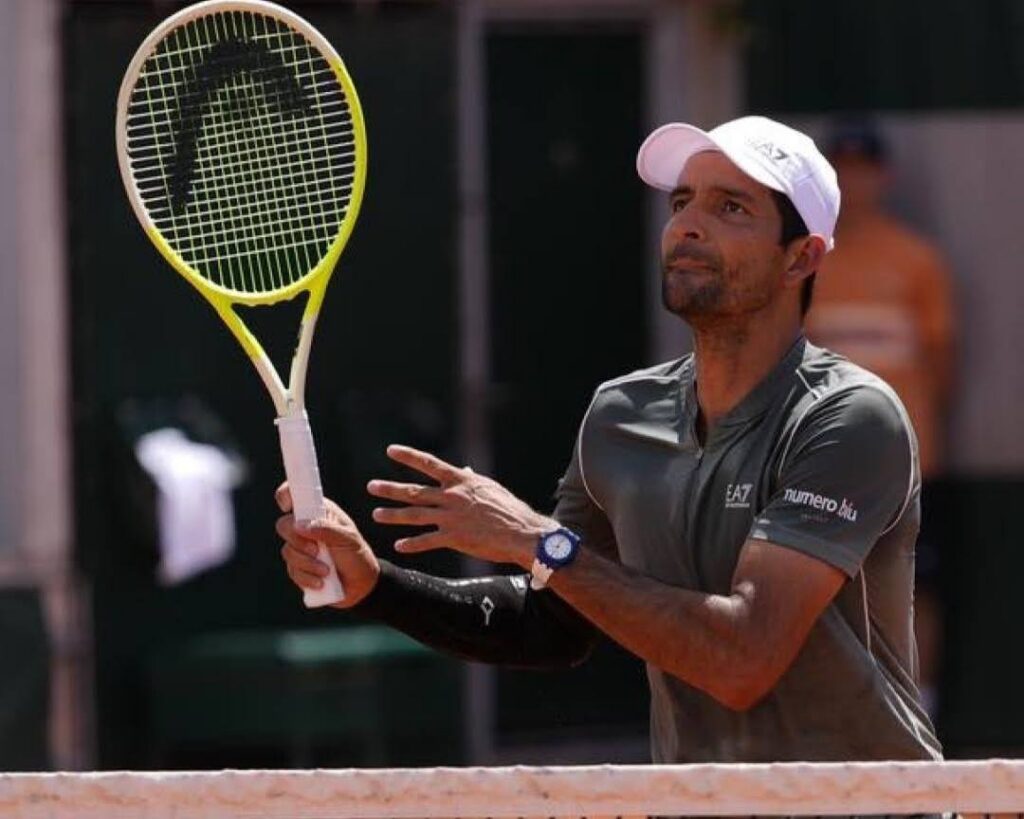
Marcelo Arévalo in competition, wearing a Maurice Lacroix before the ML Collective existed.
In July the company launched the ML Collective, a group of athletes and artists it describes as an alternative to conventional watch endorsement. The members are under no obligation to wear the watch on any given day.
Its first signing was Marcelo Arévalo, the Salvadoran doubles player. He had already been competing in a Maurice Lacroix Tide in his country’s colors before anyone signed anything.
Guélat says the industry has moved past “the old model of influencers changing brands from one week to the next.” Many brands say that but fewer write the contract so the athlete can take the watch off.
It’s the same move as the carbon dial which is run on people instead of parts. Find whoever is already doing the thing well, whether they’re 40 kilometers away or four thousand.
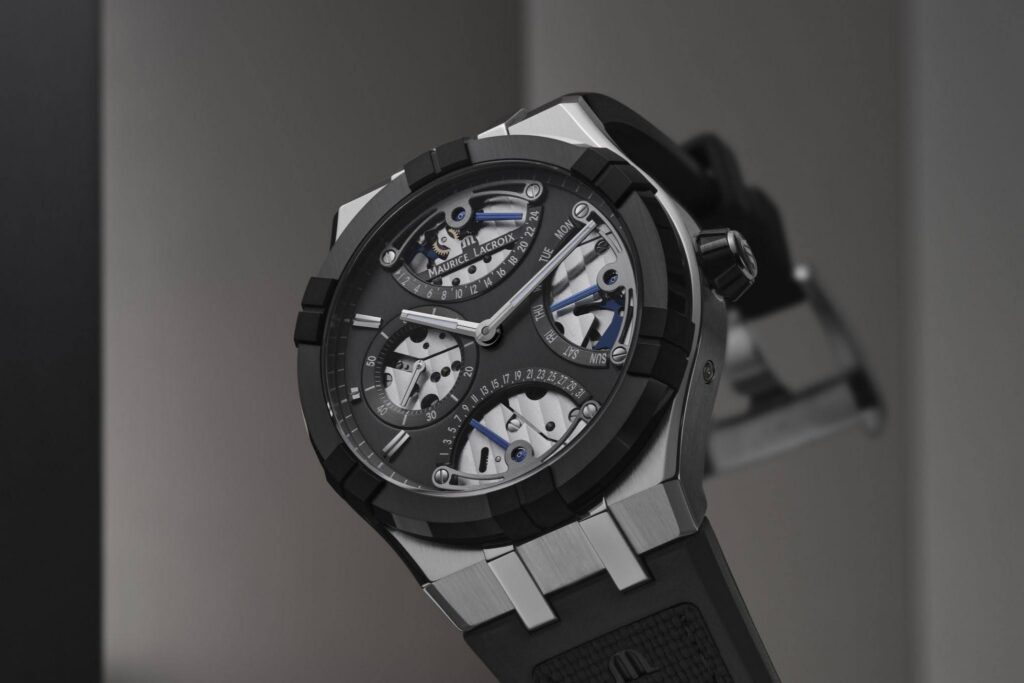
The AIKONIC Master Triple Retrograde, launched for the 50th anniversary, opens its dial onto the movement beneath.
“For us, quality in watchmaking is not defined by complexity alone, but by the coherence between design, engineering and execution. We remain deeply rooted in the traditions of Swiss watchmaking, while continuously questioning how these traditions can be expressed in a contemporary way. We believe that fine watchmaking should ultimately be appreciated not only for what is visible, but for the thought, skill and precision that lie beneath the surface.”
— Samuel Guélat, Head of International Marketing, Maurice Lacroix
The square wheel, meanwhile, keeps turning. It was never going to be the watch that pays for the workshop and it doesn’t have to be.
The patents tell you where the value went. One covers that square wheel at $9,900, another the tool-free strap system at $3,500. Fifty years in, Maurice Lacroix is still working out how to get the interesting part down the mountain.
Maurice Lacroix is based in Saignelégier, in the Franches-Montagnes district of the Swiss Jura, and is owned by the DKSH group. The collection is shown at mauricelacroix.com and sold through authorized dealers, the brand’s online shop, and boutiques in Zurich, Bangkok and Kuala Lumpur.
Images courtesy of Maurice Lacroix.