How Manfred Brassler bet a brand on subtraction and spent a quarter-century proving one hand could carry a chime, a moonphase, and a jumping hour
One hand. No minutes. No seconds. On a MeisterSinger dial, a single needle sweeps past 144 fine strokes. Each marking five minutes. That’s all the resolution you get.
It sounds like a gimmick. But it’s how watches worked first. “Mechanical watchmaking began with single-hand watches,” founder Manfred Brassler told Watch Professor. “So rather than reinventing watchmaking, we are continuing one of its oldest traditions in our own way.”
He has a point. Minute hands took generations to catch on. Seconds hands weren’t standard until the mid-18th century. For years, the tower clocks that ran daily life across Europe used just one hand. Brassler didn’t invent the format. He noticed everyone else had dropped it.
Look at the logo and you’ll see the whole idea. It isn’t a crown or a shield. It’s a fermata — the musical symbol that tells a performer to hold a note longer than written. Plenty of brands sell you speed. MeisterSinger puts a pause on your wrist.
Fittingly for a brand built on family, our questions traveled through the family itself. Tanja Brassler, MeisterSinger’s co-CEO, carried the interview to her father and returned with his answers. It’s a small relay, but it speaks about the brand: the founder still at the center, his daughter making sure the story keeps moving.
Design in Münster, Movements in Switzerland
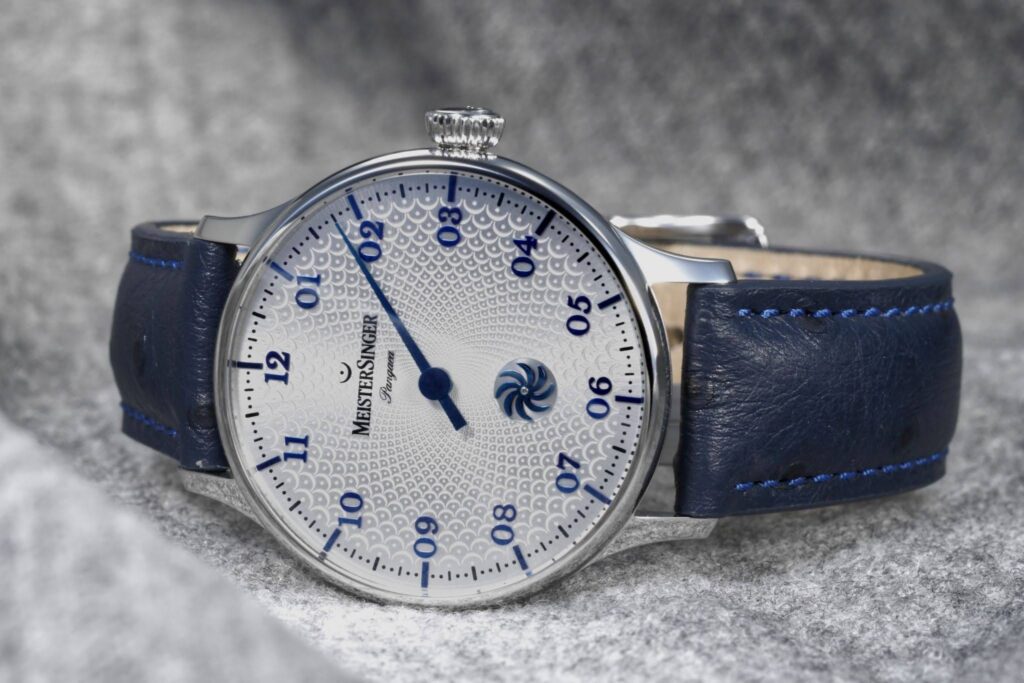
The Pangaea, one hand over a sea-scale pattern. A design unchanged in spirit since the N°01.
Brassler was 48 when he founded MeisterSinger in Münster, Germany, in 2001. He’d already built and sold Watch People, the quartz-focused company he co-founded in 1989. The new brand would be the opposite: mechanical, reduced, deliberate.
Even the name carries a note. The Meistersingers were German master singers of the 15th and 16th centuries, known for adding fresh elements to old melodies. It fits a brand trying to say something new with the oldest display in watchmaking.
The company is still independent and family-owned. Design and direction happen in Münster. The watches are built in Switzerland, close to the brand’s movement partners. Output runs to about 5,000 watches a year, by the company’s count, sold through dealers and directly to buyers across Europe, the U.S., and parts of Asia.
The look has barely changed since the N°01 launched in 2001: the single needle hand, double-digit numerals with leading zeros, the 144-stroke minute track and a domed sapphire crystal. “From the very beginning, my goal has been to create watches that are reduced to the essentials: clear, balanced and harmonious,” Brassler says.
That restraint is the point. “What makes a MeisterSinger distinctive is not just its single hand, but the many carefully considered details that come together to create a design with its own unmistakable identity,” he says — “one that many people recognize from across the room.” The design world agrees. Brassler counts nearly 40 international awards, including wins from Red Dot, iF Design, and the German Design Award.
The Constraint Keeps Producing
Hear it, don’t read it: the Bell Hora strikes once as the hour passes.
One hand doesn’t mean one watch. That’s what people miss. Every new release asks the same question: what else can a single hand carry?
“Staying true to the single-hand concept doesn’t mean standing still,” Brassler says. “On the contrary, it challenges us to keep finding new ways of surprising people through fresh designs, technical innovations and new complications, while always remaining unmistakably MeisterSinger.”
The first answer came from inside the case. In 2014, the brand introduced its first in-house caliber, the hand-wound MSH01. Made in Biel/Bienne, it uses twin mainspring barrels for a 120-hour power reserve.
Then the dial started doing more. The Bell Hora revived a nearly forgotten complication called the sonnerie au passage. The movement stores energy through the hour, then strikes a small chime as the new hour begins. It’s the same job church clocks once did for whole towns, shrunk to the wrist.
The Stratoscope aimed higher. It carries a large, photorealistic moonphase on a module built over a Sellita base. Most moonphase watches round the lunar cycle to 29.5 days and drift a full day every three years. The Stratoscope tracks the real cycle — 29 days, 12 hours, 44 minutes. You’d need to correct it only about once a century.
The Anniversary Jump
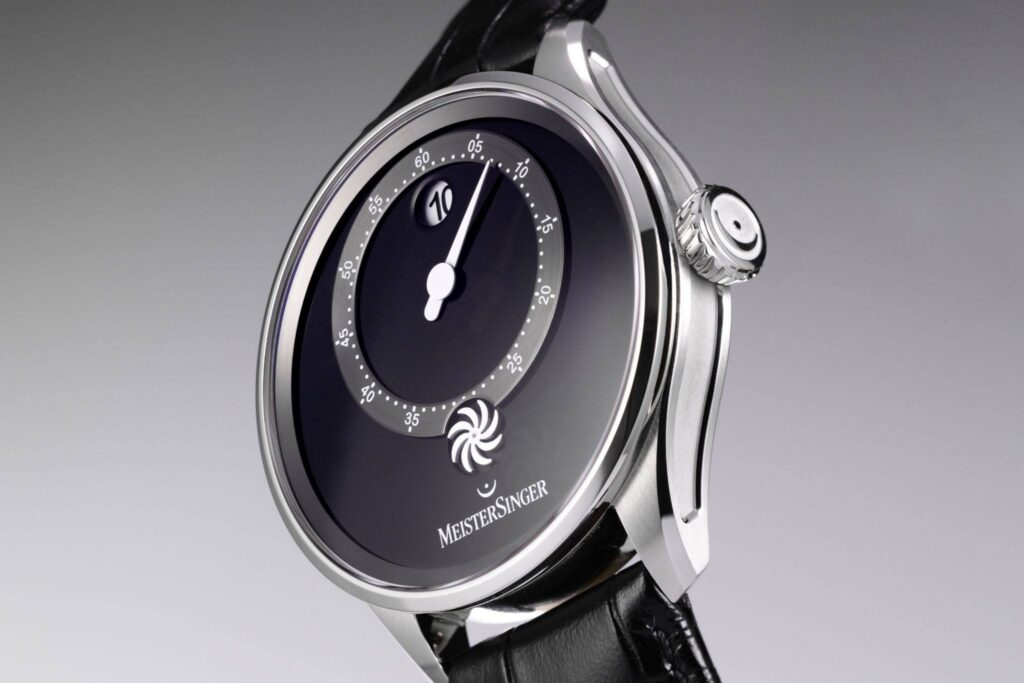
The Panthero in black lacquer. On the crown, the fermata: the brand’s pause, cut in steel.
This year brings the boldest move yet. For its 25th anniversary, MeisterSinger launched the Panthero Jumping Hour. It has a new 40.5mm case and an hour that snaps forward in a round window at 12 o’clock. The single hand now reads the minutes on an off-center ring.
Inside is a new caliber, the MS-JH-01: a Sellita SW300 base fitted with a jumping-hour module built with the complications specialist Dubois-Dépraz. An anniversary edition of 25 pieces wears a silver dial, cut line by line on a hand-operated guilloché machine.
There’s a filter behind all of it. New complications earn a place, Brassler says, “only when they genuinely add something meaningful to the way we experience time.”
What Collectors See That Others Miss
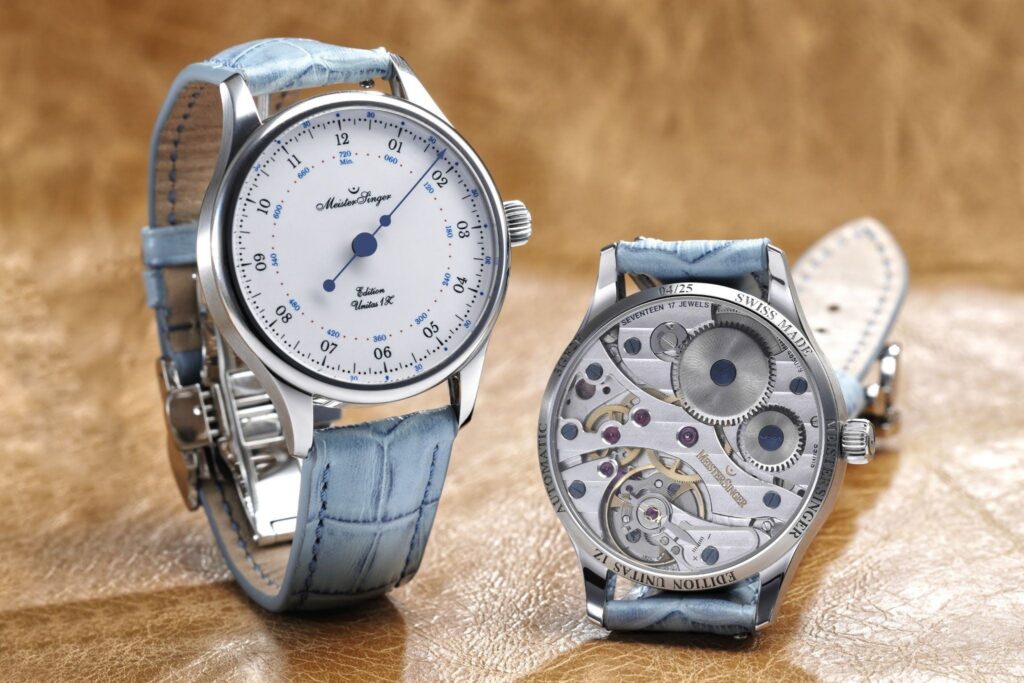
Edition Unitas: dial up, movement out. The view collectors flip to first.
Ask Brassler what serious buyers understand about his watches, and he doesn’t mention the single hand at all.
“They understand that reducing a design to its essence is often far more demanding than adding complexity,” he says. A dial with one hand has nowhere to hide. Every detail has to be right. He points to the craft behind it: enamel dials, hand-cut guilloché, and complications engineered to fit a display no one else builds for.
He collects the same way. He’s drawn to watches “with a clear identity and a story behind them,” from any era or maker. Originality over prestige.
“People express themselves in many different ways, and I think the watches we choose are part of that. It’s incredibly fulfilling to see that, for many owners, a MeisterSinger represents more to them than just a way of telling the time. It reflects a certain attitude to life and a more conscious way of experiencing time.”
— Manfred Brassler, founder, designer, and CEO
The Note, Held
MeisterSinger started in a room in the Brassler family home. Tanja grew up inside the brand before she ever worked for it. Today she runs its strategy and its next chapter alongside her father.
That’s the fermata doing its job one more time. The rest of the industry keeps adding hands, scales, and displays to justify each new release. MeisterSinger spent 25 years holding a single note — and the next generation gets to decide how long it rings.
MeisterSinger is based in Münster, Germany, with production in Switzerland. The collection is shown at meistersinger.com, and watches are sold through authorized dealers and directly from the brand.
Images courtesy of MeisterSinger.