Founded in 1846 by a Bristol family that believed in elegance from its beginning
The crown on a Fears is onion-shaped, screws down into the case, and carries a cypher. A cypher is a set of interlaced initials used as a signature, the device British monarchs stamp on official things. The Fears Watch Company puts its own on the crown, on the pin buckle, and on the solid gold rotor of the most complicated watch it has ever built.
Edwin Fear opened a workshop on Redcliff Street in Bristol in 1846. The company ran for 130 years before closing in 1976. It reopened in 2016 under his great-great-great-grandson, Nicholas Bowman-Scargill, a trained watchmaker and now the fourth managing director. This year marks 180 years since the first workshop and ten since the company reopened.
What the company offers is customization. “No single part of any watch we make is off the shelf,” Bowman-Scargill told Watch Professor. “Every single part is made to order for Fears.” Design happens in Bristol. The rest is commissioned from roughly 20 suppliers chosen for the one thing each does well.
Ask him which decision he’s proudest of in those ten years, and he names the cypher. “It conveys the heritage of the brand, but it is practical.”
Nothing Off the Shelf
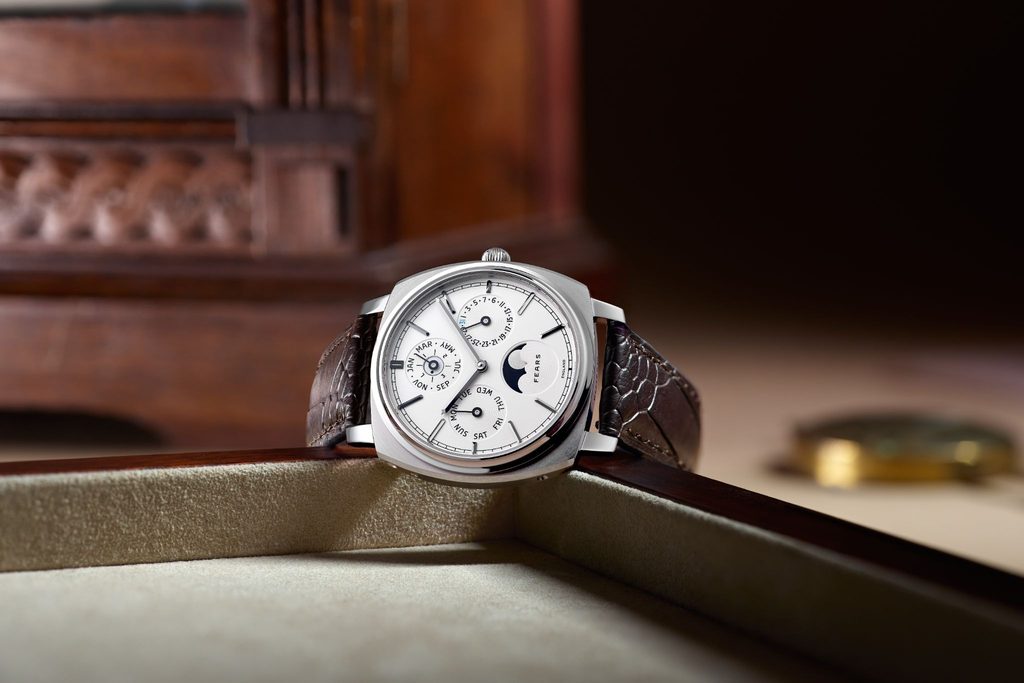
Brunswick 39 Perpetual Calendar. Set it once, keep it wound, and it won’t need adjusting until 2100.
A specification only counts if you have the relationships to get it built.
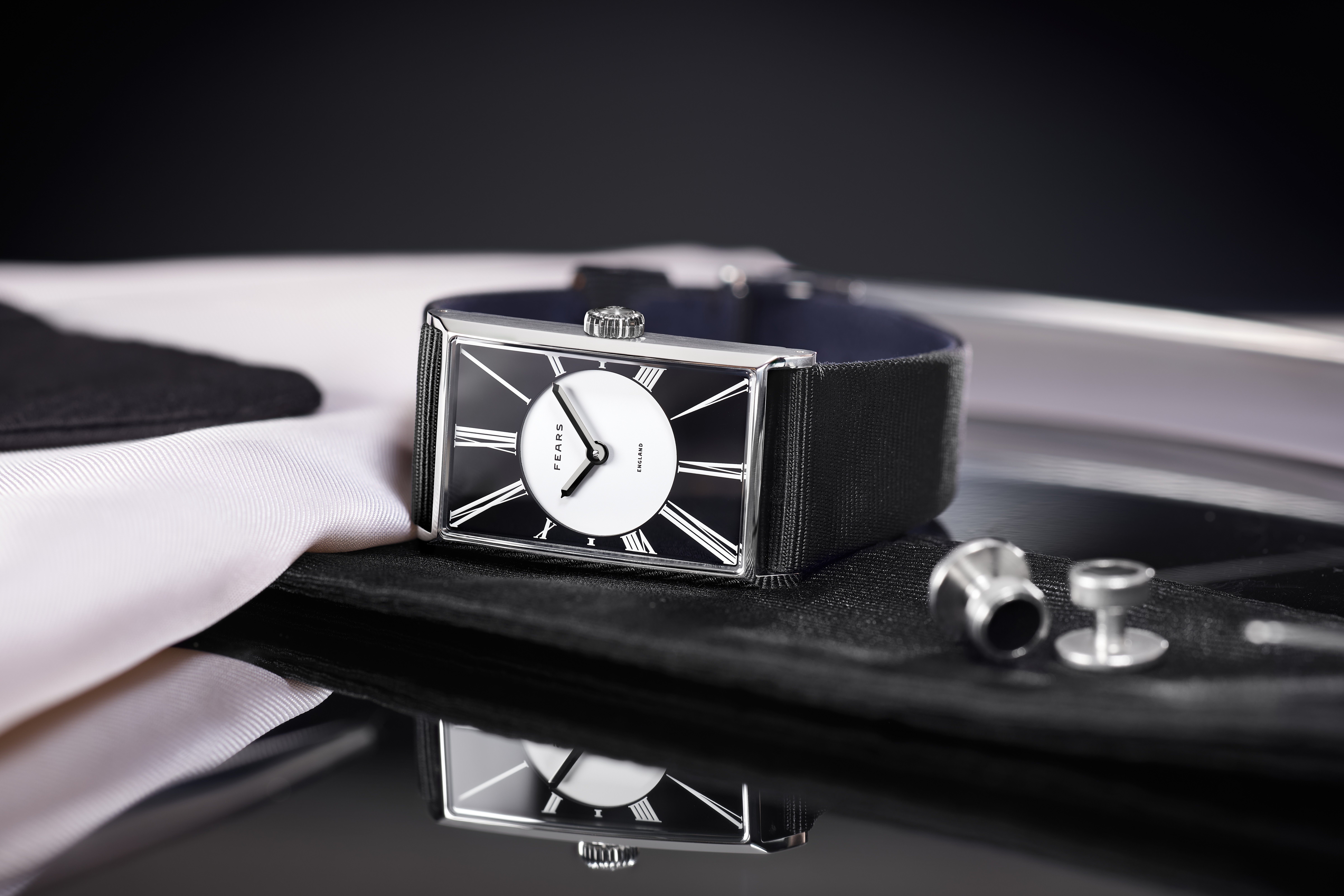
Sellita supplies mechanical calibers to much of the Swiss industry, and its SW1000-1b automatic leaves the factory with a central seconds hand. Fears asked for it to be removed on the Arnos Opera Black, its newest watch, and Sellita took it off before reaching the market. A rectangular dress watch with a sweeping seconds hand would have worked fine but not a Fears.
That agreement isn’t something a small British company gets by right. “We order from manufacturers, avoiding third parties, and they make the movements to adhere to our Fears standard,” Bowman-Scargill says. Roughly 20 suppliers, and 20 relationships to keep warm.
Fears is open about what parts come from where. The Opera Black’s spec sheet lists a Swiss case, a German dial, Indian hands, Belgian straps and a buckle made in Hong Kong. The buckle is the one wearing the cypher.
The Brunswick 39 Perpetual Calendar is the same habit at full stretch. A modified Dubois Dépraz perpetual module sits on a Sellita SW300 with hand-frosted bridges and hand-applied anglage in dark rhodium, and the result carries a caliber number nobody else uses: 55115. It’s the first high complication in the company’s 180 years, costs $28,500, and whilst limited to 25 watches a year, isn’t a limited edition.
A base caliber like the SW300 is a starting point, not a finished watch. Knowing which grade to ask for, which finish, and what to leave out takes years to learn, and it’s what Fears keeps in Bristol.
Black Tie in a Rectangle
Fears’ own film for the Opera Black. The case curves front and back, and the closed caseback is left smooth for engraving.
Some of what Fears knows is in its own archive. The company made slim rectangular watches in the 1920s and 30s, and in 2021, it built one of them again. The Archival 1930 was a re-creation down to the movement, which was vintage stock made decades earlier and never used.
The Arnos turned that case into a collection of its own in 2025. It takes its name from Arnos Vale, the Bristol district where Edwin Fear and his son Amos Daniel are buried.
The brief for the second model came out of Bowman-Scargill’s wardrobe: black tie, starched collars, silk brocade, onyx cufflinks and shirt studs. Lee Yuen-Rapati, Senior Design Manager, turned it into the Arnos Opera Black and calls the result “an exercise in creating elegant drama through a minimalist approach.”
He took the dress code at its word. Polished onyx, cut from a single stone, fills the outer dial around a circle of white lacquer, and the drama comes from interruption: white Roman numerals across the black, black gold hands across the white. The hands are the pipette shape Fears puts on everything it makes.
The evening carries on past the dial. One strap is grosgrain silk, the other Epsom leather for the rest of the week, and both fasten with a buckle carrying the cypher, the same mark that goes on the $28,500 perpetual calendar. It costs $4,500, is tested to 30 meters water resistance, and makes its public debut at WatchTime New York.
That’s ten years of Fears in one object. What comes next may expand on it. “Over the last 10 years, we’ve focused on classical designs such as dress watches, but now we’re established in our design codes, we’re translating to more sportier watches,” Bowman-Scargill says.
The Watches Come Back
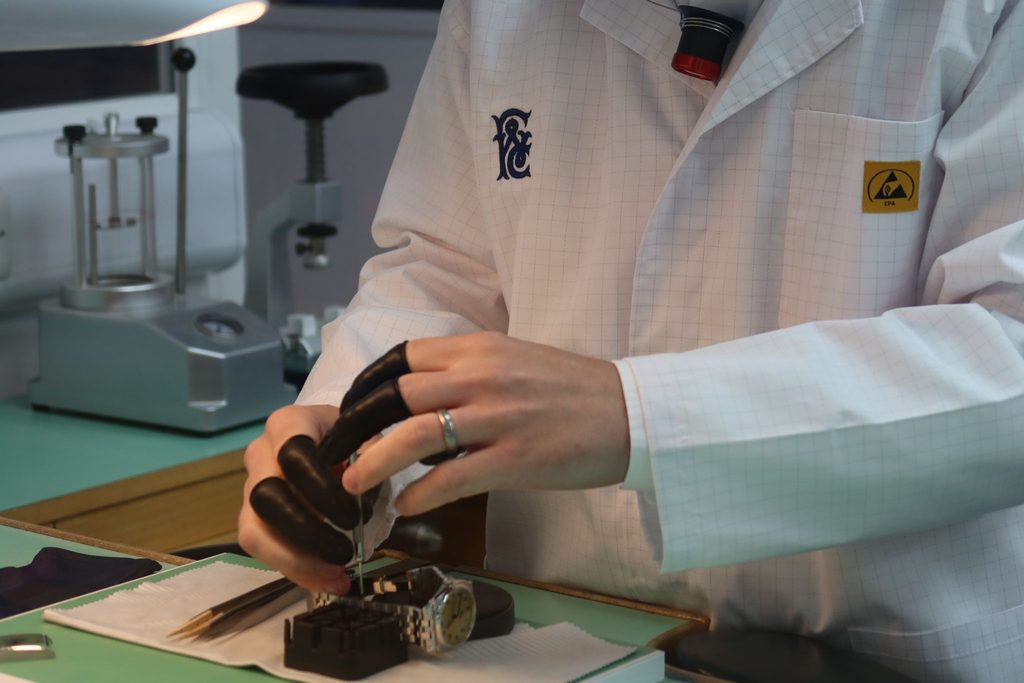
The cypher turns up on the bench coats too. Servicing and assembly now share one room in Bristol.
Fears has been selling watches out of Bristol since 1846, and the oldest of them still come back for servicing. The ones it sells today will warrant the same attention one day.
In August the company opened a workshop at its Bristol headquarters: anti-static flooring, filtered air, dedicated benches, and the equipment to strip, clean, service and assemble its watches.
Assembly moves there later this year. A component library holds parts for references the company no longer sells, and the bench will take in Fears watches made before 1976.
Production runs in the low thousands a year, by the company’s count, and capacity will rise once the workshop is running. More than half of the production will be sold in the United States.
Most of those watches go to people who will never see Bristol, and they carry its addresses anyway. The Redcliff is the street where Edwin Fear opened in 1846, and the name on the first watch of the revived company. Brunswick is the square where the export warehouse stood from 1920 to 1942. Every collection works like that, which makes the range a record of where the company has stood.
The Product Person
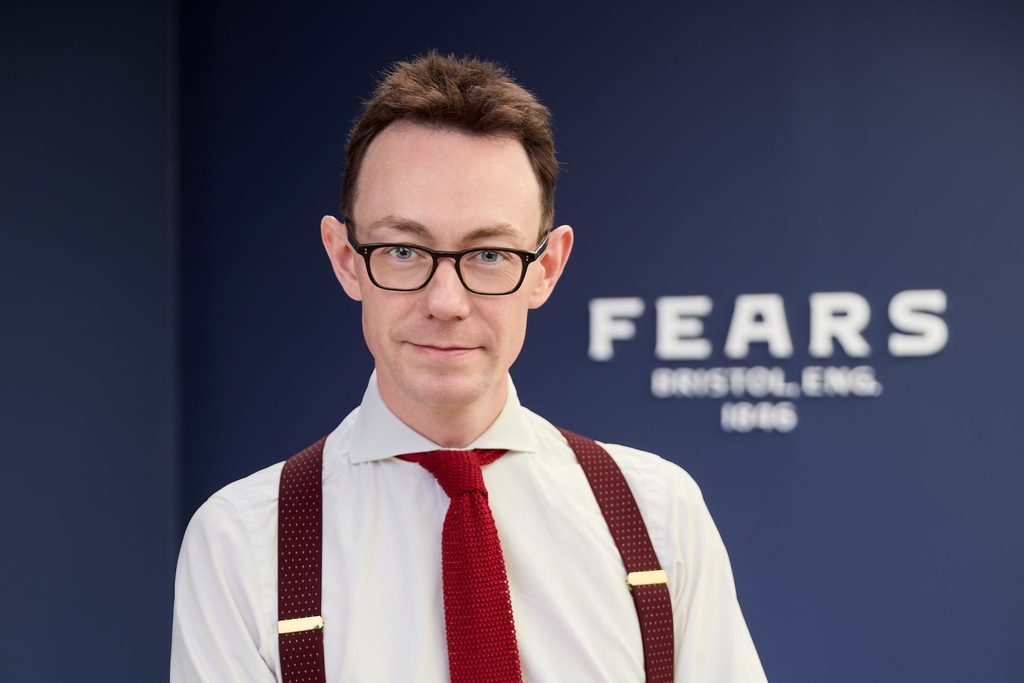
Nicholas Bowman-Scargill, the fourth managing director in 180 years and the sixth generation of the family.
A member of our team chooses the streets, the suppliers and the shape of the case. “The first 4 years, I did everything,” Bowman-Scargill says. As the team grew, he handed the work to people better at it and kept one thing back. “Deep down, I will always be a ‘product person’.”
It shows in what he wears. His personal collection is mostly watches by friends in the trade: a Garrick, built by David Brailsford in Norwich, and one of the first Bel Canto watches from Christopher Ward. Garrick cuts its own movements and built one with Fears, now sitting beside the perpetual calendar in the Eminence collection. Christopher Ward supplies the jumping-hour module.
“To me, they signify friendship and the camaraderie of running a British watch company,” he says. He picks watches the way he picks suppliers, by the people behind them. What he adds is the brief.
“Fears is in a unique position as a watch brand which has both a long and short history of producing watches. We often strive to leverage our history along with having tight control over design, development, and production to create invisible qualities that allow our watches to be more than the sum of their parts.”
— Lee Yuen-Rapati, Senior Design Manager
Those qualities are not on the spec sheet. A case can be ordered to the tenth of a millimeter and a movement built to its own reference, and the watch still turns on where somebody decided to stop. “Well designed, not over designed,” is how Bowman-Scargill puts it. Ten years in, that’s the line he still draws himself.
Fears is based in Bristol, England. The collection is shown at fearswatches.com and sold through the Fears Bristol boutique, the brand’s website and Fears Authorised Stockists worldwide.
Images courtesy of Fears Watch Company.